
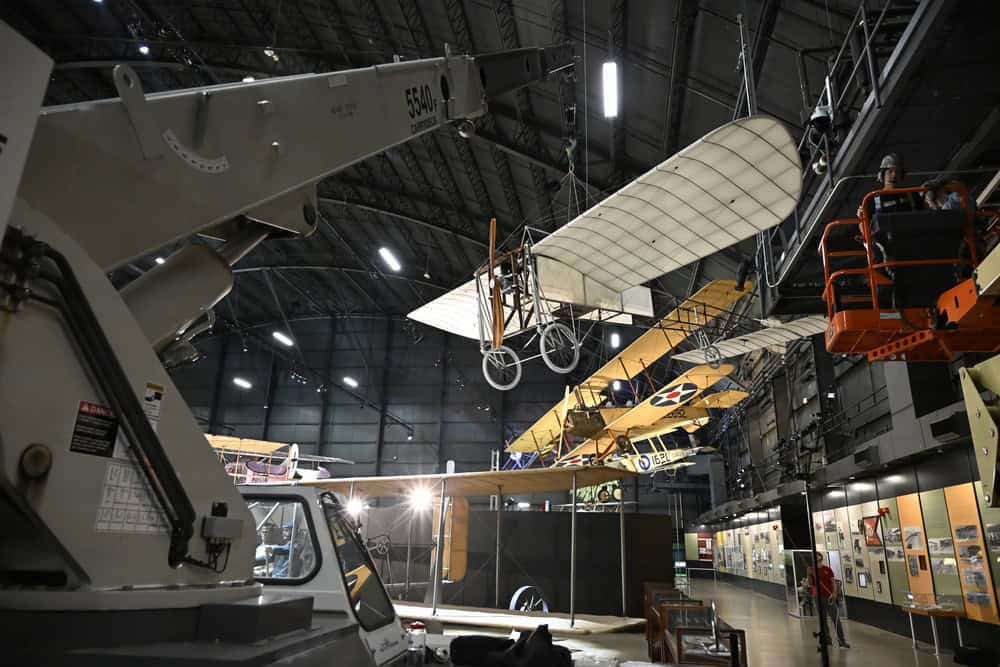
After eight months of conservation work, a historic Bleriot monoplane returned to the Early Years Gallery at the National Museum of the U.S. Air Force in Dayton, Ohio, on Nov. 17. The Air Force Materiel Command’s photo release documented the aircraft’s return to public display and identified its place in the museum’s early aviation collection. The milestone reconnects a fragile, fabric-covered monoplane with the era when the airplane was still being tested as a practical machine for training, reconnaissance and long-distance flight.
The museum’s restoration announcement was brief: an eight-month project had concluded, and the aircraft was back in the gallery. The museum describes the Bleriot as important both for its designer’s exploits and for the type’s role in early training and reconnaissance. Its own gallery overview places the aircraft among the machines that trace the formative period of military air power. The Nov. 17 return is therefore a preservation milestone and a chance for visitors to see an early monoplane again in the context of the technology that followed.
A return after eight months of restoration
The aircraft was photographed on the day it returned to the museum’s Early Years Gallery. The DVIDS record identifies the image as photo 10100906, taken Nov. 17, 2026, by Ken LaRock for Air Force Materiel Command. DVIDS marks the photograph public domain. The full-frame file used here is a 1,000-by-667-pixel derivative measuring 270,071 bytes; it preserves the full composition of the original image.
The announcement does not detail which components were repaired, what materials were replaced, or whether the work addressed a particular structural problem. Those details should not be inferred from the aircraft’s return alone. The confirmed point is that the museum completed an eight-month restoration and reopened the display. The museum had earlier identified the aircraft as undergoing restoration in its collection information, while its current gallery listing again includes the Bleriot among the exhibited aircraft.
That distinction matters for historic aircraft. A restoration may involve conservation, stabilization, repair or replacement of selected materials, but the exact treatment varies with an artifact’s condition and institutional standards. Without a technical account from the conservators, the public record supports the duration and completion of this project, not a claim about the specific work performed. The aircraft’s return nevertheless marks the end of a long period away from visitors and restores an object central to the museum’s early aviation story.
The Bleriot’s place in aviation history
The name is most closely associated with Louis Blériot’s July 25, 1909, flight across the English Channel in a Type XI monoplane. Dover Museum records that Blériot departed near Calais at 4:35 a.m. and reached the English coast in 37 minutes. With no compass aboard, he navigated by watching ships; wind pushed him off his intended course, and he came ashore at St. Margaret’s Bay before making his way toward Dover. The Daily Mail awarded him its £1,000 prize for the first successful heavier-than-air crossing of the Channel.
The crossing was a public demonstration of what a powered airplane could do beyond a short flight over land. The route was roughly 22 miles over water, leaving little margin for a mechanical failure or a navigation error. Blériot’s successful flight helped turn the airplane from a novelty into a machine with strategic and commercial possibilities. It did not make aviation safe or routine, but it gave the public a vivid example of an aircraft overcoming a natural barrier that had previously required a ship.
The Smithsonian’s National Air and Space Museum notes that the Channel flight brought Blériot’s Type XI widespread attention and led to orders for copies. The design’s broader significance lies in the period it represents: aviation was moving quickly from experimental demonstrations toward aircraft that could be reproduced, improved and put to work. The Bleriot on display in Dayton is a reminder of that transition, even though the museum’s short restoration notice does not claim that this particular aircraft was the one Blériot flew across the Channel.
Why preservation changes what visitors can learn
Early aircraft are difficult objects to preserve because their structures combine lightweight materials and construction methods that were new at the time. Wood, wire, fabric and exposed mechanical systems can make an aircraft readable as an engineering artifact, but they also require careful environmental control and maintenance. Returning a restored airplane to a gallery lets visitors examine how designers tried to balance low weight, lift, control and propulsion before later generations of aircraft standardized many of those solutions.
The National Museum of the U.S. Air Force’s Early Years Gallery presents aircraft from the formative period of military aviation. The Bleriot’s presence connects the museum’s later military collection to the small, fragile machines that preceded purpose-built combat aircraft. That context helps explain why early monoplanes mattered: they were not simply curiosities. Their configuration and practical use helped establish ideas that manufacturers and pilots would continue to refine as aviation expanded.
For visitors, the restoration also makes the aircraft’s physical details available again: its wing arrangement, bracing and compact fuselage can be seen directly rather than through a photograph or a written description. Those features are part of the historical record. The museum’s decision to display the aircraft after restoration preserves access to the object while recognizing that conservation work is ongoing stewardship, not a permanent guarantee that an artifact will never need further attention.
What the return does—and does not—tell us
The aircraft’s return is a clear update to the museum’s display status. It is not, by itself, evidence that the airframe is airworthy, that it has been returned to flight condition, or that the restoration recreated every original material. No flight was reported, and the museum’s public notice describes a return to display. The Bleriot should be understood as a preserved museum artifact rather than an operational aircraft.
The event also illustrates a quieter part of aviation history: conservation work that keeps original machines available to future audiences. The headline milestone is not a new flight, but the return of a historic aircraft to view after months of care. For an artifact associated with one of aviation’s early public breakthroughs, that visibility matters. The aircraft again gives visitors a tangible connection to the era when a monoplane and a pilot could capture international attention by crossing a narrow stretch of sea.
Sources
- Air Force Materiel Command / DVIDS: Bleriot Monoplane Returns to Public Display (Nov. 17, 2026; image and restoration announcement).
- National Museum of the U.S. Air Force: Bleriot Monoplane (aircraft context and restoration listing).
- Smithsonian National Air and Space Museum: Blériot XI (design and Channel-flight context).
- Dover Museum: Louis Blériot Landing in Dover (July 25, 1909 crossing details).
- DVIDS copyright information (public-use and non-endorsement terms).




No comment