
A robotic welding experiment bound for the International Space Station will test whether equipment can join metal in the conditions outside the station. NASA lists the Lockheed Martin-led JOINS payload for the Northrop Grumman CRS-25 cargo mission. The agency’s experiment page puts the demonstration in March 2027. The cargo flight would deliver the hardware. The welding itself is a later step. NASA’s JOINS experiment page
Two metals and two ways to join them
The experiment will work with aluminum and stainless steel. One method uses a laser to melt material at the joint. The other is friction stir welding, which uses a rotating tool to soften and move material without melting it. Both methods already exist on Earth. Flying them gives engineers a way to observe how the equipment and the metal behave when the surrounding conditions change.
Vacuum, microgravity and temperature swings can all affect the test. Engineers want to see how heat moves through the material, how the hardware behaves and what the resulting joints look like. Cameras will observe the process in orbit and send data to the ground. Later, the welded samples are expected to come back to Earth, where researchers can inspect them directly. The video and the returned specimens answer different questions. One records what happened during the weld. The other gives engineers the finished material to examine.
Why the Bishop airlock matters
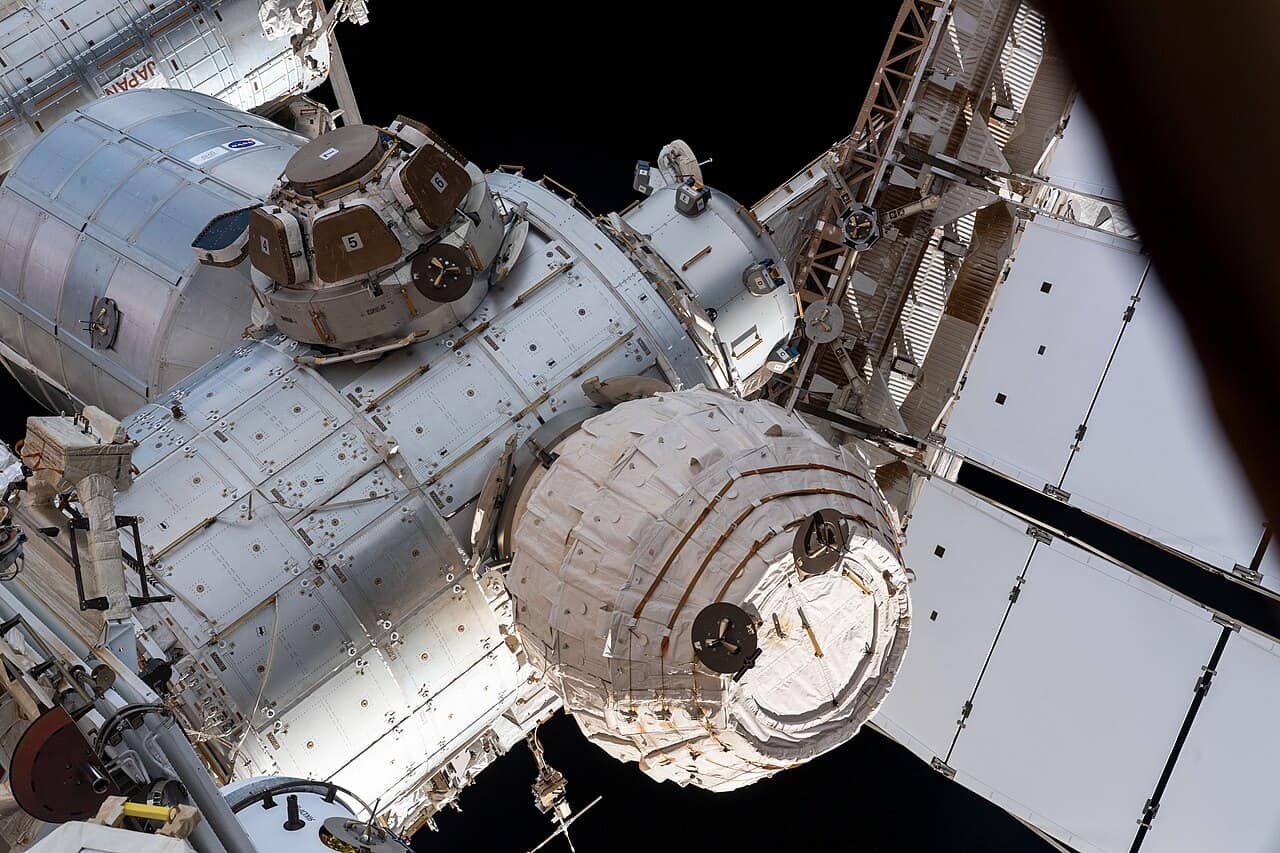
The station’s Bishop airlock will serve as the test location. Photos from Earth-based preparations show the welding payload being moved into a mockup of that airlock in Houston. On orbit, Bishop can expose a payload to the space environment while the station provides the platform for the experiment. NASA has used Bishop as a technology testbed and for other tasks, including satellite deployment. NASA’s Bishop airlock overview
Large spacecraft parts usually have to be designed around the dimensions of the rocket that carries them. A reliable way to assemble or repair structures after launch could give future missions more flexibility. NASA points to large antennas, solar arrays and radiators as examples. JOINS is an early experiment with small pieces of metal. Its immediate value is the evidence it can give engineers about whether and how the joining methods work in orbit.
Featured photograph: NASA archive image ISS067-E-214089 shows space station hardware attached to Tranquility, including the Bishop airlock, on August 2, 2022. Public domain. Image record.






No comment