
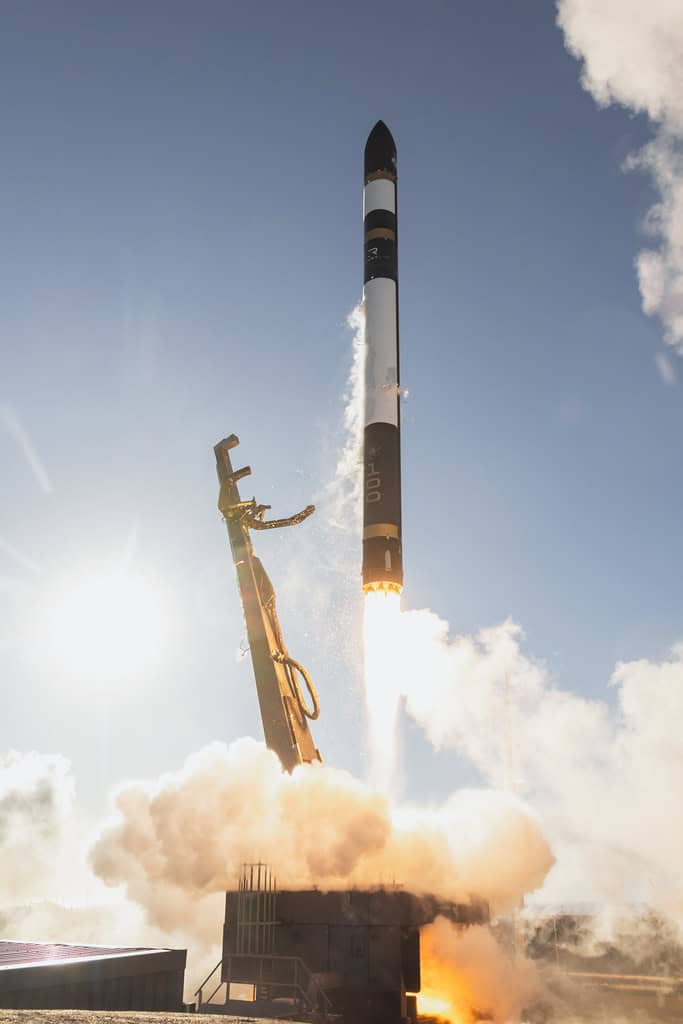
Rocket Lab’s Electron rocket completed its 100th launch on Nov. 14, carrying Japan’s QPS-SAR-19 radar-imaging satellite, nicknamed YAMATSUMI-II, to low Earth orbit. The mission, called “The Mountain God Rises,” lifted off from Launch Complex 1 on New Zealand’s Māhia Peninsula at 6:30 p.m. local time. Rocket Lab reported that the spacecraft was delivered to its planned 575-kilometer orbit, marking a new operating milestone for a launch vehicle that first flew in 2017.
The flight was the culmination of a campaign that Rocket Lab had publicly identified as its 100th Electron launch earlier in the week. The completed mission changes the story from a scheduled milestone to a demonstrated one: Electron has now flown 100 times, and the latest flight added another spacecraft to a customer’s growing synthetic aperture radar constellation. The launch was also the 11th Electron mission dedicated to iQPS, with the company reporting a record of 11 successful launches for the customer since 2023. Rocket Lab’s post-flight release and iQPS’s launch announcement confirm the deployment and first contact.
A milestone flight with a customer payload
Electron lifted off at 6:30 p.m. New Zealand Daylight Time on Nov. 14, or 5:30 a.m. UTC. Its payload was QPS-SAR-19, which iQPS calls YAMATSUMI-II. Rocket Lab’s mission page lists a target altitude of 575 kilometers and an inclination of 42 degrees. These are the orbital parameters iQPS plans to use for the spacecraft’s work; the launch itself was only the first step in commissioning a satellite that must be checked out and configured before it can begin delivering operational observations.
iQPS said the spacecraft separated into its planned orbit about 50 minutes after liftoff. The company established its first communication roughly eight minutes after deployment and reported that the satellite’s equipment was working properly and the spacecraft was in good health. Later that day, iQPS announced that YAMATSUMI-II had successfully deployed its parabolic antenna. The company said it would continue adjusting the satellite and work toward collecting its first images after scheduled calibration. The distinction matters: a successful launch and initial contact are important milestones, but the satellite still had commissioning work ahead before its radar could begin routine observation.
Rocket Lab called the mission its 100th Electron launch and said the vehicle reached the mark faster than any other commercially developed rocket. That comparison is the company’s characterization of the milestone; independent coverage by Space.com also described the flight as the company’s 100th launch and reported the satellite’s successful deployment. The claim counts Electron flights, while Rocket Lab separately operates HASTE, a suborbital variant used for test missions. The milestone therefore reflects the Electron program’s launch cadence, not every flight of every Rocket Lab vehicle.
What YAMATSUMI-II adds to iQPS
YAMATSUMI-II is part of iQPS’s planned QPS-SAR constellation. Synthetic aperture radar, or SAR, uses radar signals rather than relying on reflected sunlight, allowing a satellite to collect useful imagery at night and through cloud cover. That capability makes radar observation complementary to optical imagery, which can be limited by darkness and weather. The World Meteorological Organization’s satellite record for QPS-SAR 19 describes its mission as all-weather land observation and notes its potential role in disaster monitoring.
The satellite is a small spacecraft designed around a large deployable radar antenna. iQPS has said that its constellation is intended to provide frequent observations, with a goal of building toward 24 satellites by May 2028 and continuing deployment beyond that date. That is a company plan, not a guarantee of the final constellation’s timing or operating performance. For users of Earth-observation data, the value of a constellation depends not only on the number of spacecraft but on the coverage, revisit intervals, data processing and delivery that the operator can sustain.
The deployment also illustrates how a dedicated small-launch mission can be organized around one customer’s spacecraft and target orbit. Rather than sharing the ride with payloads headed to different destinations, YAMATSUMI-II flew on a mission arranged for iQPS. Rocket Lab said iQPS has booked seven additional dedicated Electron launches through 2030 to complete its constellation. The launch contract and the spacecraft program are separate parts of the plan: Rocket Lab supplies the ride to orbit, while iQPS is responsible for commissioning and operating the satellite after separation.
One hundred flights since Electron’s first launch
Electron’s first test flight took place in 2017 from New Zealand. Since then, the vehicle has developed into a frequent small-satellite launcher, with missions for commercial operators, government agencies and scientific programs. Rocket Lab says the vehicle has deployed hundreds of satellites and operates from launch sites in New Zealand and Virginia. Its Nov. 14 release described the 100th flight as a milestone reached in less than a decade and said the company had more than 100 Electron launches in its backlog.
The launch count is a measure of repeated operations, but it does not by itself settle questions about reliability, launch price or the ability to serve every payload class. Electron is a small-lift vehicle. Its role is to provide a dedicated launch option for payloads that fit its capacity and mission profile, while larger rockets serve heavier spacecraft or multi-payload rideshare missions. For customers who need control over deployment timing and orbital placement, a dedicated launch can be useful; whether that flexibility is worth the cost depends on each mission’s requirements.
Rocket Lab has emphasized Electron’s carbon-composite structure and Rutherford engines as distinguishing parts of the design. The company says Rutherford is an electrically pumped engine with 3D-printed components. Those are design attributes, not proof of performance in isolation. The relevant operational evidence is the vehicle’s record of flying customer missions and delivering payloads, including the 100th flight’s successful deployment of YAMATSUMI-II. Electron’s history also gives Rocket Lab a base of launch operations as it develops Neutron, its larger medium-lift rocket.
Why the milestone matters to Rocket Lab’s next vehicle
Rocket Lab’s release tied Electron’s operating history to the company’s plans for Neutron, but the two programs should not be conflated. Neutron is still in development; Electron is the vehicle that completed the 100th flight. Rocket Lab says the existing launch and manufacturing operation provides a foundation for its broader business, which includes launch services and spacecraft systems. Electron’s 100th mission demonstrates the company’s ability to sustain a recurring launch program. It does not, on its own, establish Neutron’s schedule or technical outcome.
The comparison with larger launch providers also needs context. A rocket’s cumulative flight count reflects years in service, the number of missions booked, vehicle production, turnaround between flights, launch-site availability and demand from customers. Reaching 100 in fewer than ten years is a notable mark for a commercially developed small-lift rocket, as Rocket Lab and Space.com have described it. The next test is whether Electron can keep delivering missions while the company expands into other parts of the space market.
For iQPS, the immediate measure of success is not the round number but the satellite’s health and eventual ability to produce useful radar data. First contact and antenna deployment moved YAMATSUMI-II through key early steps. The company’s next milestone is completing checkout and beginning observation. For Rocket Lab, launch 100 closes one chapter of Electron’s flight record and opens the next: turning a headline achievement into continued service for the customers already waiting in its manifest.
Sources
- Rocket Lab: 100th Electron launch mission success, Nov. 14, 2026
- Rocket Lab mission profile: “The Mountain God Rises”
- iQPS: YAMATSUMI-II launch and first communication
- iQPS: successful antenna deployment
- Space.com: coverage of Electron’s 100th launch and payload deployment
- World Meteorological Organization: QPS-SAR 19 satellite record






No comment