
Published November 24, 2026
The Fokker F27 Friendship made its first flight on November 24, 1955. The prototype stayed aloft for 34 minutes, according to the Fokker historical archive. For the Dutch aircraft maker, it was the first flight of an airliner designed to take over some of the short- and medium-distance flying that airlines had entrusted to the Douglas DC-3.
Why Fokker designed a new regional airliner
After the Second World War, surplus DC-3s gave airlines an aircraft they could put back to work quickly. That availability also shaped the market for a successor. Airlines already had a practical way to serve shorter routes, so a new model needed to offer something passengers and operators would value. Fokker’s historical account identifies passenger comfort, range and economical operation as goals of the design, which was led by Kees van Meerten.
Designing for these routes meant thinking about what a plane could do over an entire working day. A short trip might be one of several flown by the same aircraft. The plane needed to make sense for airlines considering purchases across a network of routes, with the balance of passenger capacity and operating costs shaping where they could use it. The F27 was designed around that kind of work.
A high wing, a pressurized cabin and turboprops
The Friendship combined a high wing with twin turboprop engines and a pressurized cabin. Pressurization gave operators the option of flying at higher altitudes while maintaining a lower cabin altitude for passengers. The propulsion choice was also characteristic of the job. Turboprops use a gas turbine to turn a propeller, a configuration that makes sense where an aircraft spends a significant share of each trip climbing, descending or flying a relatively short cruise segment.
Some of the engineering was less conspicuous. Fokker’s account describes the use of bonded sandwich construction in a number of wing and fuselage components. The basic idea is to separate thin outer layers with a core, creating a stiff panel without relying on solid material throughout its thickness. Passengers could see the high wing and the two propellers. Much of the work that made the design practical was in parts they would never see. Fokker’s design history.
Production on both sides of the Atlantic
The design reached the United States through licensed production by Fairchild, which also developed versions of its own. That industrial arrangement gave the aircraft family a second manufacturing base and a way into the American market. Fokker’s historical account credits production to both companies. A report in the National Transportation Safety Board’s docket also traces the development of the twin-engine Friendship and dates the prototype flight to November 24, 1955. NTSB docket report.
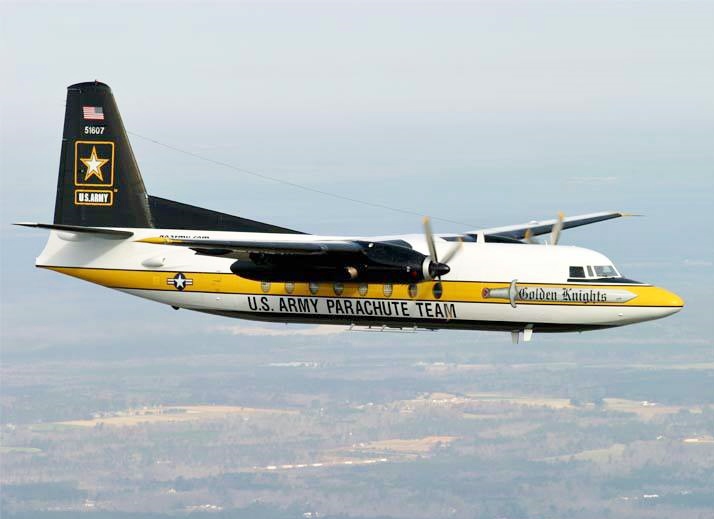
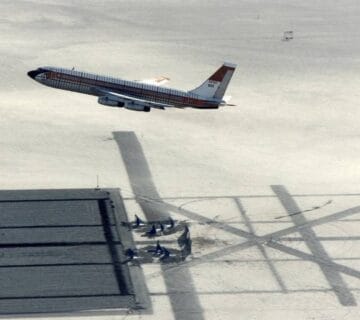
The U.S. Army photograph accompanying this article shows one of the later uses of the Friendship family. In the image, a yellow and white Golden Knights aircraft is already airborne above the clouds. It illustrates how the basic transport design found work beyond passenger service. The archive identifies the picture as U.S. Army imagery. It depicts a later aircraft, while the prototype that flew in 1955 appears in the Fokker historical collection. Featured photograph and rights record.
Looking back from those later uses, the first flight matters because it marks the start of a design that traveled far beyond the Dutch airfield where it began. The aircraft was conceived for a familiar job: connecting communities over relatively short distances. The new structure, pressurized cabin and turboprop engines were the means of building a modern aircraft around that job.



No comment