
Published November 24, 2026
On November 24, 1970, a U.S. Navy T-2C Buckeye flew from North American’s plant in Columbus, Ohio, with a thick experimental wing developed by NASA. The agency’s 1970 chronology identifies it as the first flight test of that test wing on the Navy aircraft. The joint program was exploring whether a thicker wing could offer structural advantages on aircraft that would spend much of their time flying below the speed of sound.
The airflow problem
An airplane can encounter effects associated with supersonic airflow while the aircraft itself is still flying below Mach 1. Air speeds up over parts of the wing. If the local flow exceeds the speed of sound, a shock wave can form as the air slows again. A strong shock can increase drag and make the airflow separate from the wing. Those effects matter to the design of an aircraft expected to cruise at high subsonic speeds.
NASA researcher Richard Whitcomb investigated ways to shape the airfoil so that the shock would be weaker and occur farther back. An airfoil is the shape a wing presents in cross section. Changes to that shape affect how air accelerates and how pressure changes on its way around the wing. The aim of Whitcomb’s work was to give designers more room to operate efficiently before the penalty from compressibility became severe. NASA’s historical account of supercritical-wing research.
Why test a thick wing?
Wing thickness affects more than aerodynamics. A wing deep enough to accommodate a more efficient supporting structure gives engineers another way to manage weight. Extra internal volume can also be useful in an aircraft that carries equipment or fuel in its wings. The attraction of the thick experimental airfoil was the prospect of preserving some of those benefits while improving the way the wing performed at speed.
The Buckeye made it possible to investigate the idea on an existing jet trainer. The November flight put that test wing on a complete aircraft, where the wing operated with a fuselage and the rest of the airframe. The chronology describes a research test. It does not give a measured fuel saving or a structural weight reduction for the flight, and it frames weight savings as a possibility the program was investigating. November 24 entry in NASA’s chronology.
Two wings for different questions
NASA’s chronology distinguishes the thicker test wing carried by the Buckeye from a thinner version prepared for a modified F-8. The first was intended to investigate advantages for aircraft designed for more moderate speeds. The thinner wing addressed performance at higher speeds. NASA records that the modified F-8 had arrived at its Flight Research Center earlier that November. Its flight program began the following spring.
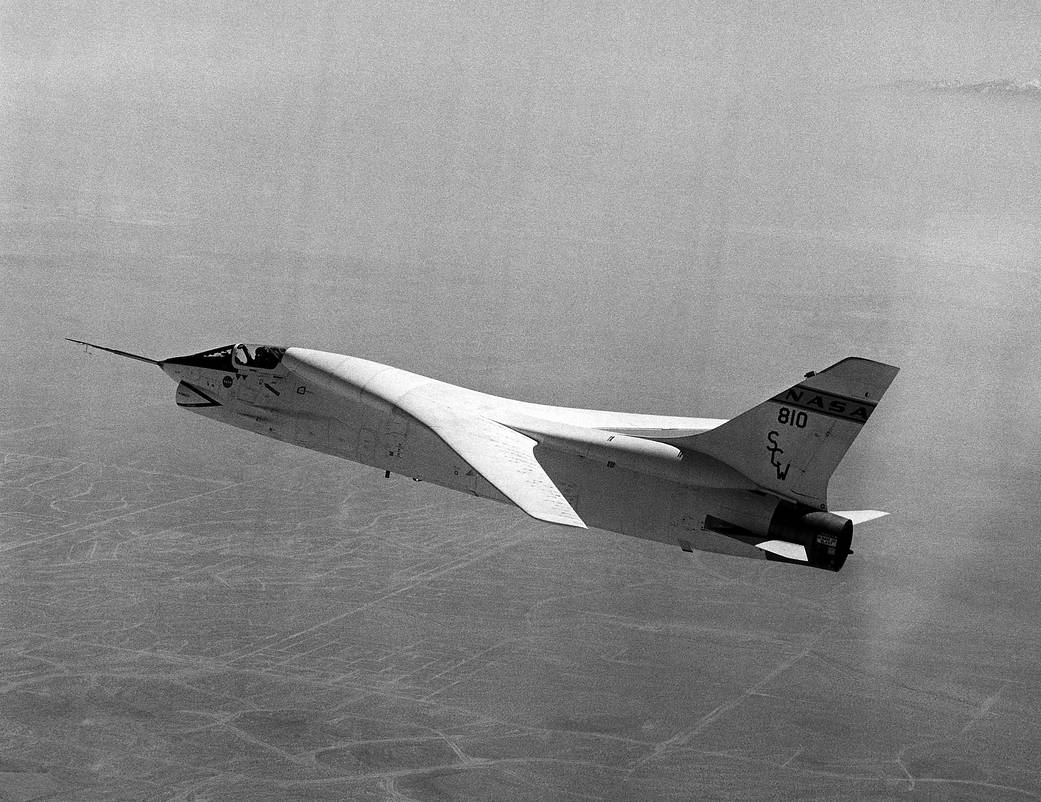
That distinction matters when looking at the featured photograph. It shows the later F-8 research aircraft in flight on March 17, 1971, in the related NASA program. It provides a clear view of a supercritical-wing test aircraft, while the chronology reproduces a separate archival photograph of the Navy Buckeye. NASA identifies March 9, 1971, as the first flight of the modified F-8. NASA’s F-8 photograph and caption.
The November anniversary is a milestone in testing a practical design tradeoff. A wing had to satisfy the people designing the structure as well as those studying the airflow. The Buckeye flight was a way to investigate whether a thick section could serve both purposes, and the F-8 flights pursued a related question at higher speeds. Taken together, the programs show why the value of a new airfoil depends on the aircraft and the speed range for which it is designed.
Featured photograph: NASA, E-22944, public-domain archival imagery.






No comment