
Published November 24, 2026
Apollo 12 ended its flight on November 24, 1969, when its command module, Yankee Clipper, splashed down in the Pacific Ocean. USS Hornet was on station. For Charles “Pete” Conrad, Richard Gordon and Alan Bean, the landing ended their time in flight. For the people aboard the carrier and in its helicopters, the next task was getting the crew safely out of a spacecraft that had come to rest upside down. NASA’s account of the recovery follows that work from splashdown through the transfer of the lunar samples.
A harder landing than expected
Parachutes slowed the capsule for its descent, but they could do little about the motion of the sea beneath it. NASA’s history describes the module striking a rising wave. The impact dislodged a camera, which hit Bean and cut his head. The capsule took up an inverted position that the recovery team knew as Stable 2. That name described how the spacecraft was floating and gave the team a common way to refer to its orientation.
Three inflatable bags brought the command module upright in less than five minutes. The ability to right itself mattered because the men still had to use the hatch to leave the spacecraft. Once Yankee Clipper was upright, a helicopter delivered the first group of Navy swimmers. They fitted a flotation collar, set up rafts and used a sea anchor to steady the capsule while the crew prepared to come out. NASA’s description of work alongside the capsule.
The helicopter leg
The swimmers and helicopter crew handled different parts of the same transfer. The swimmers worked alongside the capsule, where they could stabilize it and prepare a raft. The helicopter could lift each astronaut out of the water area and fly him directly to the carrier. A Navy decontamination officer brought fresh flight suits and respirators, then helped with the steps that moved the astronauts from the capsule onto a raft.
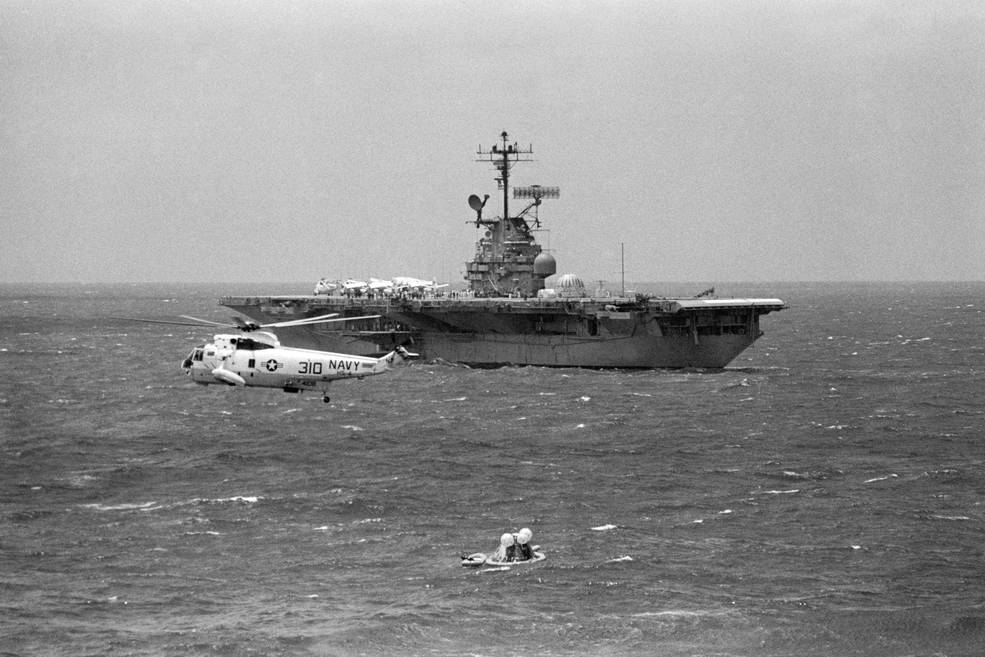
The helicopter hoisted Gordon first, followed by Bean and Conrad. A NASA flight surgeon examined all three during the flight to Hornet. The steps are visible in the imagery accompanying the NASA history, which includes photographs from the water and from the recovery helicopter. The featured U.S. Navy photograph gives a wider view, with the capsule in the water, a helicopter hovering nearby and the carrier in the background. U.S. Navy recovery imagery via NASA.
From the flight deck to quarantine
After landing, the helicopter was lowered to the hangar deck so the astronauts could walk a short distance to a Mobile Quarantine Facility. NASA records that its door was sealed one hour after splashdown. The facility let the crew stay aboard the ship while observing the quarantine procedures then used for Apollo lunar crews. Its placement near the arriving helicopter shortened the transfer through the ship.
The lunar samples and film followed a separate route. NASA describes carrier aircraft taking the containers to Pago Pago, where they were transferred to aircraft bound for Houston. Researchers began examining samples and processing film within two days of splashdown. The recovery plan had to get the crew, the capsule and the scientific material out of the Pacific, with separate arrangements for what each needed next. NASA’s account of the sample and film transfer.
The anniversary marks the completion of a flight and the work it took to turn an ocean landing into a safe arrival. In the recovery photograph, the capsule, the hovering helicopter and the carrier illustrate three successive stages of the crew’s trip home. The swimmers and their equipment made it possible to move safely between the first two.
Featured photograph: U.S. Navy, S69-22897, public-domain archival imagery via NASA.




No comment