
Published November 22, 2026
Captain Chesley “Sully” Sullenberger took control of US Airways Flight 1549 after a bird strike left its two engines producing very little thrust. He and First Officer Jeffrey Skiles had just departed New York’s LaGuardia Airport for Charlotte, North Carolina, on January 15, 2009. They were still close to the airport when they lost power, but they were low and losing altitude. Sullenberger brought the Airbus A320 down on the Hudson River. All 155 people aboard survived. NTSB investigation summary
A decision made while descending
The bird strike came about two minutes after takeoff. According to the airline’s submission to the investigation, Sullenberger took control, started the auxiliary power unit, and called for the dual-engine failure checklist. Skiles worked through the procedure while Sullenberger flew and communicated with air traffic control. They had to divide those tasks immediately because every second spent diagnosing the engines also took them closer to the ground. US Airways submission to the NTSB docket
Air traffic control offered runway options while the crew assessed what they could reach with the altitude and energy they had left. The NTSB examined simulator attempts to return to an airport. The tests highlighted how much the outcome depended on whether the turn began immediately or followed a realistic interval for recognizing and assessing the emergency. Sullenberger had to judge what the airplane could do while he was still learning how much power it had lost. NTSB final report
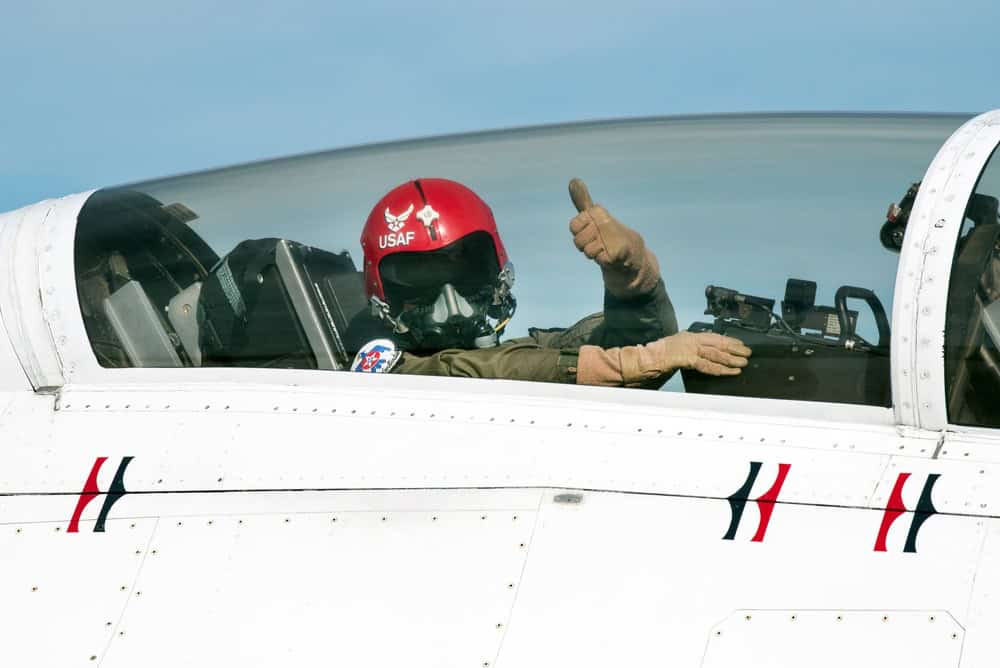
Sullenberger graduated from the U.S. Air Force Academy in 1973 and went on to fly for the Air Force before his airline career. The Air Force later photographed him at Travis Air Force Base before a flight with the Thunderbirds in 2017. That portrait accompanies this feature. The Hudson landing took place eight years earlier. U.S. Air Force photo record via DVIDS
The cabin crew and ferries carried the rescue forward
Flight 1549’s cabin crew consisted of Sheila Dail, Donna Dent and Doreen Welsh. Once the airplane hit the water, passengers and crew went out through the forward and overwing exits. Impact damage made the aft slide rafts unavailable, so the forward equipment mattered. The flight carried equipment for extended operations over water, including forward slide rafts, even though that equipment was unnecessary for its planned route. NTSB final report, survival factors
The river was cold, and reaching a wing or raft was only one step toward safety. Ferries operating nearby moved in, allowing rescuers to reach people while the airplane was still afloat. Five people suffered serious injuries, including a flight attendant and four passengers. The NTSB cited four contributors to survival: flight crew decision-making and coordination, the overwater equipment aboard, the cabin crew’s evacuation work, and the immediate response of rescuers near the site. NTSB findings on survivability
What the investigation found after the rescue
The safety board examined whether the conditions assumed in ditching certification were achievable by a crew with virtually no thrust. Its findings pointed to gaps in the guidance and training available to pilots for a water landing, as well as limitations in training for a dual-engine failure. It also examined how emergency checklists are designed and how demanding it was for Sullenberger to maintain the airspeed he wanted while managing the approach. NTSB analysis and recommendations
The investigation went beyond the cockpit to ask how travelers find a life vest, how they put it on, and what briefings tell them about getting out. Those questions came directly from the experiences of people evacuating an aircraft into cold water and waiting for help. The recommendations went to the Federal Aviation Administration, the U.S. Department of Agriculture and the European Aviation Safety Agency, covering issues that included bird hazards, engine testing and passenger survival. NTSB investigation summary and recommendations
Sullenberger’s decision put the airplane within reach of help. The people who shared the work in the cockpit, directed the evacuation and brought their boats alongside turned the landing into a rescue. Their actions are a reminder that the outcome of an aviation emergency can depend on people who have only minutes to coordinate and who, in the case of the ferry crews, may have started the day expecting to do something entirely different.
Sources
National Transportation Safety Board — Flight 1549 investigation
National Transportation Safety Board — Final accident report
US Airways — Submission to the NTSB docket
Featured photograph — U.S. Air Force photo by Louis Briscese via DVIDS, public domain


No comment