
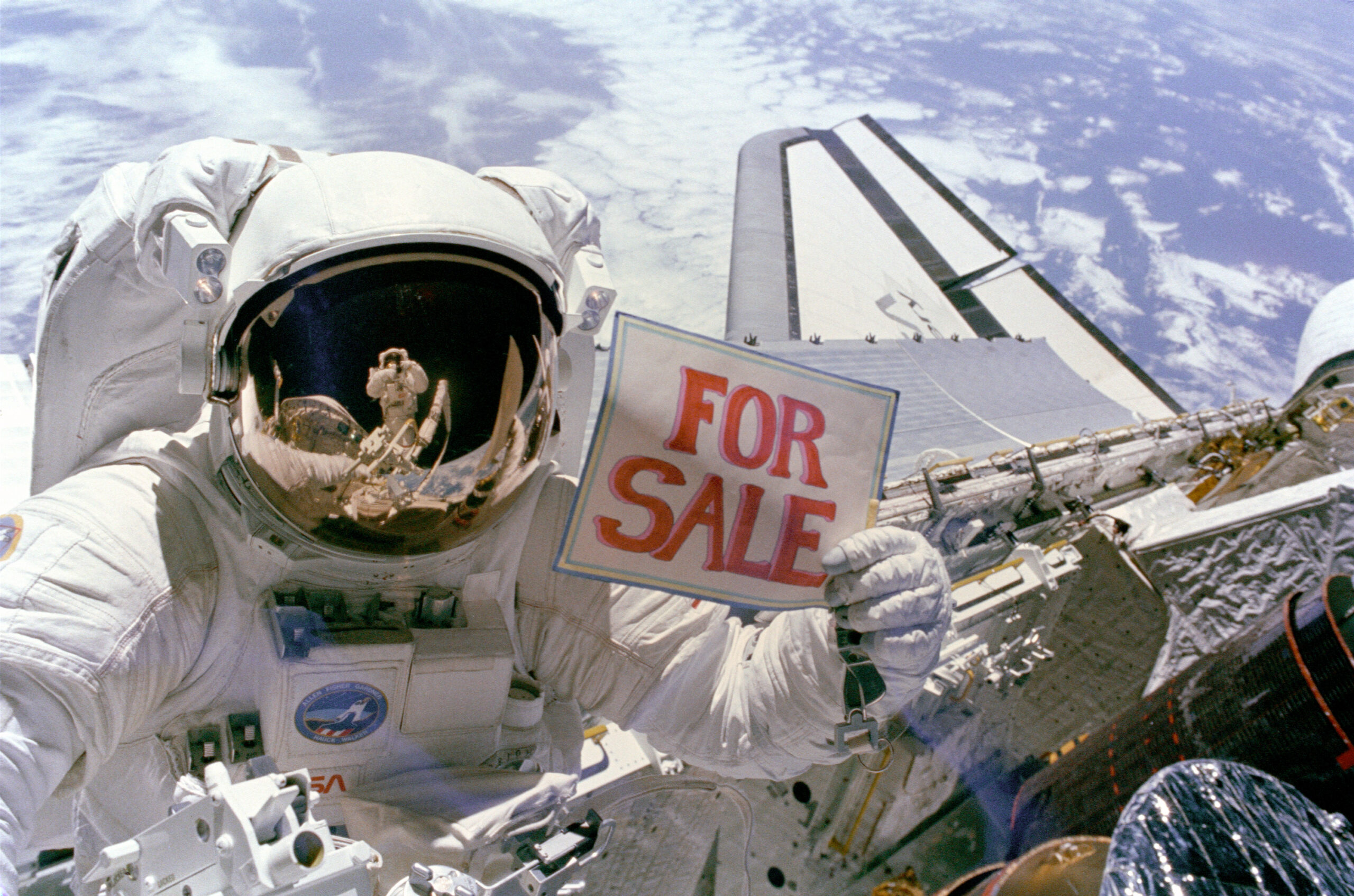
Featured photo: Astronaut Dale A. Gardner holds up a “For Sale” sign after the second satellite retrieval of STS-51A, November 1984, referring to the two satellites the crew had just retrieved. Photo: NASA (GPN-2000-001036)
On November 8, 1984, at 7:15 a.m. Eastern time, Space Shuttle Discovery lifted off from Launch Pad 39A at NASA’s Kennedy Space Center in Florida to begin mission STS-51A. Over the next eight days its five-person crew would put two new communications satellites into orbit and then do something no one had done before: fly out on jetpacks, catch two stranded satellites, and bring them home in the cargo bay. NASA’s own history office later nicknamed the flight “The Ace Repo Company.”
Two satellites stuck in the wrong orbit
The story starts earlier in 1984. On mission STS-41B, the crew of Challenger deployed two communications satellites, Westar 6 for Western Union and Palapa B2 for Indonesia. Both satellites were healthy, but the Payload Assist Module upper stages meant to boost them failed. Instead of reaching geostationary orbit about 22,300 miles up, where communications satellites need to be, they were left in low, useless orbits roughly 160 by 600 miles high. Their own small thrusters could not lift them the rest of the way.
NASA saw a chance to test one of the Space Shuttle’s signature promises: the ability not only to launch satellites but also to retrieve them and return them to Earth. Astronauts had already flown the Manned Maneuvering Unit, a self-contained jetpack, during the STS-41C Solar Max repair mission in April 1984. The plan for STS-51A was for spacewalkers using the jetpack to capture each satellite, with the shuttle’s Canadian-built robot arm then lifting it into the payload bay.
Ground controllers prepared for the rescue weeks in advance, lowering both satellites’ orbits and slowing their spin from 50 revolutions per minute to just 1. Engineers at NASA’s Johnson Space Center in Houston built a capture tool called the Apogee Kick Motor Capture Device, nicknamed the “stinger” for its shape, which a jetpack-flying astronaut could insert into the satellite’s rocket nozzle.
The crew and a record turnaround
Commander Frederick H. “Rick” Hauck led the crew, with Pilot David M. Walker and Mission Specialists Joseph P. Allen, Anna L. Fisher and Dale A. Gardner. Hauck, Allen and Gardner were on their second spaceflights; Walker and Fisher were flying for the first time. NASA notes that Fisher became the first mother in space.
The launch itself set a mark. It came just 26 days after the landing of the previous shuttle mission, STS-41G, which NASA describes as a then-record turnaround between shuttle flights. About eight and a half minutes after liftoff, Discovery was in orbit.
Deliveries first, then the repo job
On the second flight day the crew deployed Canada’s Anik D2 satellite for Telesat, the first nighttime satellite deployment from the shuttle. The next day they released Leasat 1, also known as Syncom IV-1, a defense communications satellite for the U.S. Navy.
Then the rescue began. On the fifth day, Hauck and Walker flew Discovery to within 35 feet of Palapa B2. Allen strapped into the jetpack, flew out with the stinger and docked with the satellite, using the jetpack’s thrusters to stop its slow spin. Fisher, at the controls of the robot arm, grappled the stinger and swung the satellite over the payload bay. When a hidden clearance problem kept Gardner from attaching a planned bracket, the crew switched to a backup plan: Allen held the satellite by hand while Gardner fitted an adapter so it could be locked into its cradle. The spacewalk lasted exactly six hours.
Two days later Allen and Gardner swapped roles. Gardner flew the jetpack out to Westar 6, and the team repeated the procedure, finishing in 5 hours and 42 minutes. With both satellites secured, Gardner and Allen posed at the end of the robot arm, which Fisher was operating, holding a “For Sale” sign above the two satellites, a moment captured in the NASA photo above.
Discovery landed at Kennedy Space Center on November 16, 1984, after 7 days, 23 hours and 45 minutes, 127 orbits and nearly 3.3 million miles.
Why it still matters
STS-51A proved that a crewed spacecraft could go out and recover hardware that had gone wrong in orbit, not just launch it. Both satellites flew again. Hong Kong-based AsiaSat bought and refurbished Westar 6 and relaunched it as AsiaSat 1 on April 7, 1990. Palapa B2 returned to Indonesia and was relaunched as Palapa B2R on April 13, 1990.
The mission was also an ending. It was the last flight of the Manned Maneuvering Units, and the last untethered spacewalks until STS-64 tested the smaller SAFER rescue jetpack in 1994. Since then, spacewalkers on the shuttle and the International Space Station have stayed on safety tethers. That makes the images from November 1984, of astronauts flying free beside a captured satellite, some of the most remarkable of the Space Shuttle era, and a reminder of how much the people who fly and support these missions can improvise when the plan meets reality.


No comment