
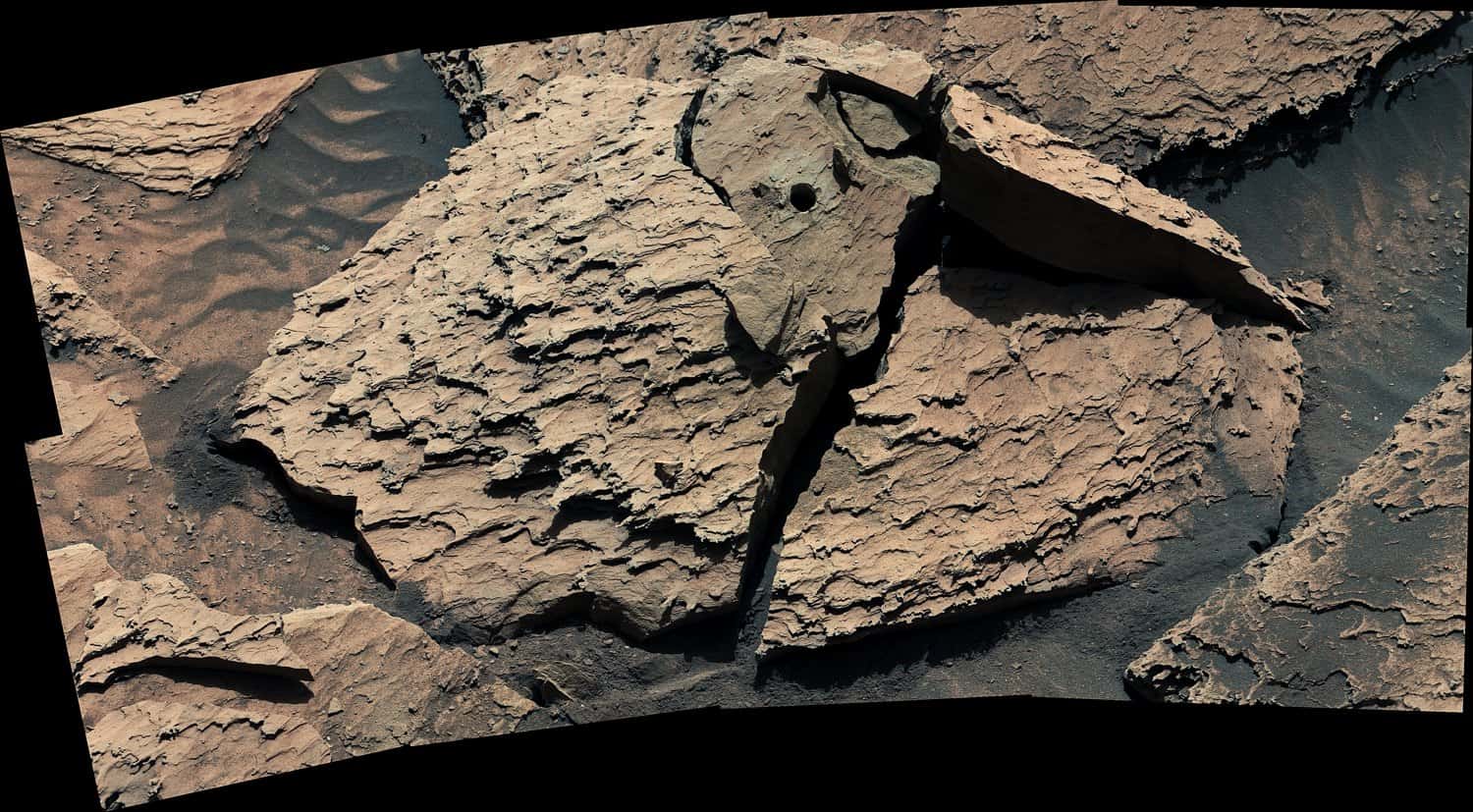
NASA published a new survey of 49 drill holes made by the Curiosity rover on Mars, bringing together years of close-up photographs of the places where the rover collected rock samples. Each hole is about 16 millimeters across. The image set, released in November 2026, makes the sampling record visible at the scale of the tool that made it. NASA’s November release
From outcrop to onboard laboratory
Curiosity carries its drill at the end of its robotic arm. When it collects a sample, the drill produces powder that can be delivered to instruments inside the rover. The close-up camera on the same arm records the hole and nearby rock. The resulting photographs give the science team a record of the surfaces from which the samples came, alongside the data collected by the instruments inside Curiosity.
This arrangement lets the rover investigate a question at two scales. An outcrop seen from farther away can show large features such as layers and changes across the rock face. A close view can show the particular surface the rover approached. The powdered material adds another line of evidence. NASA’s compilation brings together the close views, while the rover’s sampling system makes it possible to investigate the material itself. NASA Curiosity mission overview
One sample site in detail
The featured photograph shows a separate image of a rock nicknamed Atacama, taken by Curiosity’s Mast Camera on May 6, 2026. A round drill hole is visible on its surface. The Jet Propulsion Laboratory estimated the rock was about a foot and a half across at the base and about six inches thick. JPL published the photograph in an account of the rock becoming stuck on the drill. JPL’s Atacama photograph and field notes
The Atacama image shows why it helps to document the surrounding rock as well as the cavity left by the drill. A close-up of the hole captures the immediate sampling site. A wider view places that hole on a particular rock and shows what the rover’s arm encountered. The two kinds of records are complementary when scientists revisit a sampling location or compare it with another site.
The November release is a record of completed sampling work. NASA’s published total counts holes, and the uniform diameter reflects the size of the drill. The photographs show differences in the materials around those holes. Evaluating what those differences mean for the geology of Mars requires the measurements taken by the rover and the context recorded at each site.
Featured photograph: NASA/JPL-Caltech/MSSS, PIA26724. The original frame was resized for publication. Image record · JPL editorial reuse policy
Sources
NASA’s November Curiosity sampling release · JPL’s Atacama image and notes · NASA Curiosity mission overview





No comment