
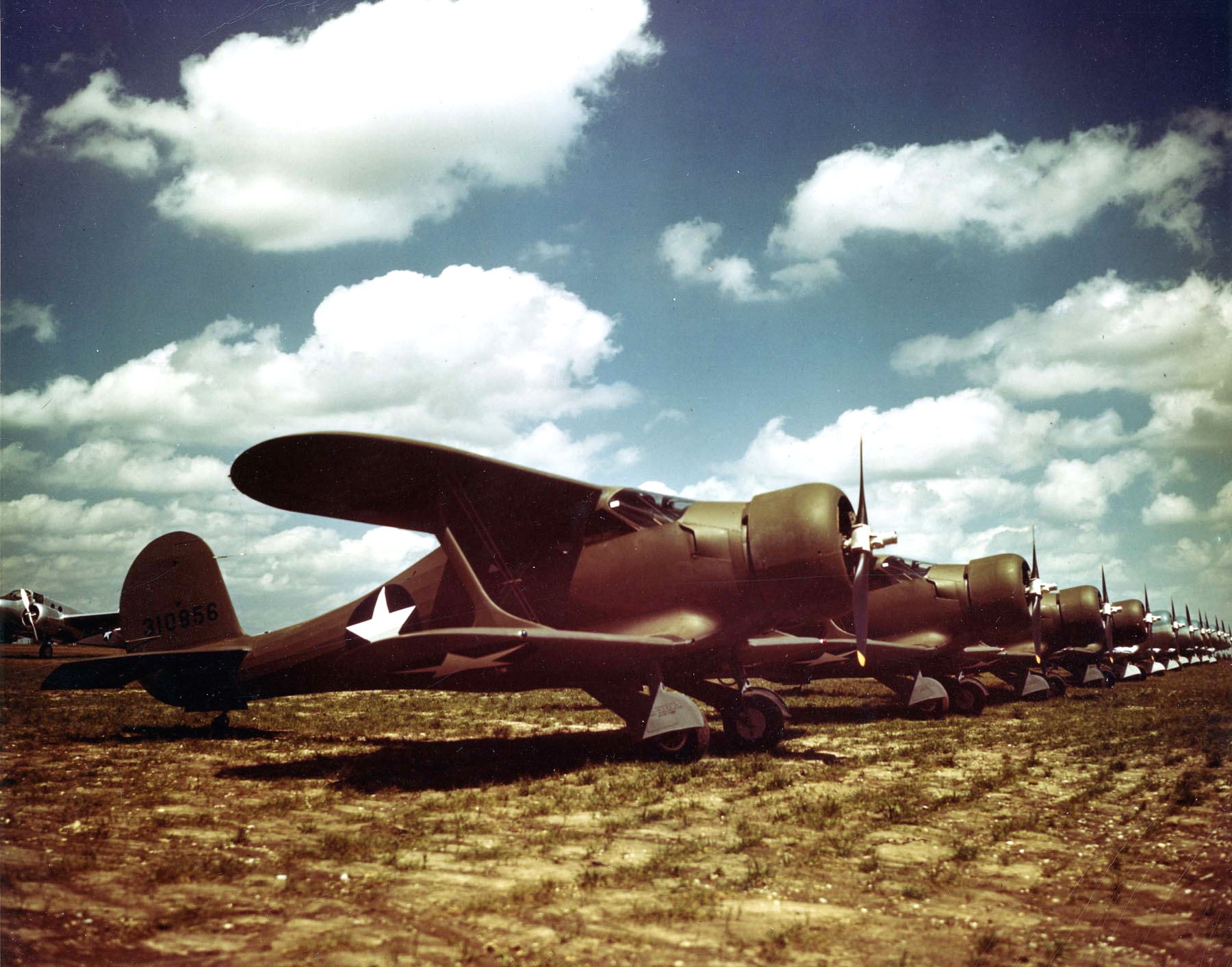
Featured photo: Beechcraft UC-43 Travelers, with U.S. Navy GB-2 versions farther down the line, in early 1943. Photo: U.S. Air Force (National Museum of the U.S. Air Force)
On November 4, 1932, a new biplane from a brand-new company made its first flight. It was the Beechcraft Model 17, and its wings looked like someone had put them on backward. The lower wing sat ahead of the upper one, the reverse of most biplanes of the day. Pilots and the public soon gave it the name it still carries: the Staggerwing.
A gamble in the middle of the Depression
The Model 17 was the first airplane built by Beech Aircraft Corporation of Wichita, Kansas. Walter Beech had helped found Travel Air in 1925 alongside Clyde Cessna and Lloyd Stearman, and Travel Air merged into Curtiss-Wright in 1929. In 1932 Beech struck out on his own, founding Beech Aircraft Corporation with his wife, Olive Ann Beech, and a small group of partners. Ted Wells, the company’s vice president and chief designer, drew up the new airplane.
The Smithsonian’s National Air and Space Museum calls the Model 17 “a gamble.” The country was in the depths of the Great Depression, and Beech set out to build an expensive, high-speed, comfortable airplane for business travelers, the role a private jet fills today. The prototypes, designated 17R, used a 420-horsepower Wright radial engine, and the first of them flew on November 4, 1932.
Why the backward wings?
Most biplanes of the era placed the upper wing ahead of the lower one. Beech’s design did the opposite, which aviation people call negative stagger. According to the National Air and Space Museum, the arrangement improved the pilot’s view from the cockpit and gave the airplane gentle stall characteristics, and it also gave the Staggerwing its unmistakable look. Production versions added retractable landing gear, which was uncommon at the time, along with careful streamlining. Inside, the enclosed cabin could carry the pilot and several passengers in real comfort.
Sales started slowly, since few buyers could afford a luxury airplane in 1933. But the design kept improving through a series of models, each with a letter for its engine, and it found its market. By the time production ended in the late 1940s, more than 780 Model 17s had been built.
Winning the Bendix
The Staggerwing’s most famous day came on September 4, 1936. Olive Ann Beech had proposed that the company sponsor a woman pilot in the Bendix Trophy Race, a cross-country speed contest. Louise Thaden flew a Beech C17R with Blanche Noyes as her co-pilot, and the pair flew from Floyd Bennett Field in Brooklyn to Los Angeles in 14 hours, 55 minutes. They became the first women to win the Bendix Trophy. Amelia Earhart, flying her Lockheed Electra with Helen Richey, finished fifth in the same race.
Going to war as the Traveler
The military noticed the Staggerwing too. In June 1939, Beech delivered three to the Army for evaluation as the YC-43, and those airplanes went to the U.S. air attachés at the American embassies in London, Paris and Rome. Early in World War II, the need for a compact executive transport and courier aircraft became clear. In 1942 the Army ordered the first of 270 Model 17s as the UC-43 Traveler, and the government bought or leased more Staggerwings from private owners to meet wartime needs. The Navy flew its versions as the GB-1 and GB-2. The photo above shows a row of Army UC-43s in early 1943, with Navy GB-2s farther down the line.
The National Museum of the U.S. Air Force in Dayton, Ohio, displays a Traveler painted as a UC-43 assigned to the Eighth Air Force in England in 1943. The museum lists its top speed at 212 mph, powered by a 450-horsepower Pratt & Whitney R-985 engine.
A connection to Apollo 11
One of the Staggerwing’s quieter stories sits in the Smithsonian’s collection. The National Air and Space Museum’s Beechcraft C17L, serial number 93, was built in 1936, and its original owner was E.E. Aldrin, the father of Apollo 11 astronaut Edwin “Buzz” Aldrin. He worked for Standard Oil Development Company, and the airplane wore Standard Oil colors. Over the following decades it had 19 owners, including a stint with the Civil Air Patrol on coastal patrol duty in World War II, before it was donated to the museum in 1981.
Why it still matters
After the war, Beech built one final Staggerwing model before the lighter, less expensive Beechcraft Bonanza took its place in the lineup. Yet the old biplane never faded. Smithsonian’s Air & Space magazine traces the founding of the Beechcraft Heritage Museum in Tullahoma, Tennessee, to the Staggerwing Club and to a 1973 Staggerwing Club event where, as antique aircraft enthusiast George Schulz recalled, guest speaker Louise Thaden “said the airplane was ahead of its time and that something ought to be done to commemorate it.” In 2007, AOPA Pilot reported that nearly 3,000 AOPA members voted the Staggerwing the most beautiful airplane.
The Staggerwing showed that a small company, launched in the worst economy of the century, could win customers by building something fast, comfortable and beautiful. Ninety-four years after its first flight, Staggerwings still draw a crowd wherever they land.
Sources
- Beechcraft C17L Staggerwing, Smithsonian National Air and Space Museum
- Women in Aviation: Beech Aircraft Company, Parade of Champions, National Air and Space Museum Archives
- Louise Thaden Photograph Collection, National Air and Space Museum
- Beech UC-43 Traveler fact sheet, National Museum of the U.S. Air Force
- “Sweet 17,” Air & Space / Smithsonian
- 4 September 1936, This Day in Aviation
- Beechcraft Model 17 Staggerwing, Wikipedia
- Photo: U.S. Air Force, National Museum of the U.S. Air Force photo 060519-F-1234P-006 (public domain)



No comment