
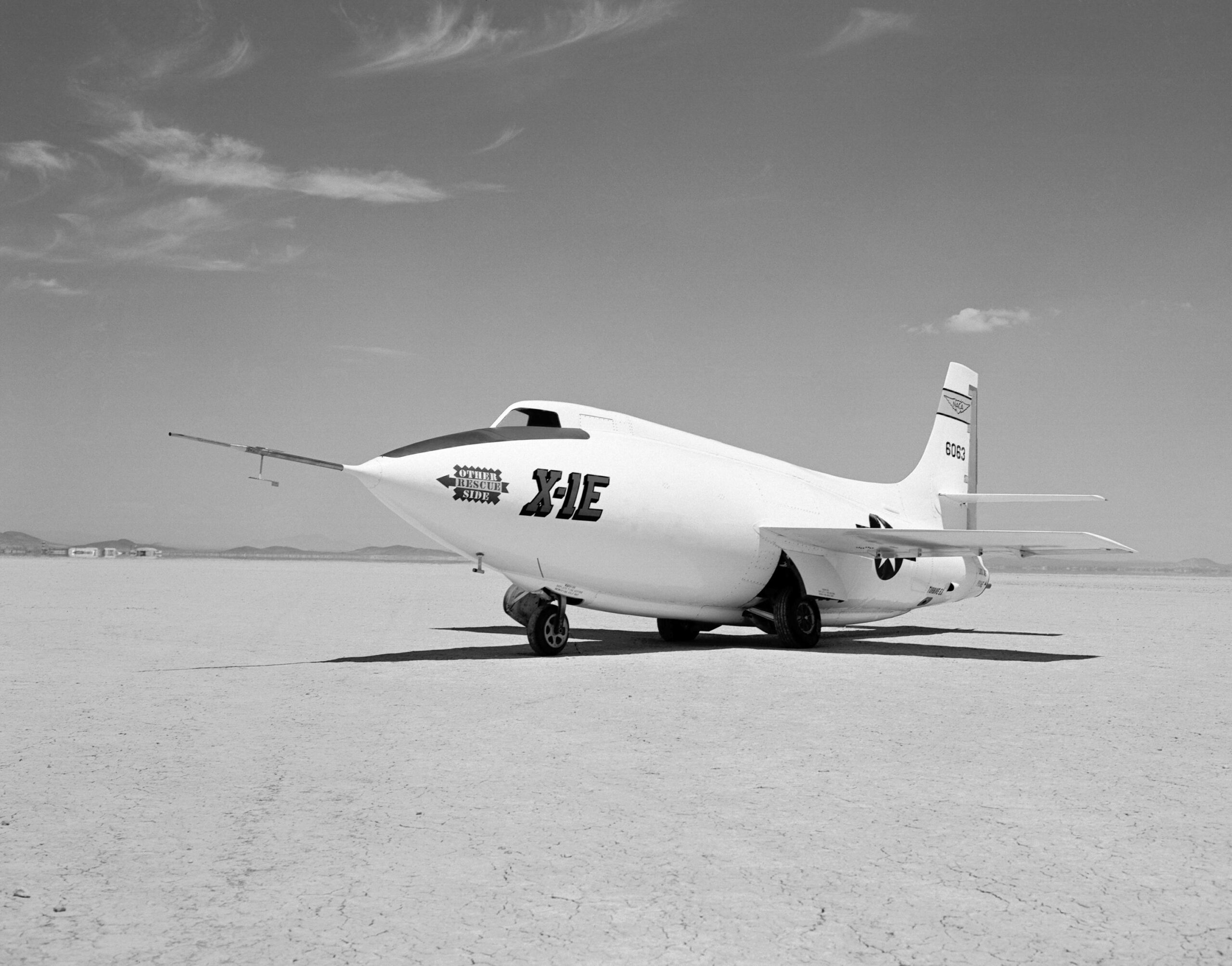
Featured photo: Bell X-1E 46-063 on Rogers Dry Lake near the NACA High-Speed Flight Station, Edwards, California, 1955. Photo: NASA (E-1927)
On November 6, 1958, NASA research test pilot John B. (“Jack”) McKay flew Bell X-1E 46-063 on its twenty-sixth and final flight over Edwards Air Force Base, California. Dropped from a Boeing B-29 Superfortress mothership, the rocketplane flew a low-altitude, low-Mach research sortie to test a new rocket propellant. When the airplane was inspected afterward, X-rays revealed a significant crack in the fuel tank wall. Repair costs, together with the impending arrival of the X-15, ended the X-1E program. That flight closed not only one airplane’s logbook but an entire series that had begun twelve years earlier with the first X-1 rocketplanes.
The date matters for another reason. NASA itself was only weeks old. The National Advisory Committee for Aeronautics (NACA) had become the National Aeronautics and Space Administration on October 1, 1958. McKay’s November flight was therefore both an X-1 farewell and an early NASA research mission at what is now NASA’s Armstrong Flight Research Center.
From Yeager’s X-1 to the X-1E
The early XS-1 aircraft, later redesignated X-1, were built to explore high subsonic and low-supersonic flight. On October 14, 1947, U.S. Air Force test pilot Charles E. (“Chuck”) Yeager flew X-1 46-062, Glamorous Glennis, faster than sound. That program, sponsored by the NACA with the Army Air Forces and Bell Aircraft, opened a new research path at Muroc — later Edwards — that would shape American high-speed flight for decades.
The X-1E was a deep rebuild of the second original X-1, serial 46-063. NACA engineers wanted thin-wing data at transonic and supersonic speeds after earlier high-speed research aircraft had been lost or underperformed. Stanley Aviation built new wings only about 3⅜ inches thick at the root, fitted with more than 200 pressure openings and hundreds of strain gauges. The side hatch gave way to a raised canopy that allowed an ejection seat. A turbopump fuel system replaced the high-pressure nitrogen spheres that had worried engineers on the earlier airplane. The result looked related to Yeager’s X-1, but it was a different research tool: thinner wing, instrumented surfaces, and a cockpit built for escape.
Joe Walker, Jack McKay, and twenty-six flights
NACA research pilot Joseph A. Walker made the X-1E’s first glide flight on December 15, 1955, and went on to fly twenty-one of the airplane’s twenty-six flights. On October 8, 1957, he took the X-1E to Mach 2.24 — about 1,450 miles per hour — its highest speed. On May 14, 1958, he also flew it to its peak altitude of 70,046 feet. Walker’s work defined what the thin-wing rocketplane could do and where its directional stability began to thin out at high Mach numbers. Two ventral fins were later added to help.
When Walker left the X-1E program, John McKay took over. McKay made checkout flights in September 1958, then flew research sorties in October to test engine changes: higher rocket chamber pressure and nozzle extensions meant to raise thrust. The November 6 flight pushed into a new propellant called U-Deta, a mixture of unsymmetrical dimethylhydrazine and diethylenetriamine that replaced the alcohol-and-water blend. Engineers hoped the engine work and new fuel might push the X-1E toward nearly Mach 3. The flight itself stayed low and slow by X-plane standards — a careful check of the new propellant, not a record attempt.
Why the program stopped
After McKay’s fifth X-1E flight — the airplane’s twenty-sixth — the aircraft was grounded for inspection and for installation of a new ejection seat. X-ray inspection found a crack in the fuel tank wall. Fixing it would have been expensive. The X-15 was about to take the high-speed research story further, into hypersonic flight and the edge of space. Research tasks planned for the X-1E moved to F-104s with similar performance. The X-1 family as a whole — X-1, X-1A, X-1B, X-1D, and X-1E — had logged 236 flights. The series that had broken the sound barrier had run its course.
The airframe did not disappear. On April 29, 1960, the X-1E was mounted on a pole in front of the Flight Research Center headquarters building at Edwards. It remains a gatekeeper at what is now NASA Armstrong Flight Research Center — a physical reminder that the path from NACA lakebed research to modern flight test ran through airplanes like this one.
Why it still matters
November 6, 1958, is easy to miss next to louder dates: Yeager’s Mach 1 flight, Walker’s later X-15 altitudes, the first Moon landings. Yet endings matter in research. The X-1E’s last flight closed a program that had taught engineers how thin wings, rocket propulsion, and instrumented flight test could open the supersonic regime safely enough to keep going. McKay’s U-Deta sortie was not glamorous. It was careful. That is how flight research often ends — not with a parade, but with an inspection, a hard call, and the next airplane waiting on the ramp.
Sixty-eight years later, the X-1E still stands at Armstrong. The lakebed is still there. So is the idea that brought the NACA west in 1946: put the airplane in the sky, measure what happens, and let the data decide what comes next. On this day in 1958, that idea closed one chapter and cleared the runway for the next.



No comment