
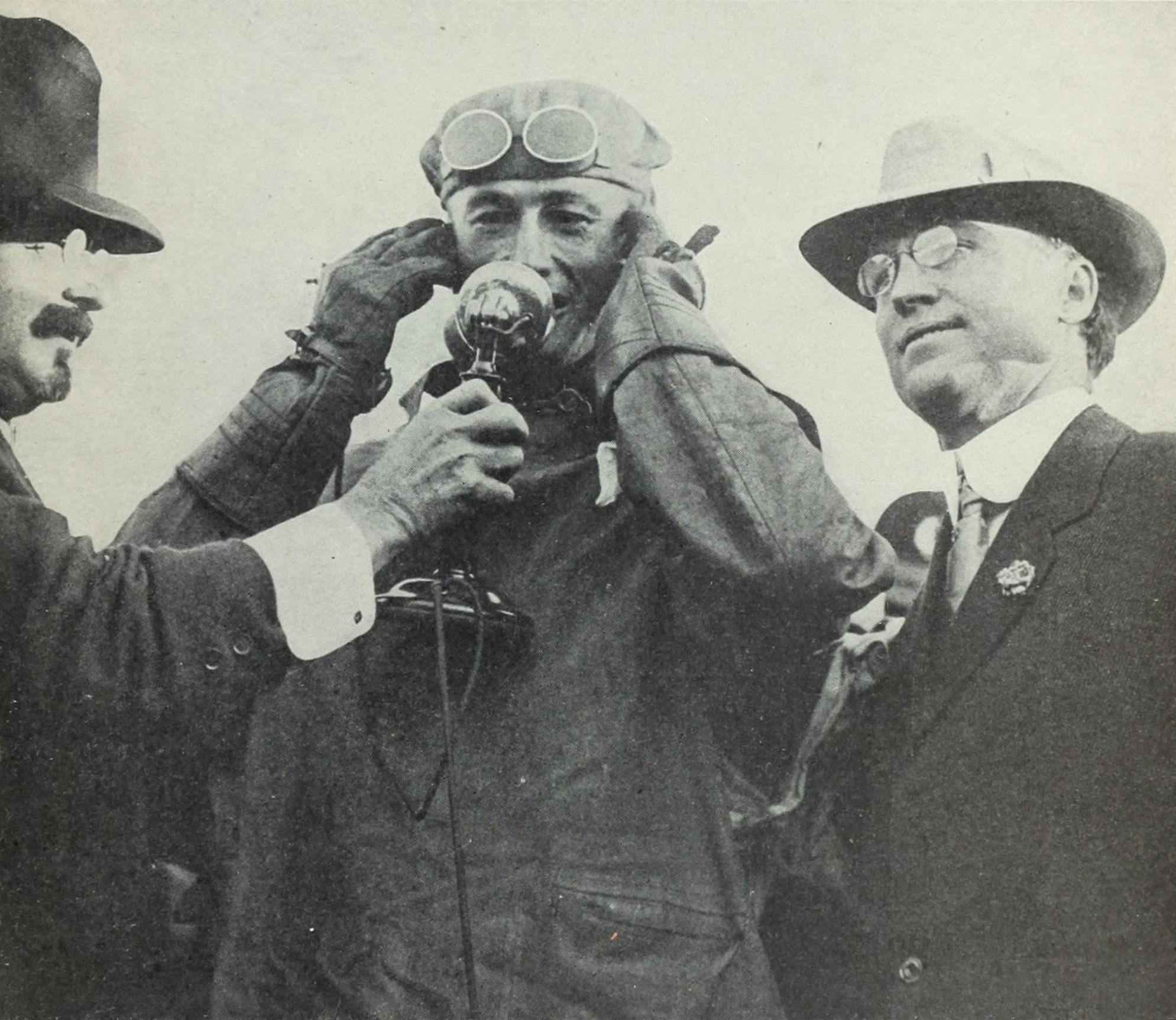
Featured photo: Calbraith Perry Rodgers and the Vin Fiz just after landing in Pasadena, November 1911. Photo: The World’s Work (via Wikimedia Commons), public domain
On November 5, 1911, at about 4:04 p.m. local time, Calbraith Perry Rodgers brought a Wright Model EX biplane named Vin Fiz down at Tournament Park in Pasadena, California. Roughly 20,000 spectators were waiting. When the wheels touched, he finished what no one had done before: the first airplane flight from coast to coast across the United States.
The flight had begun nearly seven weeks earlier, on September 17, 1911, at Sheepshead Bay, New York. Between those two points lay 49 days, more than 70 landings, about 4,321 miles (6,914 kilometers) of distance, and roughly 82 hours and 4 minutes of actual flying time. The average speed worked out to about 51.5 miles per hour. It was not a race against the clock so much as a long, stubborn campaign to keep an early airplane and its pilot moving west until the Pacific side of the country was finally in reach.
A brand-new pilot with a coast-to-coast idea
Cal Rodgers was not a seasoned airman when he set out. He had learned to fly from Orville Wright at Huffman Prairie, and on August 7, 1911, he received Fédération Aéronautique Internationale certificate number 49. Only weeks later he was attempting the longest aerial journey yet undertaken in America. That timeline alone says something about the era: aviation was still new enough that a freshly certificated pilot could aim at a national first and be taken seriously.
Publisher William Randolph Hearst had put up a $50,000 prize for anyone who could cross the country by airplane in 30 days or less. Rodgers went after it. The clock on that prize ran out before he reached California, but he kept flying anyway. The money mattered; finishing mattered more. By the time he landed in Pasadena, the prize was gone and the achievement remained.
The Vin Fiz and its grape-soda sponsor
The airplane was a Wright Model EX, a biplane with a wingspan of about 31 feet 6 inches. It was powered by a Wright four-cylinder engine of roughly 30 to 35 horsepower driving dual pusher propellers. In an age when aircraft were often unfinished in appearance by modern standards, this one carried a brand in plain sight. Armour & Company, the meatpacking firm, sponsored the flight to promote Vin Fiz, a grape soda. The airplane took the soft drink’s name, and the venture became the first major commercial aerial advertising campaign flown on an airplane in the United States.
That sponsorship was more than paint on fabric. Crossing a continent in 1911 meant spare parts, fuel, lodging, and a way to keep the airplane airworthy after hard landings and hard flying days. Armour’s backing helped make the logistics possible, and the Vin Fiz name rode with Rodgers from the Atlantic start to the California finish.
A special train and Charlie Taylor
Rodgers did not cross the country alone in spirit. A special train followed the flight, including a hangar car so the airplane could be worked on between hops. Aboard that support effort was Charlie Taylor, the Wright brothers’ mechanic. Taylor’s presence linked the Vin Fiz flight directly to the earliest practical airplane engineering in America. When something broke or needed adjusting hundreds of miles from Dayton, the man who had helped build the Wrights’ engines was there to keep the journey alive.
The numbers tell how hard the road was. More than 70 landings across 49 days meant almost daily decisions about weather, fields, fuel, and repairs. Total flying time of about 82 hours and 4 minutes, spread over that calendar span, shows how much of the expedition was spent on the ground. Early airplanes did not cruise for hours the way airliners do now. They hopped, rested, and hopped again. Rodgers’ average of about 51.5 miles per hour was respectable for a Wright pusher of that power, and it was enough, day after day, to close the gap between New York and California.
Pasadena, then the Pacific
Tournament Park turned the finish into a public event. A crowd on the order of 20,000 people watched Rodgers arrive. For many of them, an airplane that had started on the Atlantic coast and was now overhead in Southern California was proof that the machine was not a fairground curiosity. It could cross the nation.
Pasadena marked the completion of the first coast-to-coast airplane flight across the United States. Rodgers later continued on to Long Beach, reaching the Pacific shore on December 10, 1911. The Pasadena landing on November 5 remains the date remembered for the transcontinental first; the Long Beach leg closed the story at the water’s edge a little more than a month later.
What remains
The Vin Fiz itself survives. The airplane is preserved in the collection of the Smithsonian National Air and Space Museum, where it stands as a physical record of that 1911 crossing. Visitors can see the machine that carried a new pilot, a soft-drink sponsor, a Wright mechanic on a chase train, and a national ambition across nearly 4,300 miles of early American sky.
One hundred fifteen years later, the outline of the story is still clear. A pilot certificated in August set out in September. He flew for 49 days through dozens of landings. He lost a prize and kept the mission. He landed in Pasadena before a huge crowd on November 5, 1911, and proved that the United States could be crossed by airplane. That is why Cal Rodgers and the Vin Fiz belong on the calendar of this day in aviation history.
Sources
- Wright EX Vin Fiz, Smithsonian National Air and Space Museum
- How a Brand-New Pilot and a Grape Soda Made History Crossing the U.S., Smithsonian National Air and Space Museum
- 5 November 1911, This Day in Aviation
- Photo: Rodgers — Just landed in Pasadena, The World’s Work (via Wikimedia Commons), public domain
- Calbraith Perry Rodgers, Wikipedia (pointer)



No comment