
A command change at Point Mugu
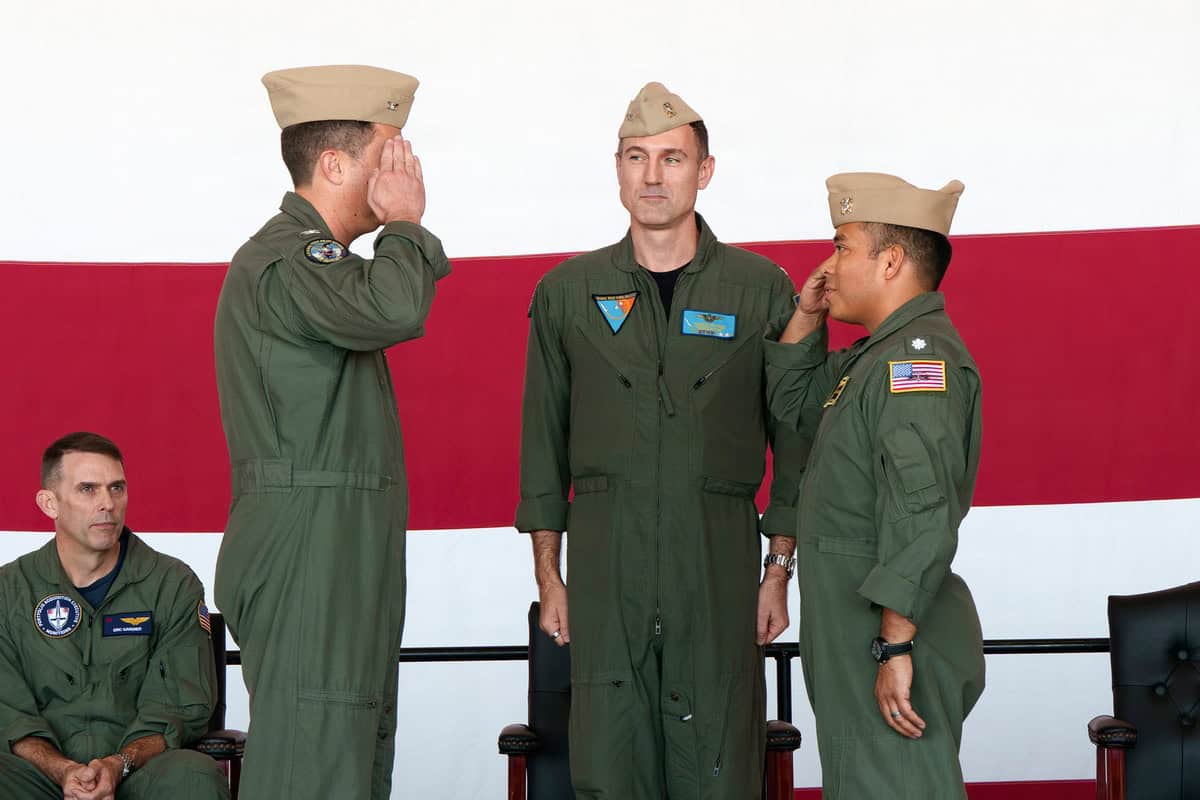
U.S. Navy Cmdr. J. Anderson Ayala took command of Air Test and Evaluation Squadron 30 (VX-30), the “Bloodhounds,” during a Nov. 10 change-of-command ceremony at Naval Base Ventura County, Point Mugu, California. He relieved Capt. Barry Carmody and became the squadron’s 23rd commanding officer. Ayala had served as VX-30’s chief test pilot for nearly two years, giving the incoming commander direct experience with the unit’s work and aircraft before taking responsibility for its next phase. The Navy’s Naval Air Warfare Center Weapons Division reported the change on Nov. 12.
The timing places the leadership transition alongside a planned reshaping of VX-30’s aircraft lineup. The squadron is bringing in the Gulfstream-based NC-37B range-support aircraft and expects to retire its P-3 Orion over the coming year, according to the Navy’s report. That transition matters because VX-30’s aircraft are not simply operational platforms: they help keep test ranges safe, collect test data and support development work for the fleet.
What the Bloodhounds do
VX-30 is part of Naval Test Wing Pacific and is based at Point Mugu. The squadron evaluates manned and unmanned fixed-wing and rotary-wing aircraft and weapons systems, while also supporting the Point Mugu Sea Range locally and on deployments. NAVAIR’s unit description lists range surveillance, photometric support, area clearance and airborne telemetry among its responsibilities. Range personnel also help provide flight safety and clear the 36,000-square-mile sea range for testing.
That mission is less visible than a carrier launch or an operational deployment, but it supports the work that precedes them. Developmental testing can involve aircraft, sensors, weapons and other systems operating in the same area. Before a test can proceed, the range needs to be managed and cleared; after and during an event, teams need instrumentation and observations that help engineers understand what happened. VX-30’s work therefore connects the test aircraft and systems to a controlled environment where data can be gathered and evaluated.
The squadron’s tasks can also reach beyond California. NAVAIR says its Airborne Threat Simulation Detachment deploys worldwide to support distinctive weapon-testing requirements at remote ranges and provide fleet support. The change-of-command report offers a recent example: a VX-30 KC-130T operated in Australia as a stand-in missile during an Army rehearsal of its first overseas Typhon missile launch. That aircraft was supporting a joint test activity, not carrying out an operational missile strike.
Other examples show the range of VX-30’s responsibilities. The report says Navy aviation electronics technicians deployed to the U.S. 7th Fleet to support Angry Kitten electronic-warfare pods. VX-30’s E-2D team used two aircraft in the first cross-platform Advanced Integrated Fire Control events described in the report. These missions require the squadron to coordinate its aircraft, specialist teams and range support around the needs of a particular test or evaluation.
A squadron changing aircraft while keeping the range mission moving
The ceremony brought five aircraft types into the squadron’s hangar: the P-3 Orion, KC-130T Hercules, E-2D Advanced Hawkeye, NC-20G and P-8A Poseidon. Their presence reflected how VX-30 combines different platforms for different kinds of range and test support. The official account says the first P-8A assigned to VX-30 arrived at Point Mugu in June. It is also the first P-8A built, a detail that distinguishes this aircraft from fleet patrol aircraft configured for the standard operational mission.
The Navy says Carmody led more than $80 million in modernization to bring the P-8A and NC-37B into the squadron. It also says VX-30 trained the first pilots for the NC-37B range-support jet. NAVAIR describes the NC-37B as a military version of the Gulfstream G550 with structural modifications for specialized Navy range-support equipment. The service lists the aircraft’s primary function as range support and its complement as two pilots and six operators. Those details point to a platform intended to carry both the flight crew and personnel needed for its specialized mission.
The Navy’s report says the NC-37B is expected to join the squadron over the next year as the P-3 Orion is retired. The announcement does not provide a precise arrival or retirement date, nor does it state that one aircraft will immediately replace every function of the other. It does establish that the squadron is preparing for a transition while continuing its range and test-support work.
The shift has a broader operational context: test squadrons need aircraft that can support current programs while adapting to new systems and capabilities. The P-3 has served VX-30’s range work for years, and the Navy’s account notes that one P-3 was the first aircraft to capture images of NASA’s Artemis II Orion capsule returning from the Moon. The squadron also expects its P-3 retirement to coincide with the NC-37B’s arrival. The specific division of tasks between the departing Orion and incoming Gulfstream was not detailed in the announcement, so the transition should be understood as a planned change in the squadron’s aircraft mix rather than a fully described one-for-one replacement.
The Navy has previously described the NC-37B as a range-support aircraft, and its addition aligns with the role VX-30 performs for the Point Mugu Sea Range. NAVAIR’s aircraft information page provides the model’s basic configuration and mission description. The new airplane’s arrival is part of an ongoing modernization effort, but the service has not publicly outlined the specific equipment installation or operational schedule for VX-30 in the change-of-command report.
Carmody’s tenure in numbers
During Carmody’s command, VX-30 personnel logged about 4,800 flight hours across 1,400 flights and completed 19 detachments, according to the Navy. Those deployments ranged from Australia to Puerto Rico. The report says the squadron at one point supported test work in two hemispheres more than 13 hours apart. Such figures give a sense of the tempo and geographic spread of the unit’s assignment, although the Navy did not break down the hours by aircraft or individual mission.
In addition to the deployed work, range aircraft flew more than 100 missions to gather data and photograph tests. Those numbers describe a mix of flying and supporting activity rather than a single campaign. A test squadron’s output is measured not only by aircraft sorties, but also by whether the range can be safely and reliably configured for the event and whether the test team can obtain the information it needs.
The change-of-command report also noted the squadron’s role in capturing imagery of Artemis II’s return capsule. That task illustrates how range aircraft can contribute to a high-profile space mission without being part of the spacecraft or its recovery team. The aircraft’s role was observation and documentation from the air, an extension of VX-30’s range-support and data-gathering work.
Ayala inherits a working test organization
Ayala takes command after serving as chief test pilot, while Carmody remains at the Naval Air Warfare Center Weapons Division. Cmdr. Nathan Durham succeeds Ayala as chief test pilot, the Navy reported. The new assignment keeps continuity in the squadron’s aviation leadership as the outgoing commander moves to another role within the same warfare center.
That continuity will be useful as VX-30 integrates the NC-37B and continues to operate its other aircraft. The change-of-command report does not detail Ayala’s individual priorities or provide a new timeline for the transition. It does place him in charge of a unit with a varied fleet, recurring range responsibilities and test support that can extend across services and locations. His previous work as chief test pilot gives him familiarity with the squadron’s air operations, while the command role now encompasses the people and ground functions that make the flights possible.
For naval aviation, the practical measure of the change will be whether VX-30 can keep supporting safe, instrumented testing as its aircraft inventory evolves. The squadron’s work is often behind the scenes, but the range needs to be available, cleared and monitored for tests to move forward. The planned transition from the P-3 toward the NC-37B is one part of that longer task, alongside the P-8A’s arrival and the continued use of platforms such as the KC-130T and E-2D.
Ayala assumed command on Nov. 10. The publicly stated milestones now ahead are the NC-37B’s arrival and the P-3’s retirement over the coming year. Until the Navy releases a more detailed schedule or explains how the new aircraft will be integrated into specific test missions, the central point is straightforward: the Bloodhounds have a new commander and a changing fleet, while their core responsibility—supporting aircraft and weapons testing and keeping the Point Mugu range ready—continues.





No comment