
NASA’s Voyager 1 is closing in on a distance marker that has no practical equivalent in everyday life: one light-day from Earth. The spacecraft is expected to reach that threshold at 5:16:07 a.m. Eastern Standard Time on Wednesday, Nov. 18, when it will be about 16.094 billion miles (25.902 billion kilometers) away. The milestone measures distance, not elapsed travel time. At that separation, a radio signal traveling at light speed takes a full day to go one way.
Voyager 1 will become the first human-made object to reach that distance from Earth. The crossing will not trigger a maneuver or a change in the spacecraft’s environment. NASA says nothing aboard the probe will change when it passes the mark. Its meaning is instead a measure of how far a machine launched in 1977 has traveled, and of the communication delay now built into every exchange between the mission team and the farthest spacecraft.
What a light-day means for a spacecraft
A light-day is the distance light travels in 24 hours: roughly 16.09 billion miles, or 25.9 billion kilometers. It is a length, just as a light-year is a length, though both borrow a unit of time to describe distance. At the one-light-day threshold, a command sent from Earth will take 24 hours to arrive at Voyager 1. A response sent immediately from the spacecraft will require another 24 hours to return. A round trip therefore takes about two days before accounting for the time needed to prepare or interpret a command.
The figures NASA publishes for the crossing make the milestone unusually precise. The agency’s Voyager position page lists Nov. 18, 2026, at 2:16:07 a.m. Pacific Standard Time, equivalent to 5:16:07 a.m. Eastern Standard Time, and gives the distance as 16.094 billion miles. NASA’s one-light-day explainer explains why that point matters: for the first time, the radio signal from a human-built spacecraft will need a full day to bridge the distance from Earth.
That delay is not new to Voyager’s flight controllers. It has grown continuously as the probe has moved outward, making remote operations unlike piloting an aircraft or commanding a nearby satellite. The team cannot send a command and watch the result in real time. It must plan carefully, transmit instructions through NASA’s Deep Space Network, wait for them to arrive, and then wait again for data confirming what the spacecraft did.
A mission launched for the outer planets
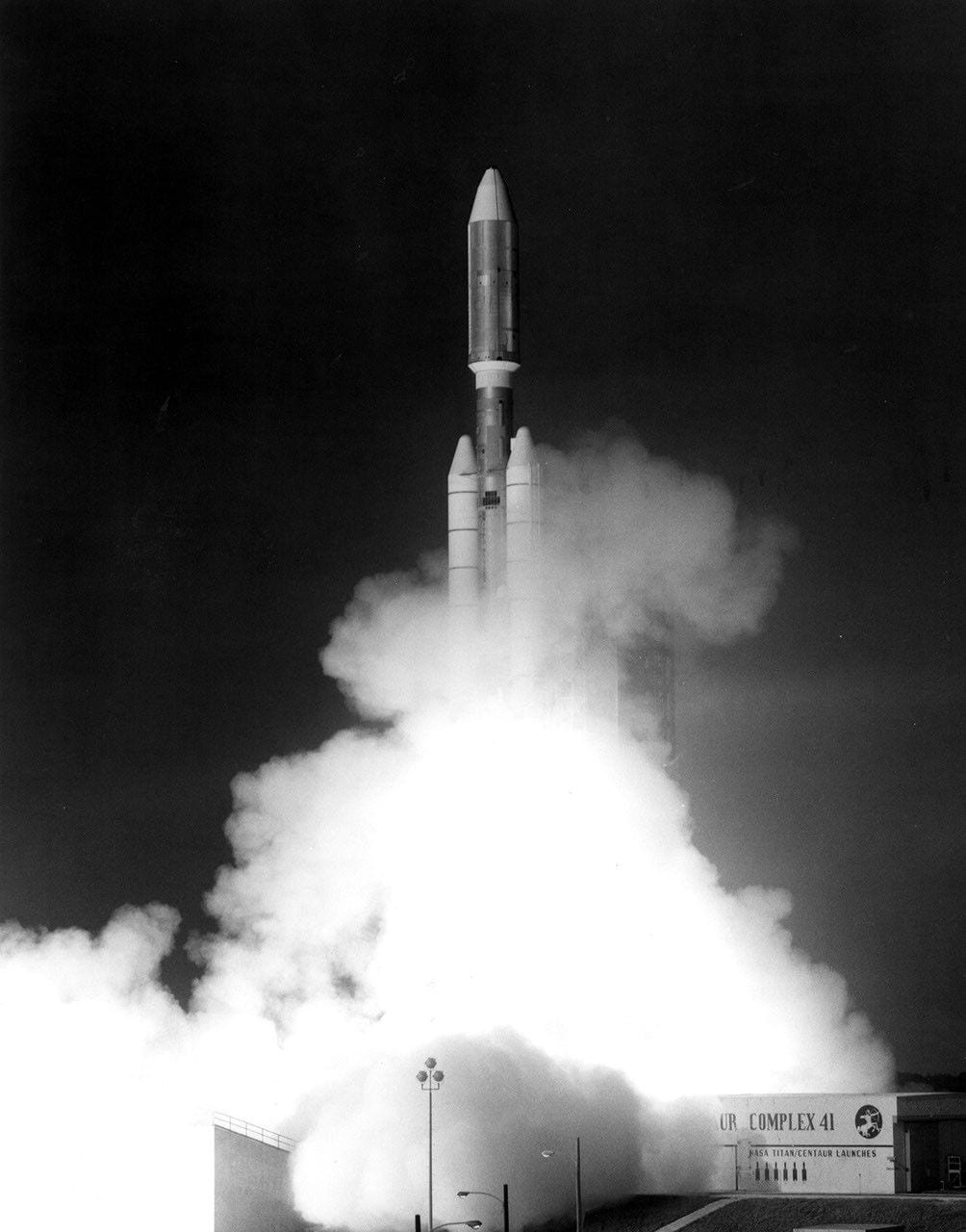
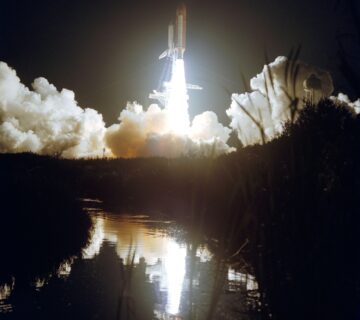
Voyager 1 lifted off from Cape Canaveral on Sept. 5, 1977, aboard a Titan IIIE-Centaur rocket. NASA designed the Voyager twins to take advantage of a rare alignment of the outer planets and to conduct close flybys. The launch came after Voyager 2’s departure, but Voyager 1 followed a faster trajectory and reached Jupiter first.
At Jupiter in 1979, Voyager 1 returned close-up observations that helped reveal the planet’s dynamic atmosphere, its thin ring, and active volcanism on Io. The mission also identified two previously unknown Jovian moons, Thebe and Metis. It then used Jupiter’s gravity to alter its path toward Saturn, where it made its closest approach in November 1980 and examined the planet’s atmosphere, rings, and moons. NASA’s mission overview records those encounters and the discoveries that made Voyager 1 a planetary-science mission before it became an interstellar probe.
Saturn was the end of Voyager 1’s planned planetary tour. The spacecraft’s trajectory took it north of the plane of the planets, away from the route to Uranus and Neptune. Voyager 2 continued on to those worlds, becoming the only spacecraft to visit them. Voyager 1’s path instead carried it into the outer reaches of the Sun’s influence, while the probe continued to send measurements back across an ever-growing gulf.
Crossing the heliopause and entering interstellar space
NASA scientists determined that Voyager 1 crossed the heliopause in August 2012. The heliopause marks the outer boundary of the heliosphere, the vast bubble shaped by the solar wind and the Sun’s magnetic field. Beyond it lies interstellar space, where the spacecraft samples particles and magnetic conditions in an environment no earlier probe had directly measured.
The distinction is useful because “leaving the solar system” can mean different things. Voyager 1 has passed beyond the heliosphere, but the Sun’s gravitational influence extends much farther, into the distant Oort Cloud. The one-light-day milestone is a communications and distance benchmark from Earth; it does not mark the edge of the solar system or a new boundary in space.
Voyager’s twin, Voyager 2, also operates outside the heliosphere, after crossing the boundary in 2018. The two spacecraft are traveling in different directions and at different speeds. NASA’s current Voyager location and status page tracks their positions and lists the instruments that remain active. Their measurements continue to provide rare direct observations from beyond the Sun’s protective bubble.
Keeping an aging spacecraft alive
Voyager 1 was built for a much shorter prime mission than the nearly half-century journey it has completed. It draws electricity from radioisotope thermoelectric generators, which convert heat from decaying plutonium into power. Output has declined over time, forcing mission engineers to shut down heaters, subsystems, and science instruments in a planned sequence intended to preserve the spacecraft and its remaining science capability.
In April 2026, NASA reported that engineers turned off Voyager 1’s Low-Energy Charged Particles experiment to conserve power. The instrument had measured ions, electrons, and other particles for almost the entire mission, helping characterize the interstellar medium beyond the heliosphere. NASA said two science instruments remained operating at that time: the magnetometer and the plasma-wave subsystem. The agency’s instrument update describes the tradeoff: every power-saving decision protects the mission’s ability to continue gathering data, but it also narrows the set of measurements the spacecraft can make.
The engineering challenge became more visible in the fall. NASA’s Jet Propulsion Laboratory reported that Voyager 1 briefly stopped communicating after two scheduled tracking attempts on Oct. 18 and 19 failed to detect its radio signal. Contact returned on Oct. 20. The team found that a group of thrusters had gone offline and backups had taken over, while it continued investigating the event.
In that same JPL update, NASA described a September power-saving procedure called the “Big Bang,” in which engineers replaced several powered devices with lower-power alternatives. The operation was intended to extend the period during which Voyager’s science instruments can continue working. It underscores that reaching the next distance record is only one part of the story: the mission’s daily work is also about keeping a 1970s spacecraft warm, correctly oriented, powered, and able to communicate.
Why Voyager still matters
Voyager 1’s scientific value comes from the unusual location it occupies and the decades-long baseline of observations it has built. Its instruments have measured changes in particles and magnetic fields as the probe moved from the outer heliosphere into interstellar space. Scientists can compare those readings with Voyager 2’s measurements from a different route, helping distinguish local conditions from broader patterns in the space between stars.
The spacecraft also carries the Golden Record, a 12-inch gold-plated copper disc assembled as a message about Earth and its inhabitants. The record is a cultural artifact rather than an instrument, but its presence reflects the mission’s dual character: Voyager was built to collect scientific data and also to represent humanity on a journey that would long outlast its original operational plan.
There is no expectation that Voyager 1 will suddenly accelerate, alter course, or communicate differently when it crosses one light-day. NASA’s recent mission reporting stresses that the probe will not detect a special boundary at that point. The milestone is meaningful from Earth because it makes the communications delay tangible: a question sent on Wednesday morning cannot receive a reply until roughly Friday morning, even if the spacecraft answers as soon as the message arrives.
Marking the milestone from Earth
NASA has invited the public to take part in “Shine Bright for Voyager’s Light-Day” after sunset on Nov. 17. Participants can flash the letters V-G-R, the Voyager mission’s call sign, in Morse code using a phone or a light. The gesture cannot be seen by Voyager from Earth, and it is not a communication link to the probe; NASA frames it as a symbolic, shared celebration of the mission.
On Nov. 19, NASA’s Jet Propulsion Laboratory plans to host a discussion with mission leaders and scientists about the spacecraft’s status, the science it continues to return, and the challenges of operating it across such a long distance. NASA’s media advisory lists the participants and the public viewing details.
The crossing itself will be quiet. No spacecraft will be visible in the sky, and no signal will arrive from Voyager at the instant it reaches the mark. Yet the timing captures an extraordinary engineering achievement: a machine launched before personal computers became commonplace will be more than 16 billion miles away, still communicating with Earth through a network of large antennas and a mission team that must work on a two-day round-trip clock.
When Voyager 1 reaches one light-day, the distance will be a number on NASA’s tracking systems. The implications are more human: every command will take a day to arrive, every reply another day to return, and the probe will continue into a region of space where no other human-made craft has traveled.
Sources
- NASA Science: What Is a Light-Day?
- NASA Science: Where Are Voyager 1 and Voyager 2 Now?
- NASA: One-Light-Day Activities and Nov. 19 Mission Discussion
- NASA Science: Voyager 1 Mission Overview
- NASA JPL: Voyager 1 Instrument Shutdown to Conserve Power
- NASA JPL: Power Conservation and October Communications Pause
- Associated Press: Voyager 1 Approaches One-Light-Day Distance from Earth
- NASA Photojournal PIA17464: Voyager 1 Launch (1977)
- NASA Images and Media Usage Guidelines



No comment