
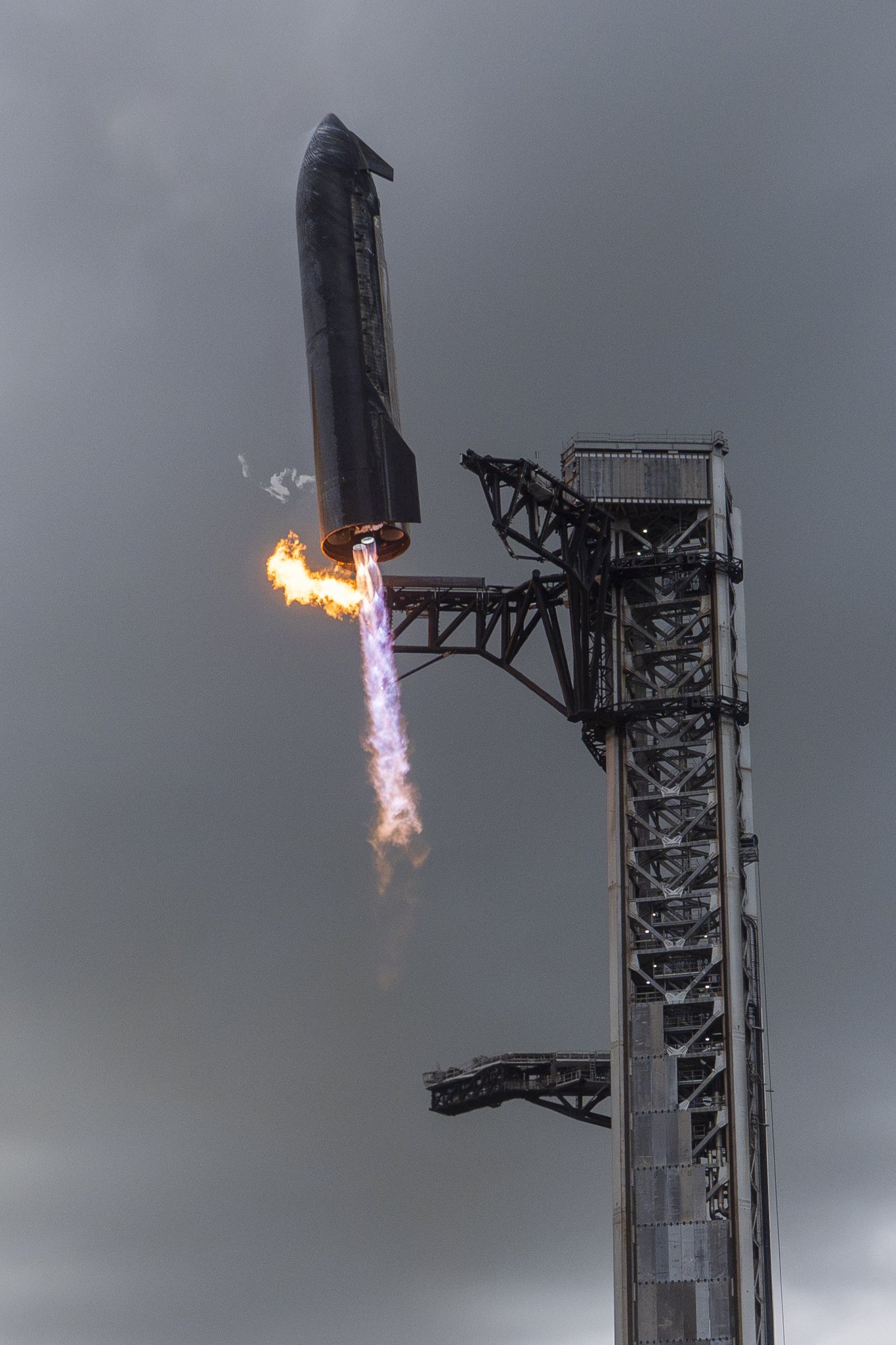
SpaceX’s Starship Flight 15 ended on Nov. 14 with a first-of-its-kind recovery: Ship 42 returned from orbit and was caught by the launch tower at Starbase, Texas. The spacecraft’s success capped a roughly 22.5-hour mission that also carried and deployed 26 Starlink V3 satellites. The result demonstrated a major part of SpaceX’s plan for a reusable upper stage, while leaving the paired booster recovery goal unfinished.
The mission was a step beyond Flight 14, which reached orbit in September but ended after roughly three hours. Flight 15 remained in orbit for about 14 circuits of Earth before returning to the same site from which it launched. Reuters reported the orbital leg at approximately 260 kilometers altitude and the total mission at more than 22 hours. The company’s Flight 15 mission page described the goal as bringing both Starship and Super Heavy back to the launch site for catch and recovery.
A long flight with a large payload
Ship 42 reached orbit on Nov. 13 and deployed all 26 Starlink V3 satellites. Space.com’s live coverage tracked the deployment and reported that the complete batch was out about 77 minutes after launch. Those payloads made the flight a revenue-generating mission as well as a vehicle test: SpaceX was testing a new way to put its larger satellites into orbit while collecting data on the vehicle that carried them.
The flight’s duration mattered because Starship had to remain in space, maintain its systems through an extended coast, and then execute a controlled return. For this test, the company planned a return to Starbase after about 22 hours rather than a splashdown far from the launch site. SpaceX’s target was to catch Ship with the tower’s two mechanical arms, part of a design intended to move the vehicle from landing to inspection and preparation without a conventional landing-leg recovery operation.
The upper stage’s return was not a routine landing. The vehicle had to reenter the atmosphere, manage heating and aerodynamic loads, then approach the tower at a controlled speed and attitude. Reuters reported that the ship completed 14 Earth orbits before the landing sequence. Space.com’s coverage described the return and the first tower catch as the principal milestone at the end of the mission. The successful catch gives SpaceX hardware and operational data that the company can examine before it decides what changes the next flight needs.
Ship 42 made the catch; Booster 22 did not
Flight 15’s headline achievement was one half of the planned two-stage recovery. Super Heavy Booster 22 was supposed to return to the launch site minutes after liftoff and be caught by the same tower system. That attempt was called off after a guidance or navigation issue, and the booster diverted to a controlled splashdown at sea. Reuters reported the booster could not return to the pad, while the Space.com mission coverage tracked the abort separately from Ship 42’s later return.
That distinction is central to evaluating the flight. SpaceX did not recover both stages, and the flight did not demonstrate a complete two-stage catch-and-reuse cycle. It did demonstrate that the upper stage could return from orbit and be captured at the launch site after a long mission. The booster outcome remains a separate engineering problem for the next test campaign, and the company has not established through this flight that both catches can be completed on one mission.
The two recovery attempts also took place on very different timelines. The booster’s return was planned for minutes after liftoff, while Ship 42 remained in orbit through the night and returned the next day. Flight 15 therefore tested a chain of operations extending from ascent and stage separation to payload deployment, orbital flight, atmospheric return and launch-site capture. It also gave the team a real mission on which the two recovery systems could be evaluated against their distinct demands.
Why the tower catch matters
SpaceX has designed Starship and Super Heavy as a reusable transportation system. Recovering a booster and upper stage at the launch site could reduce the time and infrastructure required to prepare them for another flight, though a catch alone does not prove that a stage is ready to fly again. The vehicles still need inspection, maintenance, any necessary repairs, and a safe route through regulatory review before another launch.
The Flight 15 result should therefore be read as a major test milestone, not as proof of mature, rapid reuse. SpaceX will need repeated recoveries, post-flight inspections and subsequent flights of recovered hardware to show how well the system performs over time. The first successful Ship catch establishes that the tower recovery approach can work under actual flight conditions; subsequent flights will show whether the result can be repeated and what refurbishment the spacecraft requires.
SpaceX’s ambitions for Starship extend beyond satellite deployment. NASA selected the vehicle as a lunar lander for the Artemis program, and the company has described Starship as a system for transporting crew and cargo beyond Earth orbit. Those future uses depend on many capabilities that Flight 15 did not test, including crew operations and lunar missions. But a vehicle that can return to its launch site after orbital flight would be a significant building block for a system designed around reuse.
What the mission proved—and what remains open
The confirmed outcomes were specific: Ship 42 reached orbit, deployed all 26 Starlink V3 satellites, completed an extended flight of approximately 22.5 hours, and returned to Starbase for a tower catch on Nov. 14. The planned Booster 22 catch was aborted, so that stage was not recovered at the launch site. These outcomes make Flight 15 both a successful upper-stage recovery demonstration and an incomplete test of the company’s full two-stage recovery plan.
Questions remain about the booster guidance issue, the condition of Ship 42 after launch and reentry, and how quickly either vehicle can be prepared for another flight. The tower catch makes inspection possible at the launch site, but the extent of any work required after the mission is not yet established by the catch itself. SpaceX has not announced a definitive reuse schedule for Ship 42.
Flight 15 also delivered operational value through its Starlink payload. SpaceX reported that all 26 V3 satellites were deployed, a payload more than ten times the capacity added by a typical Falcon 9 Starlink launch according to the company’s third-quarter 2026 results. The result connects Starship’s long-term case for reuse to a near-term commercial role: carrying larger batches of the next-generation satellites that will expand the Starlink network.
For now, the most defensible conclusion is measured. Flight 15 showed that a Starship upper stage could complete an extended orbital mission and be caught by its launch tower on return. It did not show that both stages can be recovered together, that either stage is ready for immediate reuse, or that the vehicle has completed the much broader work required for operational crewed or lunar missions. The data from the flight and its post-flight inspections will determine how much closer SpaceX is to turning an impressive recovery into a repeatable launch system.
Sources
- SpaceX, Starship Flight 15 mission page
- Reuters, Starship returns from orbit and is caught by the launch tower, Nov. 14, 2026
- Space.com, Starship Flight 15 live mission coverage
- Space.com, Flight 15 launch and recovery attempt coverage
- SpaceX, Third-quarter 2026 results
Featured image: SpaceX’s Ship 42 after its Flight 15 tower catch at Starbase, Nov. 14, 2026. Photo by SpaceX, shared under Creative Commons Attribution 4.0 via Wikimedia Commons. No image edits. This attribution does not imply SpaceX endorsement.







No comment