
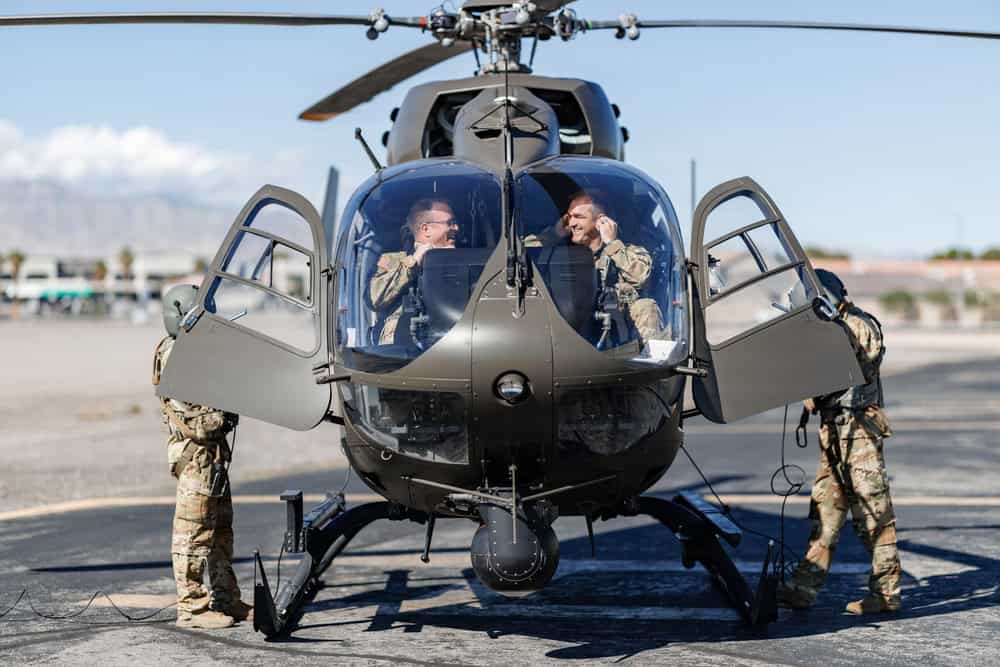
Chief Warrant Officer 5 Kevin Keeler’s last Army helicopter flight took place Oct. 23 at Cheyenne Air Center in North Las Vegas, closing a flying career that spanned three rotary-wing aircraft and more than 5,700 hours. The Nevada Army National Guard aviator is scheduled to retire in March 2027 after more than 34 years of military service, according to a November account from Nevada Joint Force Headquarters Public Affairs.
Keeler’s final flight was the latest milestone in a career shaped by very different kinds of missions: medical evacuation, overseas deployments, wildfire support, flood response, missing-person searches, maintenance test flights and instruction. His record offers a view of how Army aviation work moves between combat readiness and domestic response, often relying on the same crews and aircraft to serve very different needs.
A career that began outside the cockpit
Keeler enlisted in May 1992 as a fire support specialist, a role involving coordination of artillery. He remained on active duty through 1996. After moving to Carson City, Nevada, he joined the Army National Guard as a flight operations specialist with the 717th Medical Company, a unit that flew UH-1 Huey helicopters. He became a warrant officer in 1998 and began the progression that would take him from flight operations into the cockpit and, later, into pilot training and aviation standards work.
His service included deployments to Kosovo and Macedonia with the 717th Medical Company, followed by two deployments to Afghanistan. There he flew medical evacuation missions and worked as an aviation safety officer, helping crews identify hazards and manage risk. The assignments put him in both operational and safety roles: carrying out missions while also helping other aviators prepare for them and learn from them.
The flight-hour total at the end of his flying career was spread across three distinct helicopter families. Keeler logged more than 2,400 hours in the OH-58A/C Kiowa, about 800 in the UH-60 Black Hawk and roughly 2,400 in the UH-72A/B Lakota. The Army National Guard’s account lists more than 5,700 hours overall. That experience across scout, utility and light-utility platforms gave him a broad base for the instructor and standardization duties he later took on in Nevada.
Search and rescue during Oregon’s Bootleg Fire
One of the missions that stayed with Keeler’s family came during the 2021 Bootleg Fire in Oregon. While supporting wildfire operations, he and an Oregon Department of Forestry ranger searched for a firefighter who had become separated from the crew. A contemporaneous National Guard report said they located the firefighter after about an hour, roughly a mile and a half from the crew, and relayed the location to a ground team that brought him out.
Keeler described that kind of work as part of the job. His wife, Jannaria, saw the human consequence differently: a person who had been separated from colleagues was able to get back to them. The 2026 account says she still remembers that rescue as a defining moment. The episode illustrates the way Army Guard aviation can shift from reconnaissance or fire-support coordination to a time-sensitive search, with pilots working alongside local agencies and ground responders.
Keeler also flew an OH-58 Kiowa to Louisiana to support recovery efforts after Hurricane Katrina. In Nevada, his assignments included counterdrug operations, flood response in both the northern and southern parts of the state, missing-person searches and wildfire missions. These operations called for crews to adjust to changing weather, terrain, visibility and coordination needs rather than follow a single routine mission profile.
From pilot to instructor and standardization officer
As Keeler’s career progressed, his work increasingly included preparing other aviators. He served as an instructor pilot, maintenance test pilot and aviation maintenance officer. A maintenance test pilot checks an aircraft after maintenance work to confirm that it performs as expected before it returns to other duties; an instructor helps pilots build and maintain the skills required for unit missions.
His later role as Nevada’s State Aviation Standardization Officer involved working with aviation units in northern and southern Nevada, reviewing records, updating procedures and mentoring pilots. Standardization work is less visible than a rescue or a deployment, but it helps ensure that crews across a state’s aviation force train to consistent procedures and remain ready for both overseas support and domestic emergencies.
Keeler received two Air Medals, three Humanitarian Service Medals and the Master Army Aviator Badge, according to the Guard’s report. The honors reflect different parts of a career that combined operational flying, humanitarian response and the transfer of experience to younger pilots.
A career across changing cockpit tools
Keeler’s flying years also tracked a significant shift in the tools available to military helicopter crews. He recalled moving from paper maps and analog instruments to digital displays, tablet-based flight planning and more capable autopilot systems. Those changes altered how crews prepared, navigated and managed information, but they did not eliminate the need for judgment when communications or other support were unavailable.
He remembered flying in Afghanistan in 2003 without satellite communications. After a crew crossed a ridgeline, it could lose contact with its base until it returned. That meant pilots and crews sometimes had to make decisions without immediate guidance from the command post. Keeler later carried those lessons into his safety and instructor roles, where experience could help others anticipate what they might face away from direct support.
The perspective is relevant to his final assignment. As State Aviation Standardization Officer, he was responsible for helping maintain flight standards across units rather than focusing solely on his own aircraft. His official account emphasized learning from each flight and passing lessons along. That approach makes the end of one pilot’s flying career part of a larger handoff: the next generation takes over with the benefit of procedures, mentorship and hard-earned experience.
Final flight, with a transition still ahead
Keeler’s final flight took place in a UH-72A Lakota at the Cheyenne Air Center. The aircraft is part of the platform mix he accumulated hours in alongside the Kiowa and Black Hawk. The Guard documented the occasion with a water-cannon salute from the North Las Vegas Fire Department and photos of family members watching the Lakota fly.
The date marks the end of his flying duties, but not the immediate end of his military service. Keeler is expected to retire in March 2027. Until then, his transition allows the state’s aviation leadership to pass responsibilities to other pilots, including those he has trained and advised. The final flight therefore closes one chapter while leaving a period for continuity and transfer of standards.
For Nevada Army aviation, the numbers tell only part of the story. More than 5,700 hours captures time spent aloft, but not the full range of work behind them: evacuating wounded troops, searching for a missing firefighter, supporting disaster response, checking aircraft after maintenance and preparing other pilots to fly safely. Keeler’s last flight put a visible marker on that record; the systems and people he helped train will continue carrying it forward.
Sources
- Nevada Joint Force Headquarters Public Affairs: “After 5,700 flight hours, Nevada Guard aviator completes final flight” (Nov. 3, 2026).
- Nevada Joint Force Headquarters Public Affairs: “Nevada Army Guard pilot credited with locating missing Oregon firefighter” (July 23, 2021).
- Featured photo: DVIDS image 10068042, U.S. Army National Guard photo by Staff Sgt. Adrianne Lopez.
- DVIDS public-use and copyright notice.





No comment