
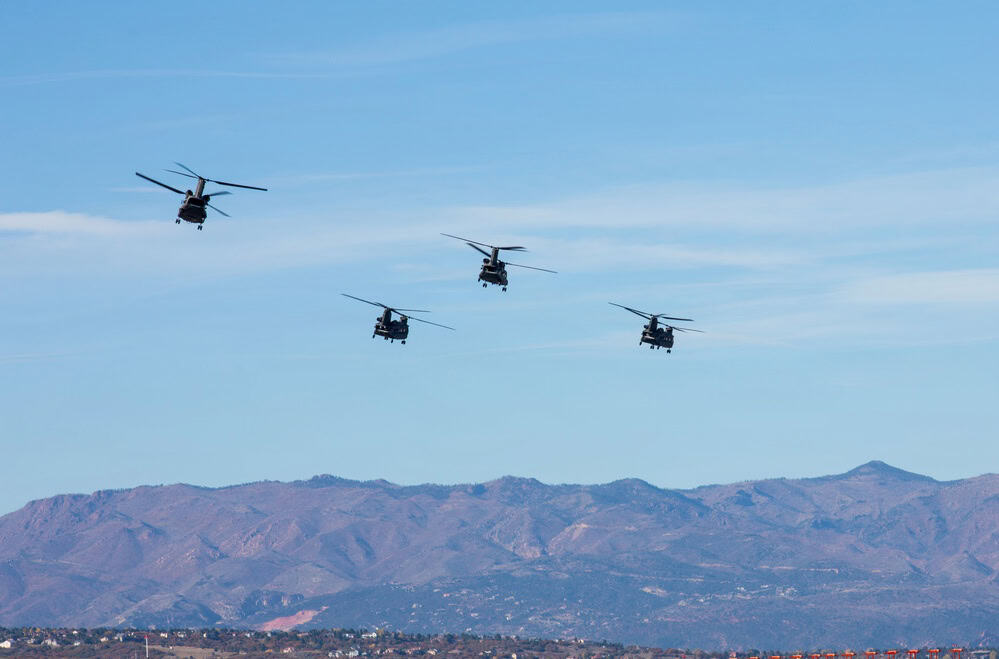
The 4th Combat Aviation Brigade at Fort Carson, Colorado, received four CH-47F Block II Chinooks in an Oct. 27 delivery flight, bringing a substantial upgrade in heavy-lift capability to one of the Army’s aviation brigades. The aircraft arrived at Butts Army Airfield, according to a Nov. 12 release from the 4th Infantry Division Public Affairs Office. The delivery marks the brigade’s entry into the Block II configuration; it does not establish that these are the Army’s first Block II aircraft overall.
The delivery is significant because the Chinook remains the Army’s heavy-lift workhorse for moving troops, equipment and supplies. The Army’s 2024 acquisition portfolio describes the CH-47F as its only heavy-lift cargo helicopter and says Block II is intended to add payload and operational reach. The 4th CAB release says the new aircraft can carry more weight farther, while its details do not state a specific payload figure for the four delivered helicopters. 4th CAB’s delivery announcement | Army Acquisition Program Portfolio, 2024
A delivery to a brigade with a broad mission
The receiving unit is the 4th Combat Aviation Brigade, part of the 4th Infantry Division. The Chinooks will be operated and maintained by brigade personnel at Fort Carson. Army aviation brigades use heavy-lift helicopters to move personnel and outsized cargo, support air assault and sustain units that may be separated from fixed infrastructure. Those roles can include routine training and domestic support as well as deployment missions; the Nov. 12 release did not identify a specific operation or deployment for these four aircraft.
The Fort Carson announcement focuses on the practical link between lift and logistics. The Army says Block II’s increased payload and reach can allow crews to move loads in fewer sorties. That can reduce the number of trips needed for a given movement, though the actual number depends on the cargo, distance, weather, altitude and operating conditions. The Army release offered the example that some tasks previously requiring two missions could be completed in one, but it did not publish a load plan or test data for the aircraft that arrived at Fort Carson.
The Army’s program portfolio gives useful context without substituting for unit-specific performance data. It lists a maximum gross weight of 54,000 pounds for the Block II configuration and describes increased payload capacity and reach compared with the existing CH-47F. Maximum gross weight is the aircraft’s total weight at takeoff, including the aircraft, crew, fuel and cargo; it is not the same as cargo capacity. The portfolio’s figure is a program description, not a published weight or payload measurement for the Fort Carson aircraft.
The cockpit and controls are part of the upgrade
The delivery release points to cockpit and flight-control changes alongside the lift improvements. The CH-47F Block II includes the Common Avionics Architecture System, or CAAS, and digital flight controls. The Army’s acquisition portfolio separately describes the CH-47F’s CAAS digital cockpit and Digital Automatic Flight Control System, which are intended to improve controllability in reduced visibility, brownout conditions and high winds. A brownout occurs when rotor wash lifts dust or sand and obscures a pilot’s view during a low-level landing or takeoff.
For helicopter crews, degraded visual environments can make the final portion of a landing especially demanding. A digital cockpit can consolidate flight and systems information, while flight-control assistance can help a pilot manage the aircraft when outside visual cues are poor. Those features do not remove the need for trained crews, procedures or judgment. The Army’s description establishes the design purpose of the systems; it does not report performance results from the four Fort Carson aircraft in dust, wind or operational trials.
The aircraft are also described as wired for future autonomous landing technology. That wording signals preparation for possible later integration, not that the four helicopters arrived with autonomous landing capability already operational. The Fort Carson release gives no schedule for that integration or identifies a specific system. Boeing has separately reported flight testing of automated approach-and-landing technology on a CH-47F, but that test is not evidence that the same capability has been installed or cleared for use on the 4th CAB aircraft.
That distinction matters as Army aviation modernizes older aircraft families through both new production and upgrades. Block II is a major evolution of the Chinook platform, but the delivery announcement describes a fielding event rather than a new flight-test result. The release does not identify aircraft serial numbers, unit training dates, initial operating milestones or the number of additional Block II aircraft planned for the brigade.
Fielding turns program changes into unit capability
Receiving aircraft is only the visible start of fielding. Crews need training on the new configuration, maintainers need to establish servicing practices, and the brigade must integrate the helicopters into its normal scheduling and mission planning. Those steps determine how quickly a delivery becomes routine unit capacity. The 4th Infantry Division release says aviators and maintainers are beginning that work, but does not give a date when the aircraft will be fully available for operational tasking.
The Army has previously described Block II as part of its effort to extend Chinook lift and operational reach. In its 2024 portfolio, the service said the aircraft supports troop and equipment transport, routine aerial sustainment, and secondary missions that include medical evacuation, search and rescue, parachute drops, disaster relief and aircraft recovery. The Fort Carson delivery therefore connects a long-running program objective to a specific unit’s fleet, while leaving the details of local readiness and employment for later reporting.
For the 4th CAB, the four-aircraft arrival establishes a tangible starting point: the brigade now has Block II Chinooks on its airfield and is preparing its people to operate and support them. The next milestones to watch are crew qualification, maintenance integration, follow-on deliveries and any Army updates on how the configuration performs in unit training. Until those details are released, the clearest measure is the confirmed fielding event itself: four aircraft delivered to Fort Carson, with the service’s stated goal of carrying heavier loads farther and improving cockpit support in difficult flying conditions.
Sources
- 4th Infantry Division Public Affairs, “4th CAB Welcomes Game-Changing Block II Chinooks to Fort Carson,” Nov. 12, 2026.
- DVIDS photo 10082811, taken Oct. 27, 2026; public domain; U.S. Army photo by Staff Sgt. Kayla Cheesman-Miles.
- U.S. Army, Acquisition Program Portfolio 2024, “Chinook Cargo Helicopter (CH-47F & CH-47F Block II).”
- Boeing, CH-47F supervised-autonomy landing flight test, April 2026; cited only as separate program context.





No comment