
Blue Origin has introduced a third stage for its New Glenn rocket and says it already has a customer for a flight to cislunar space in 2028. The company’s Nov. 5 announcement identifies the customer as a government entity and gives no agency name or payload details. The new stage, called GS3, is intended for missions that need the launch vehicle to deliver a payload directly to a distant orbit or put it on a trajectory toward the Moon or beyond Earth.
What direct delivery changes
A satellite bound for geostationary orbit often starts in a transfer orbit and uses its own propulsion to reach its final orbit. Blue Origin says GS3 will allow New Glenn to deliver satellites directly to geostationary orbit. For a customer with a spacecraft designed around direct delivery, that can shift some of the work of reaching the final orbit from the spacecraft to the launch vehicle. The company also lists medium Earth orbit, trajectories that escape Earth, and deployments involving more than one payload among the stage’s intended uses.
Blue Origin projects that the 9×4 version of New Glenn with GS3 can carry up to 14 metric tons to geostationary orbit or 20 metric tons to translunar injection. It gives corresponding figures of 8 and 10 metric tons for the 7×2 version. Translunar injection places a spacecraft on a path toward the Moon. The figures are company projections for different mission destinations. Blue Origin says the third stage fits below the payload fairing so the volume available to customers stays the same.
A test in Texas and a flight on the calendar
Blue Origin plans to power GS3 with its BE-7 engine, which it describes as suited to missions with multiple burns and extended periods between them. The company also reported a ground test of the stage’s composite liquid-hydrogen tank at Launch Site One in Texas. It said the tank held its maximum expected operating pressure for two and a half hours and 150 percent of that pressure for ten minutes. Those results describe the tank test. The announcement lists 2028 as the scheduled launch year for the contracted mission.
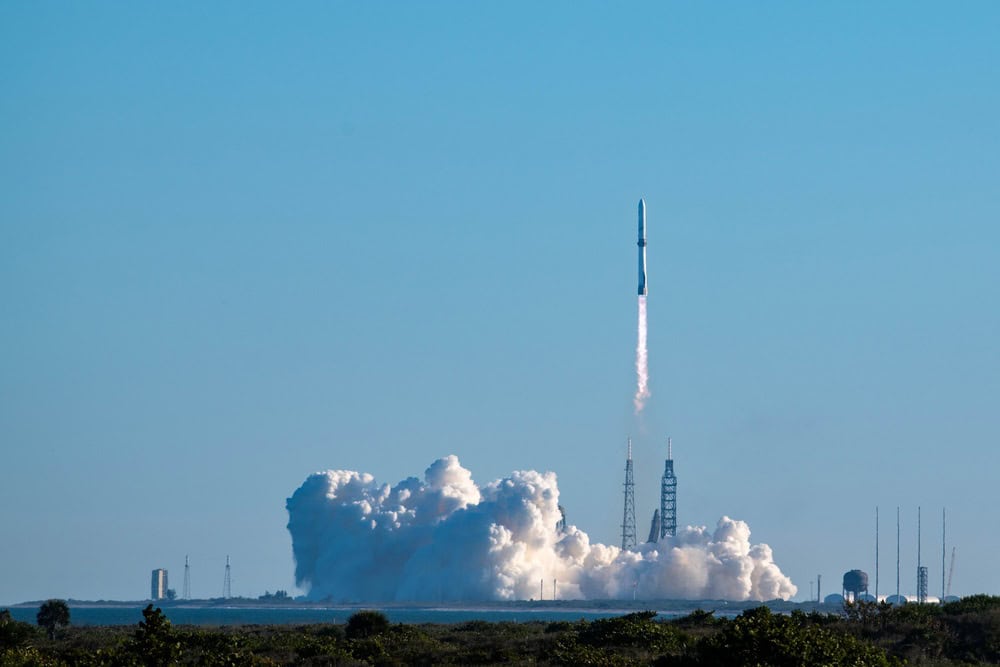
The launch photograph accompanying this report shows New Glenn at Cape Canaveral in November 2025, a year before the third-stage announcement. Blue Origin says GS3 can support lunar science and exploration and that its lunar lander architecture can operate independently of the new stage. The 2028 mission is the first customer commitment disclosed in the announcement.
Sources
Blue Origin’s Nov. 5 New Glenn GS3 announcement
DVIDS archival photograph 9387521, public domain. U.S. Space Force photo by Samuel Becker.





No comment