
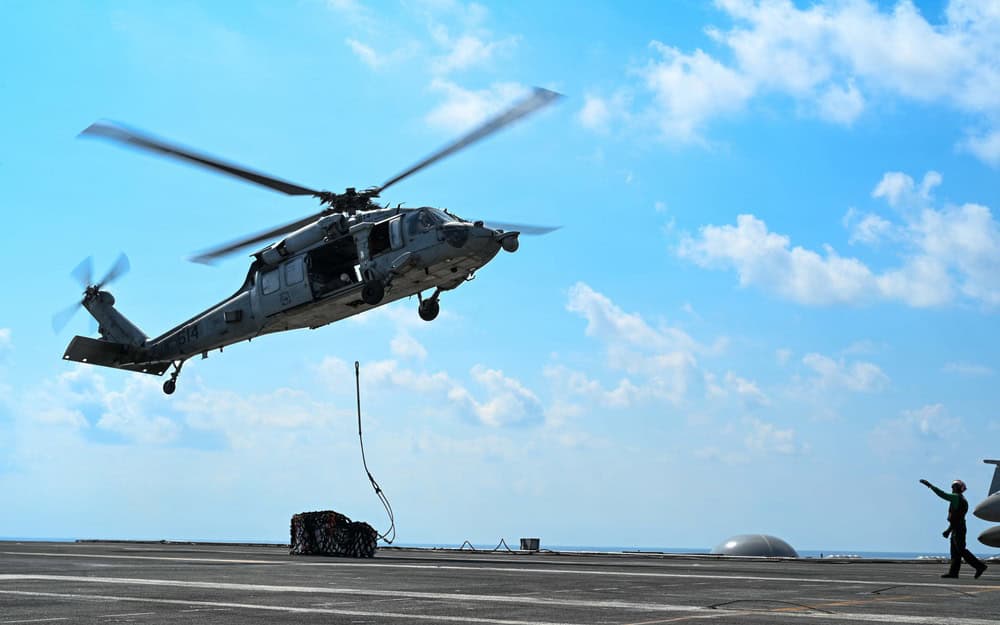
The aircraft carrier USS Theodore Roosevelt (CVN-71) and its embarked carrier air wing are now operating in the U.S. 5th Fleet area, a deployment milestone documented in Navy imagery released Nov. 16. The official photo record shows an MH-60S Sea Hawk from Helicopter Sea Combat Squadron 12 transferring supplies during a vertical replenishment at sea with Roosevelt and USS George Washington (CVN-73). The Navy caption says Roosevelt is deployed to support maritime security and stability in the Middle East.
The arrival adds another carrier strike group to a region that already included two U.S. carriers. The Associated Press reported that Roosevelt reached the Middle East on Sunday, Nov. 15, citing a U.S. official; USNI News reported that the ship entered the 5th Fleet area that day. The Navy’s public photo record the next day independently places the ship in that operating area. The Navy has not said in that release that the arrival signals a particular combat mission.
A carrier deployment is also an aviation deployment
Theodore Roosevelt is the flagship of Carrier Strike Group 9, with Carrier Air Wing 11 embarked. The Navy’s official CVW-11 overview lists nine squadrons and a mix of F/A-18E/F Super Hornets, EA-18G Growlers, E-2D Hawkeyes, V-22 Ospreys and MH-60R/S Sea Hawks. Together, those aircraft support strike, electronic warfare, airborne command and control, transport and helicopter missions from the carrier.
The air wing’s presence is what makes a carrier different from a ship that simply carries aircraft as cargo. Its flight deck, hangar, maintenance shops and aviation crews form a mobile airfield able to operate at sea. Aircraft are launched and recovered from the deck, inspected and serviced aboard ship, then prepared for subsequent sorties. The Navy’s public information page describes Roosevelt as a Nimitz-class nuclear-powered carrier; the ship is designed to operate with its embarked air wing as a component of the strike group.
The exact mix and readiness of individual aircraft can change during a deployment. The official CVW-11 page describes the wing’s aircraft types, while the Nov. 16 photo set offers a more specific view of the current operation: it includes the MH-60S from HSC-12 moving supplies between the two carriers. The image documents a logistics evolution, not a combat sortie, and the caption does not identify any additional mission tasking.
Why the helicopter transfer matters
The photographed maneuver is a vertical replenishment, commonly shortened to VERTREP. A helicopter carries cargo between ships, allowing supplies to move without the vessels pulling alongside one another. The image shows a suspended load being lowered toward the flight deck. This kind of transfer supports the day-to-day work of keeping a carrier and its aviation units operating at sea, including the movement of parts, equipment and provisions.
HSC-12’s Sea Hawks are part of the same carrier air wing whose fixed-wing aircraft perform the carrier’s most visible flight operations. Their utility extends beyond cargo movement: the Navy lists MH-60R and MH-60S aircraft within CVW-11’s broader composition. The two helicopter variants support distinct fleet tasks, and the Navy source identifies the aircraft in the Nov. 16 photo specifically as an MH-60S assigned to HSC-12. The caption says it conducted the replenishment with both Roosevelt and George Washington.
That detail matters because the photo captures a practical operational connection between ships, not merely an aircraft portrait. Carrier operations depend on a network of people and platforms: deck crews, maintainers, aircrew, aviation support departments and other ships. A helicopter transfer can move cargo while the carrier group remains underway, without interrupting the broader shipboard routine for a pier-side resupply.
Three carriers in the region
The Associated Press reported that Roosevelt’s arrival brought the number of U.S. aircraft carriers in the Middle East to three, alongside USS George H.W. Bush and George Washington. The Washington Post also reported the carrier’s arrival and described it as an increase in U.S. naval presence. Those reports provide regional context; the Navy photo caption itself uses the narrower wording that Roosevelt is operating in the 5th Fleet area to support maritime security and stability.
Roosevelt departed San Diego in September with other ships, according to the AP report. The Navy’s Nov. 16 image record shows it operating alongside George Washington, but does not provide a detailed itinerary, deployment schedule or planned duration. Nor does the imagery establish that the carrier’s aircraft have been assigned a specific operational task. The available public information supports the deployment’s location and the air wing’s composition, while leaving those operational details unspecified.
That distinction is important in covering a military deployment. A carrier’s arrival may change the forces available in a region, but an arrival report is not itself a report of combat activity. The Navy source characterizes the deployment’s purpose as support for maritime security and stability. Independent reporting has connected the broader presence to regional tensions, but the Navy image record does not announce an operation, target or change in rules of engagement.
What the photo shows—and what it does not
The featured image is an authentic U.S. Navy photograph distributed through the Defense Visual Information Distribution Service. DVIDS identifies it as photo 10097924, taken Nov. 16, 2026, and marks it public domain. The original file is listed at 7,808 × 4,880 pixels and 2.61 MB. The full-frame derivative used here measures 1,000 × 625 pixels and 154,087 bytes; it preserves the original aspect ratio and is not cropped or enlarged.
The image’s caption identifies the helicopter, squadron, two carriers, date and replenishment activity. It does not show or establish a combat mission. The credit and non-endorsement notice are retained with the image: “The appearance of U.S. Department of War visual information does not imply or constitute endorsement.”
For naval aviation, Roosevelt’s entry into the 5th Fleet area is a fresh deployment update, while the photo offers a concrete look at the air wing’s routine support work at sea. It shows one part of a carrier group’s aviation system in motion: an MH-60S moving supplies between ships as the carrier and its air wing continue operating in the region.
Sources
- U.S. Navy / DVIDS: USS Theodore Roosevelt Enters U.S. 5th Fleet Area of Operations, photo 10097924 (Nov. 16, 2026)
- U.S. Navy, Naval Air Force U.S. Pacific Fleet: Carrier Air Wing 11
- U.S. Navy, Naval Air Force U.S. Pacific Fleet: USS Theodore Roosevelt
- Associated Press: Third American aircraft carrier arrives in the Middle East, US official says (Nov. 16, 2026)
- The Washington Post: Third U.S. aircraft carrier arrives in Middle East as Iran blockade continues (Nov. 16, 2026)
- DVIDS copyright and public-use limitations





No comment