
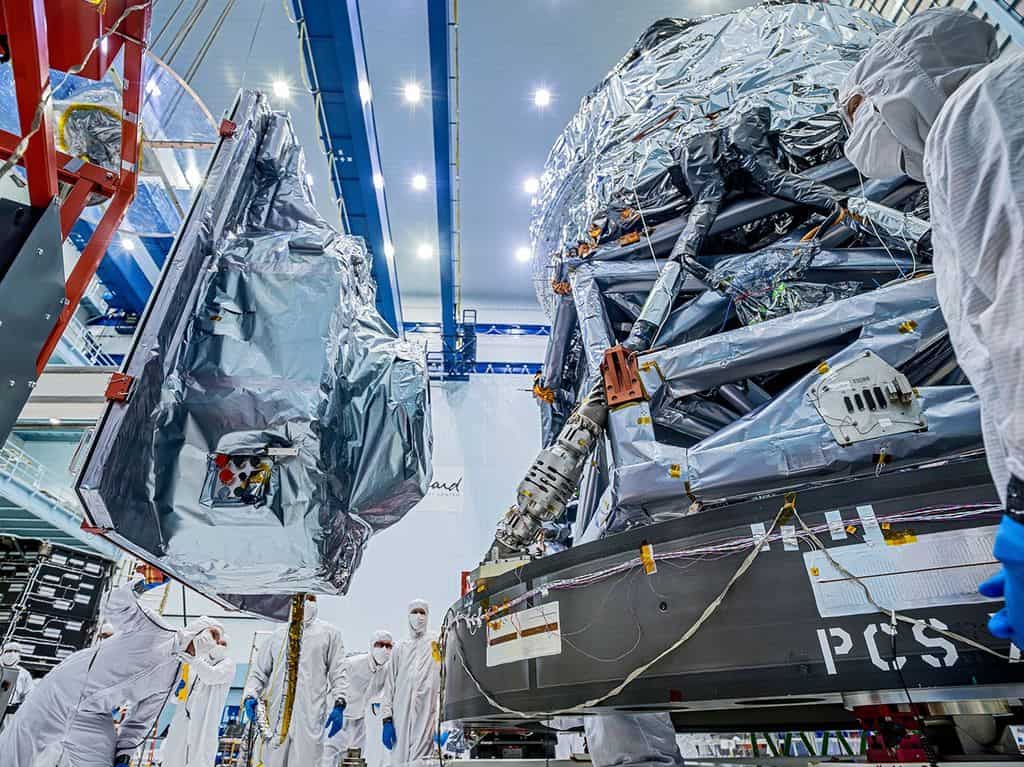
NASA’s Nancy Grace Roman Space Telescope has completed a key alignment milestone during its science commissioning phase, refining how the observatory’s instruments and guidance system work together. The team reported the result Nov. 13 after test observations helped map the positions of stars across Roman’s detector layout. That internal map is essential to pointing the telescope accurately and holding it steady as it gathers wide-field infrared data.
The work is a step beyond the observatory’s earlier ground alignment. NASA says launch vibration, temperature changes and the transition to weightlessness can shift optical components by small amounts. Commissioning observations let engineers and scientists measure those shifts in the actual operating environment and update the reference information used to guide observations. The milestone was described in NASA’s Nov. 13 Roman mission update.
A telescope that needs an unusually stable view
Roman’s optical system and instruments were aligned on the ground before launch, but that work could not fully account for the changes that occur during launch and in space. NASA says the team has been making test observations, comparing the measured locations of stars in Roman’s images with the positions predicted by its internal map. The difference gives the team information it can use to adjust future pointing and correct small drifts.
For Roman, that precision matters because its Wide Field Instrument is designed to image a large patch of sky while keeping fine detail. The telescope’s guidance system must know where guide stars fall on its detectors so it can orient the observatory and maintain its aim. NASA’s mission team says Roman must be substantially more stable than Hubble or Webb to deliver the measurement precision its science requires.
The alignment work also concerns how the two instruments share the observatory’s optical system. Roman’s Wide Field Instrument is both its main survey camera and part of its guidance approach. The Coronagraph Instrument, meanwhile, is designed to suppress a star’s light so scientists can study much fainter objects nearby, including planets and dusty disks. The instruments look at adjacent areas of the sky, and Roman can use both at once.
The Wide Field Instrument also helps guide Roman
NASA says the Wide Field Instrument has 18 detectors that need to work together when the observatory locks onto guide stars. If the internal map predicts that a star should land in one detector window but it actually falls elsewhere, the discrepancy can complicate guiding. Mapping the detector positions precisely gives the team a more reliable reference for aiming Roman and correcting minute motion during observations.
The camera’s scale is a central part of Roman’s design. NASA describes the instrument as a 300-megapixel infrared camera with the angular resolution of Hubble and a field of view at least 100 times larger. Each exposure will cover an area larger than the apparent size of the full Moon. That combination is intended to let Roman survey large areas quickly while still resolving details needed for studies of dark energy, the distribution of matter, and planets outside the solar system.
Those goals depend on more than a large detector array. NASA’s Roman team says the observatory must hold very steady during individual observations, and the updated internal map is part of making that possible. The alignment milestone therefore supports both the mission’s broad surveys and the more demanding observations planned for the Coronagraph, which will need to distinguish a planet’s faint light from the much brighter star it orbits.
Alignment is one part of commissioning
Roman entered its science commissioning phase in October, after a comprehensive checkout and refinement of the observatory and its primary instrument. NASA said that phase would use planned test observations to characterize performance, calibrate how instruments respond to light and refine image quality. The Nov. 13 update describes a specific result within that broader process: the alignment map now reflects how Roman’s instruments are arranged and operating after launch.
NASA says the next steps include exercising more than 3,000 small moving parts in the Wide Field Instrument’s deformable mirrors. Those mirrors are part of the Coronagraph’s starlight-control system. By changing their shape, the instrument can redirect unwanted starlight while preserving light from nearby planets. NASA has demonstrated the method in laboratory testing; applying the later stages with real stars and planets in space is an important objective for the mission.
The alignment update does not mean Roman has completed commissioning or begun its full science survey. Rather, it reports that the team has measured and corrected an important internal geometry problem so later testing can proceed with a more accurate map. The commissioning program will continue to test how the observatory points, tracks, focuses and records incoming light before routine science operations begin.
What the milestone enables
Roman’s survey strategy depends on repeating precise observations over large regions of sky. A stable guide-star reference helps the telescope place those observations where planned, while the Wide Field Instrument’s large detector array captures broad views in a single exposure. The Coronagraph adds a different capability: it will test methods for observing objects close to bright stars, a problem that has limited direct studies of exoplanets and circumstellar material.
NASA’s update frames the internal alignment as a prerequisite for getting the most from both instruments. The work links engineering measurements to science quality: if the observatory’s model of its own optical path is accurate, the team can place targets more reliably and account for small shifts. The careful mapping now underway will inform subsequent commissioning tests and help establish the observatory’s performance baseline.
The milestone is a reminder that a space telescope’s science readiness is built through a sequence of checks, not a single switch-on. Roman’s mirrors, detectors, guidance sensors and Coronagraph must operate as one instrument system. The Nov. 13 update records a concrete step in that process: NASA has brought the instruments into precise internal alignment and is using test observations to refine the telescope’s map before science operations.






No comment