
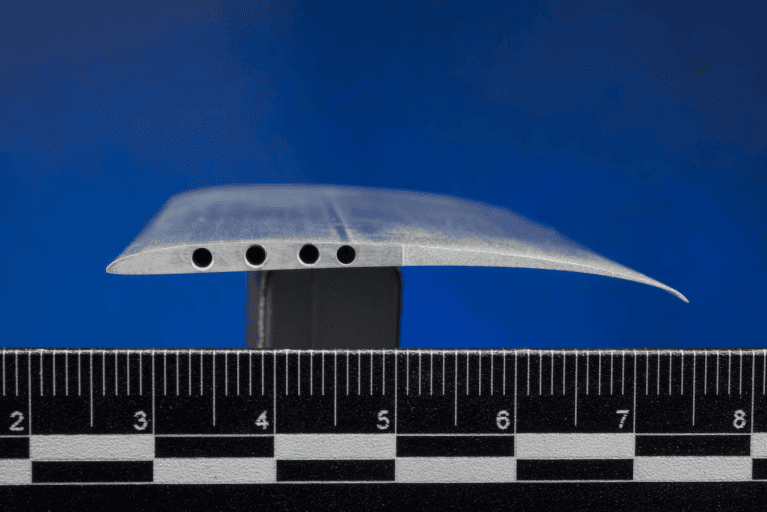
NASA researchers are testing a slimmer rotor-blade profile that could give future helicopters on Mars a much longer reach. The optimized airfoil, called roamx-0201, has shown stronger aerodynamic performance than the blade profile flown by Ingenuity in computer simulations and wind-tunnel tests. NASA says the redesign could help a future Mars helicopter travel as far as 18.7 kilometers in one flight while carrying science instruments. That figure is a projected capability, not a flight result: roamx-0201 has not flown on Mars, and the design still needs development before it is ready for a mission.
A new shape for a difficult atmosphere
The work tackles a problem that makes powered flight on Mars unlike ordinary helicopter operations on Earth. The Martian atmosphere is extremely thin, so a rotor must move through much less air to generate lift. Ingenuity proved that a small, lightweight aircraft could take off and fly in those conditions, but its rotor system had to spin rapidly and was designed around a narrow set of operating requirements. For later rotorcraft, researchers want more aerodynamic performance so aircraft can cover greater distances and carry useful scientific instruments.
NASA Ames Research Center developed roamx-0201 with collaborators from Imperial College London and Nagoya University. The profile is thinner and more asymmetrical than the CLF5605 airfoil used on Ingenuity. An airfoil is the cross-sectional shape of a wing or rotor blade; small changes to that shape can alter how air flows over it, how much lift it produces and how much resistance it creates. The design team used optimization algorithms and simulations tuned to Martian flight conditions to select a shape for further study.
What the comparison found
The researchers compared the Ingenuity airfoil, CLF5605, with roamx-0201 at a Reynolds number of 20,000 and a Mach number of 0.60 across a range of angles of attack. Those conditions put the flow in a regime where small differences in geometry or test setup can substantially affect results. To avoid relying on one model or one test alone, the team used three independent approaches: NASA’s OVERFLOW computational solver, direct numerical simulations with the PyFR solver, and physical experiments in the Mars Wind Tunnel at Tohoku University in Japan.
Across those methods, the new profile produced an approximately 19 to 43 percent improvement in lift-to-drag ratio compared with CLF5605. Lift-to-drag ratio describes how much lift an airfoil generates relative to the drag it creates; a higher value can help a rotor produce the needed force more efficiently. The computational simulations also indicated better stall characteristics and a maximum lift approximately 20 percent higher than the baseline profile. These are results for the tested airfoil and conditions, not a guarantee that an assembled rotor or aircraft will achieve the same gains.
The study’s multiple methods matter because high-speed, low-density flow is difficult to reproduce and model. Simulations can explore many design choices, but predictions must be checked against physical tests. The Mars Wind Tunnel at Tohoku University let the team test the airfoils in a controlled environment designed to represent relevant Martian conditions. Agreement across independent approaches gives researchers a stronger basis for deciding whether the trends are real, while differences between methods also show where further measurement and analysis are needed.
Why higher speed and stall behavior matter
NASA’s explanation of the results highlights two aerodynamic limits. One is drag divergence, a sharp rise in drag that can occur as airflow over a blade approaches the local speed of sound. Because the speed of sound is lower in Mars’ thin atmosphere than in Earth’s atmosphere, a rotor operating there can encounter this limit at conditions that would be less concerning in ordinary terrestrial flight. NASA reports that roamx-0201 operated longer at higher speeds before experiencing drag divergence than the more rounded Ingenuity profile.
The other issue is stall. When airflow meets an airfoil at an unsuitable angle, it can separate from the surface and lift can fall sharply. The NASA article describes the new profile as intentionally disrupting the thin boundary layer near the leading edge, the front of the blade, to help create lift. In the tested conditions, the simulations found roamx-0201 maintained better stall behavior than CLF5605. A wider safe operating range could give future rotorcraft more room to handle changing flight conditions, although the research does not establish how a full vehicle would behave in every Martian environment.
From Ingenuity’s demonstration to longer-range science
Ingenuity began as a technology demonstration attached beneath NASA’s Perseverance rover. Its original goal was modest: complete up to five experimental flights over about 30 Martian days. The helicopter instead completed 72 flights over nearly three years, covering about 17 kilometers in total and proving that powered, controlled flight was possible on another world. NASA ended the mission after a January 2024 flight damaged one or more rotor blades. Ingenuity’s performance and its flight data now provide a practical baseline for designing aircraft that can do more than demonstrate takeoff and landing.
NASA’s SkyFall mission is planned to send three helicopters to Mars in late 2028 to investigate the planet’s geology and climate history. The mission builds on Ingenuity’s legacy, but roamx-0201 is not identified as a flight-ready SkyFall component. NASA describes the airfoil research as groundwork for future missions after SkyFall, where longer flights could help cover more terrain and bring instruments to sites that a rover might reach slowly or not at all. The difference between a demonstrated capability and a research projection is central: the new profile is a promising test result, not a committed aircraft design or a mission promise.
The proposed 18.7-kilometer range illustrates the potential scale of the improvement. NASA compared that estimate with Ingenuity’s single-flight distance of about 0.7 kilometers and said future helicopters using redesigned blades could carry scientific instruments while traveling much farther in one uninterrupted flight. That comparison describes what the research could enable if the design survives additional engineering and system-level tests. It should not be read as a planned range for SkyFall, a result already achieved by a prototype, or a prediction that a future flight will cover exactly that distance.
The next steps are still engineering work
NASA says the technology is not yet ready for Mars. A successful airfoil comparison is only one part of an aircraft design: engineers must still determine how the blade behaves as part of a rotating system, how it performs across a mission’s range of speeds and conditions, and how it can be manufactured, integrated and operated reliably. The research team is continuing to investigate gaps between computer predictions and physical measurements. Those gaps are not a sign that the experiment failed; they show where the next design and testing effort should concentrate.
The results were reported in an AIAA Journal paper titled “Computational and Experimental Comparison of CLF5605 and Roamx-0201 Martian Helicopter Rotor Airfoils.” NASA’s Technical Reports Server identifies the work as a public accepted manuscript from Ames Research Center and summarizes the three-method comparison. The project’s NASA ROAMX page describes the broader research program aimed at improving rotorcraft performance for Mars exploration. Together, the paper and NASA’s project reporting put the headline range claim in context: a carefully measured improvement in airfoil performance has opened a new design path, but mission hardware will require further proof.
For aviation, the research is a reminder that flight principles travel beyond Earth, while the conditions that shape an aircraft’s performance do not. Mars rotorcraft must solve a distinctive combination of thin air, low Reynolds numbers and compressible flow. Ingenuity showed that a rotorcraft could operate in that environment; roamx-0201 asks how much farther future designs might go. The immediate achievement is not a longer flight over the Red Planet, but a better-tested blade profile and a clearer set of engineering questions for the next generation of aerial exploration.
Sources
- NASA: Experimental Mars Helicopter Blade Designs Target Longer Flights
- NASA Technical Reports Server: Computational and Experimental Comparison of CLF5605 and Roamx-0201 Martian Helicopter Rotor Airfoils
- NASA Ames: Rotor Optimization for the Advancement of Mars eXploration (ROAMX)
- NASA Science: SkyFall Mission
- NASA Science: Ingenuity Mars Helicopter
- NASA Images and Media Usage Guidelines






No comment