
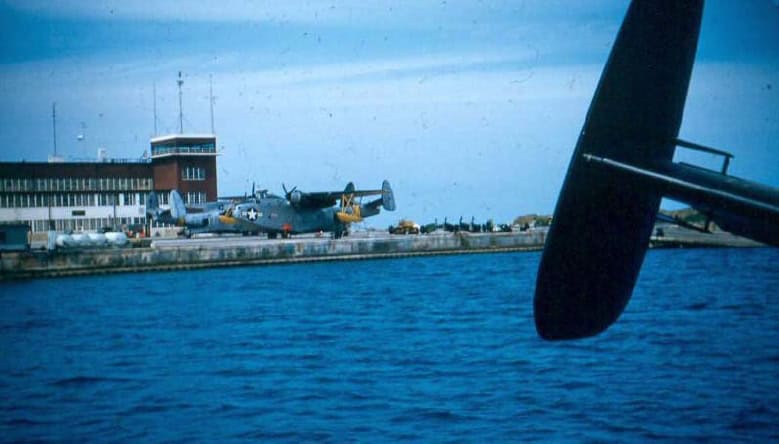
On Nov. 16, 1955, the U.S. Coast Guard awarded its Gold Lifesaving Medal to the crew of a PBM-5G Mariner that had attempted a dangerous rescue off China nearly three years earlier. One of the Coast Guardsmen recognized was Aviation Electronicsman First Class Carl R. Tornell, who died during the mission. The award date makes this a fitting day to remember Tornell and the rescue crew’s actions near Swatow, now Shantou, on Jan. 18, 1953.
The Coast Guard’s historical account places Tornell among the eight crew members aboard PBM-5G No. 84738, launched from the service’s air detachment at Sangley Point in the Philippines to assist a downed Navy patrol plane. The story was not a single-person feat: the pilot, copilot and enlisted crew faced the same deteriorating sea and darkness, while another Coast Guard aircraft and the destroyer USS Halsey Powell helped bring survivors out of the water. The official Coast Guard account of the Korean War rescue and the service’s Gold Lifesaving Medal recipient register document the crew and its recognition.
A Navy patrol aircraft in distress
The emergency began with a U.S. Navy P2V-5 Neptune, tail number 127744, assigned to Patrol Squadron VP-22. The aircraft was operating over the China Sea on a reconnaissance mission when Chinese anti-aircraft fire struck it near Swatow. The Coast Guard’s account says the damage included a wounded radar operator, an inoperative radar, intermittent fuel indications and holes in the vertical stabilizer. The plane initially remained controllable, and its crew turned toward a friendly landing field in Taiwan to inspect the damage.
The situation changed when the Neptune’s left wing and first engine caught fire. The crew lost the engine, and the fire continued despite emergency procedures. With the wing burning and structural failure feared, the Navy crew sent an SOS and prepared to ditch. The water was already rough: the Coast Guard account describes 15-foot swells and winds around 30 knots at the time of the ditching. All 13 Navy crew members escaped the aircraft, but only a damaged, partly inflated raft was available. A separate aircraft found them and dropped another raft, but the sea prevented the survivors from retrieving it.
The Mariner’s landing and rescue
Coast Guard Air Detachment Sangley Point scrambled PBM-5G Mariner No. 84738. Its crew included Lt. John Vukic, pilot; Lt. j.g. Gerald W. Stuart, copilot; and enlisted aircrew members Joseph M. Miller Jr., Robert F. Hewitt, Winfield J. Hammond, Carl R. Tornell, Joseph R. Bridge and Tracy W. Miller. Tornell’s name appears in the Coast Guard narrative as AL1 Carl R. Tornell; the medal citation identifies him as Aviation Electronicsman First Class.
By the time the Coast Guard aviators reached the scene, the Navy survivors had been in the water for almost five hours. The service’s account records winds of 25 to 30 knots, seas of eight to 12 feet and a water temperature later measured at 62 degrees Fahrenheit. Four survivors were clinging to the side of the partly inflated raft. The crew had no guaranteed arrival time for a ship, and darkness was approaching.
Vukic chose to put the amphibian down on the water despite the conditions. The PBM settled near the raft, and its crew pulled the Navy airmen aboard. Coast Guardsmen gave up their own flotation vests to help care for the injured. Vukic and Stuart then taxied through the worsening sea for about half an hour, searching for the two Navy crew members who had become separated from the main group. They could not find them.
The first PBM’s landing had brought survivors out of the sea, but the takeoff became another emergency. As the Mariner used jet-assisted takeoff bottles to help it climb, its first engine failed. The left wing dipped into a swell; water caught the hull and the aircraft cartwheeled, broke apart and sank. Four rescued Navy airmen and five Coast Guard crew members died in the crash, including Tornell. The Coast Guard’s published account lists the dead and says two additional Navy crew members, last seen after the original ditching, remained missing.
A second aircraft and a destroyer complete the rescue
The rescue effort did not end with the loss of No. 84738. A second Coast Guard PBM-5G, No. 84722, arrived after dark. Its crew dropped 34 parachute flares to help illuminate the area and guide the destroyer USS Halsey Powell through poor visibility and hazardous coastal waters. The seven people in a second raft used their remaining signal flare to mark their position. Sailors from the destroyer swam a line to the raft, and the survivors were pulled aboard. Vukic and two other men from the first PBM were later recovered from another raft.
Across the two aircraft crews, the Coast Guard account says 10 of 21 men survived: seven Navy aircrew and three Coast Guardsmen. It records nine deaths in the PBM crash and identifies two Navy aircrew who were lost after the initial ditching and remained unaccounted for. These totals matter because summaries of the event can easily blur the two aircraft and two phases of the rescue. The first PBM brought men aboard before it crashed; the second PBM and the destroyer helped locate and recover survivors later that night.
The medal recognized a crew, not a solo act
The Coast Guard’s Gold Lifesaving Medal register dates the crew’s award to Nov. 16, 1955. The award recognized the dangerous rescue attempt and the crew’s actions, including the decision to land in heavy seas and the effort to recover the Navy airmen. Tornell was one of the enlisted Coast Guardsmen named in the official list. A separate copy of his award citation, preserved by the Coast Guard Aviation Association, describes the medal as posthumous and links it to the Jan. 18, 1953 rescue. The date on the medal record is an anniversary of recognition; the rescue itself took place on a different date.
That distinction is central to Tornell’s story. The historical record does not single him out as the pilot or claim that one person directed the rescue. It identifies him as a member of a small aircrew that launched toward a distress call, operated a flying boat in dangerous conditions and shared the consequences when the aircraft was lost. Remembering him by name also means retaining the names of his crewmates and the Navy airmen whose emergency brought the rescue aircraft to the scene.
Remembering Carl Tornell
Tornell’s profile is best understood through the sequence preserved by the Coast Guard: a damaged Navy patrol aircraft, a rough-water ditching, a rescue landing made as daylight faded, a failed takeoff, and a second effort that continued into the night. The account records both courage and loss. It does not turn the event into a clean success story; it names the people rescued, those who died, and those who were never found.
For the 71st anniversary of the medal’s award, Tornell stands as one of the Coast Guard aircrew members honored for that mission. His recognition belongs alongside the rest of PBM-5G crew No. 84738 and the men who continued the rescue in No. 84722 and aboard Halsey Powell. The Coast Guard’s historical record provides a way to remember the mission with precision: Tornell was a crewman, the medal was awarded to the crew, and the rescue cost lives even as it brought survivors home.
Sources
- U.S. Coast Guard Historian’s Office, “Commemorating Korean War 75th Anniversary” — detailed account of the Swatow rescue and the PBM crews.
- U.S. Coast Guard Historian’s Office, Gold Lifesaving Medal recipient register — crew members and award date.
- Coast Guard Aviation Association, citation for Carl R. Tornell’s Gold Lifesaving Medal — preserved award citation.
- U.S. Coast Guard PBM-5G archival photo source and rights record — image shows sister aircraft at NAS Bermuda, circa 1951–1956, not the rescue aircraft.





No comment