
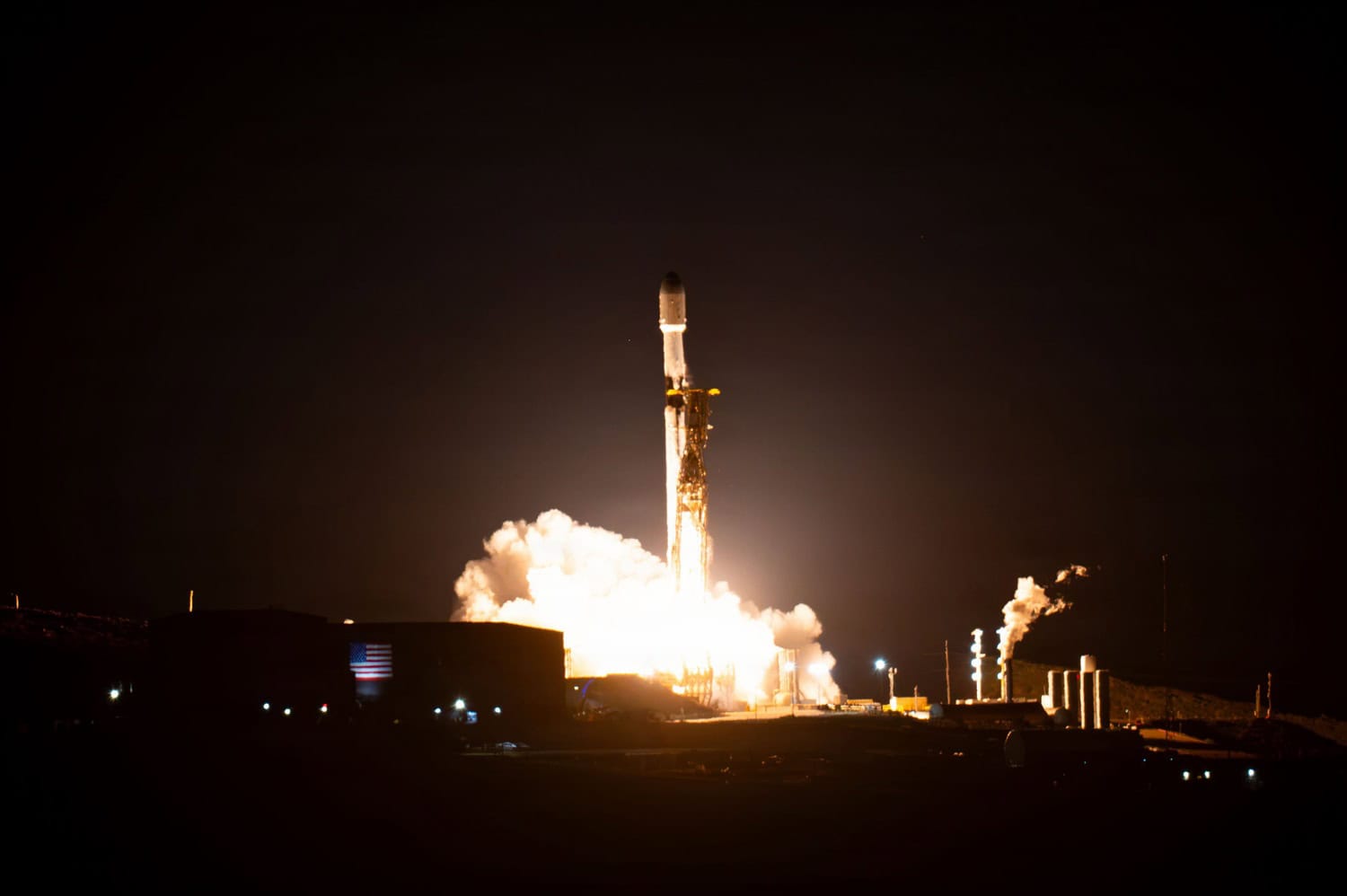
Space Launch Delta 30 marked its 75th launch supported from Vandenberg Space Force Base in 2026 when a SpaceX Falcon 9 carried the U.S. Space Force’s USSF-627 mission from Space Launch Complex 4 East. The launch took place Wednesday evening, Nov. 11, Pacific time. The milestone is a count of launches supported by the Vandenberg range this year, according to the Space Force photo caption—not a claim that the base has launched 75 national-security missions.
That distinction helps explain the operational work behind a modern launch. A rocket and its customer provide the visible mission, but a launch range supplies tracking, coordination, safety processes and access to the corridor needed for flight. Space Launch Delta 30 said Guardians and Airmen supported USSF-627 by providing range capabilities. The organization’s 75th-launch figure captures that support role across a busy year, rather than the payload count or the number of missions operated by the Space Force.
A classified mission, publicly confirmed at launch
SpaceX identified USSF-627 as a Falcon 9 mission from SLC-4E at Vandenberg. The company’s mission information says the first stage landed on the droneship Of Course I Still Love You after separation. Space reporting likewise described the payload as classified and noted that SpaceX ended its webcast after the booster landing. Neither the public announcements nor the cited mission materials identify the spacecraft or its orbital task. This report does not infer a payload from speculation about the mission.
The timing can appear different across records because the rocket left the pad on Nov. 11 in California but crossed into Nov. 12 in Coordinated Universal Time. SpaceX’s mission notice gives the local Wednesday evening launch time, while launch logs may record the same event after midnight UTC. The Space Force’s DVIDS caption also dates the launch to Nov. 11. Read together, these sources describe one event, not separate launch attempts.
What the 75th-launch milestone counts
Vandenberg’s west-coast location supports missions that need access to trajectories over the Pacific. The base’s launch range is used by government and commercial customers, and every launch depends on the range organization’s ability to coordinate activity around the spaceport. For USSF-627, Space Launch Delta 30 described its contribution as providing range capabilities that help ensure assured access to space from the Space Force’s West Coast spaceport and test range.
The 75th count is therefore a measure of range activity and support workload. It is not, by itself, a measure of how many satellites reached orbit, how many launches were dedicated to the military, or how many missions succeeded. Those distinctions matter at a site where civil, commercial and national-security activity share infrastructure and range resources. The public caption supplies the annual support tally but does not provide a breakdown by customer, rocket, mission type or launch outcome.
For the Space Force, reliable access to launch infrastructure is part of the broader space mission. Launch ranges help customers move from a prepared vehicle and payload to a scheduled, safely coordinated flight. They support the controlled use of airspace and range zones, track vehicles after liftoff, and coordinate response to anomalies if a flight does not proceed as planned. Those responsibilities are less visible than the rocket’s ascent, but the launch cannot occur without the range’s readiness and clearances.
Falcon 9 recovery adds another operational thread
USSF-627 also continued Falcon 9 booster reuse. SpaceX’s notice said the first stage landed on the autonomous droneship positioned in the Pacific. The booster had flown six previous missions, making USSF-627 its seventh flight, according to the company’s launch information. Reusing the first stage does not make the mission routine: each flight still requires vehicle checks, range coordination, payload integration and launch-specific review.
The launch photo released by Space Launch Delta 30 shows the Falcon 9’s engines igniting at SLC-4E. It is a real photograph by U.S. Space Force Staff Sgt. Daekwon Stith, marked public domain by DVIDS. The image documents the launch environment, but it does not disclose the classified payload or show a spacecraft in orbit. Its caption identifies the event and provides the proper photographer credit.
A demanding launch calendar
Reaching 75 supported launches before the end of the year points to a high operational tempo at Vandenberg. It also reflects the work required to sustain launch access while the base supports different customers and mission priorities. Each launch has a schedule, vehicle, payload, range plan and customer requirements of its own; an annual milestone does not mean that all launches share the same purpose or that every flight is a Space Force mission.
USSF-627 was a Space Force mission launched by SpaceX, with Space Launch Delta 30 providing range support. That division of roles is central to understanding the event. The launch provider operated the Falcon 9, the customer was the U.S. Space Force, and the range organization supported safe access to orbit from Vandenberg. Public information confirms the launch and booster recovery while leaving the payload’s identity and mission details undisclosed.
The milestone is a useful snapshot of the infrastructure that makes space operations possible. The 75th launch supported in 2026 was not just another number on a calendar: it represented another coordinated mission through a West Coast range that serves national-security and other launch customers. The public record gives a clear account of the support achievement and the rocket’s flight, while appropriately preserving the secrecy surrounding USSF-627’s payload.





No comment