
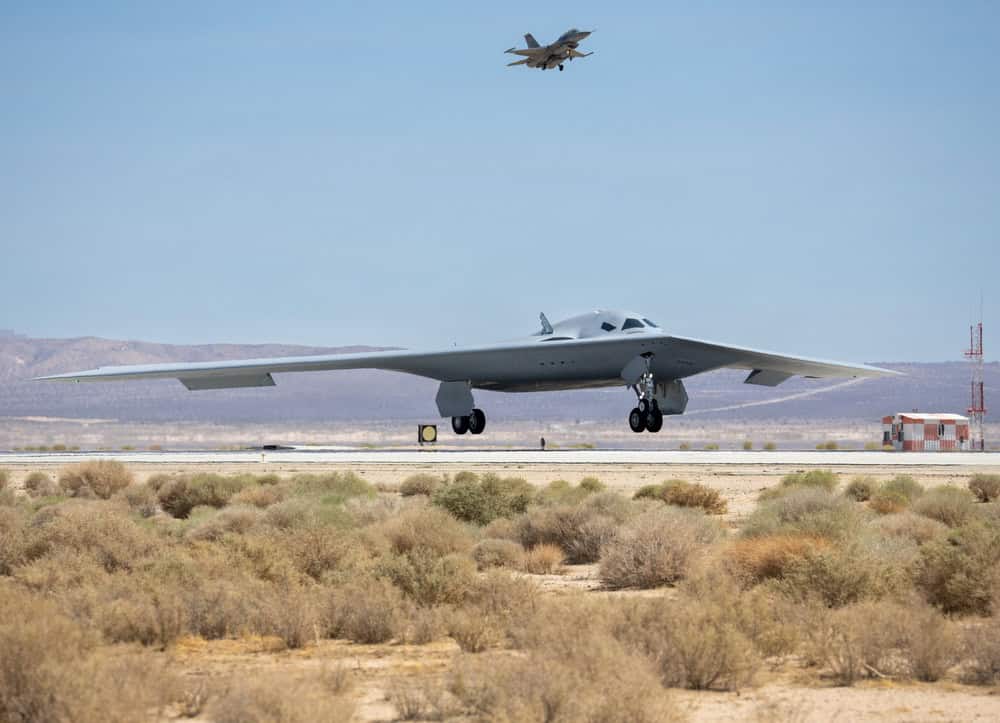
The U.S. Air Force has disclosed a new B-21 Raider test milestone: a test aircraft released a conventional weapon during a recent flight from Edwards Air Force Base, California. The Department of the Air Force announced the result Nov. 13, saying the event validated digital models and the maturity of the bomber’s open-systems architecture. The service did not identify the weapon or provide the test date.
That distinction matters. The announcement establishes that a weapons-release test took place and that the Air Force regards it as a meaningful step in the aircraft’s development. It does not reveal the munition, the release conditions, how many releases occurred, or the detailed test results. Those details remain undisclosed. The public record therefore supports a focused conclusion: the B-21 program has moved into a new phase of weapons integration, while the service has kept the specifics of the event classified or otherwise unreleased.
What the Air Force said the test established
In its Nov. 13 announcement, the Department of the Air Force said a B-21 test aircraft flew from Edwards and released a conventional weapon. The service said the test validated digital models and the maturity of the aircraft’s open-systems architecture. It also described the result as evidence of strike capability and of the aircraft’s ability to take on new weapons rapidly. The announcement characterized the event as a transition from flight testing toward a functional weapons platform.
The Air Force said the test was prepared through thousands of hours of modeling in a digital-twin environment. According to the service, that work let the Combined Test Force predict and refine the weapon’s trajectory before the aircraft flew. Digital modeling can help test teams narrow the range of conditions they need to explore in flight, but it does not replace the physical release. The event is significant because it puts a real aircraft and weapon through an integrated test, then compares observed performance with the predictions and system models.
The service has not publicly named the conventional weapon. It has also not described whether the test assessed a particular weapon interface, release sequencing, separation behavior, targeting data, or a broader mission-system function. Without those details, it would be premature to infer a specific operational loadout or claim that a particular weapon has completed all integration and certification steps. A successful release is one milestone in a broader test program, not proof that every intended weapon is ready for operational use.
Why weapons integration is a major test step
Aircraft development typically proceeds through overlapping work on airworthiness, flight performance, mission systems, weapons, maintainability, and operational procedures. A new bomber must demonstrate that it can fly safely and reliably, but it must also show that its sensors, software, crew interfaces, and weapons can work together as intended. A weapons-release event exercises several parts of that chain at once: the aircraft must carry the store, communicate with it, execute the release sequence, and provide test data that engineers can use to assess what happened.
For the B-21, the open-systems architecture is central to the Air Force’s public explanation of the milestone. The design approach is intended to make it easier to incorporate updates and new capabilities over the aircraft’s service life. In practice, an open architecture is only useful if the aircraft’s hardware, software, interfaces, and test processes can safely accommodate new configurations. The Nov. 13 statement says the release test validated the architecture’s maturity, but the service has not disclosed the test configuration or which parts of that architecture were examined.
The B-21 is planned as a penetrating bomber able to deliver conventional and nuclear weapons. The Air Force’s public fact sheet describes it as part of a future bomber force that will include both B-21s and upgraded B-52s. It also describes an open architecture intended to reduce integration risk and support future modernization. Those are program objectives; the specific weapon-release announcement is an early public indicator that the program is testing how the aircraft’s weapon capability works in flight.
A test program built around a government-industry team
The Air Force and Northrop Grumman share responsibility for developing and testing the aircraft. The service’s B-21 Combined Test Force brings Air Force personnel and company engineers together at Edwards, where flight-test results can inform design, software, and weapons work. Northrop Grumman said in its Nov. 13 release that the Raider had demonstrated weapons-release capability and described the milestone as a step forward in weapons testing. The company’s account corroborates the broad result announced by the service, while neither release provides the weapon type or detailed test data.
That restraint is consistent with the sensitivity of a new penetrating bomber program. Public announcements can confirm progress while leaving operationally relevant information undisclosed. The Air Force’s release gives a general account of the event, but readers should distinguish between confirmed facts and program claims. The publicly confirmed facts are that a test aircraft flew from Edwards, released a conventional weapon during a recent test, and that the service said the work validated digital models and the open architecture. More detailed assessments are not available in the public material reviewed for this report.
What comes next
The weapons-release milestone sits within a much larger effort to move the B-21 from development into operational service. The Air Force has said the first operational aircraft are expected at Ellsworth Air Force Base in South Dakota in 2027. That projected arrival depends on continuing test, production, training, infrastructure, and support work. A successful weapons event advances one piece of the program, but it does not by itself establish that the aircraft has achieved initial operational capability or completed testing of its planned weapons set.
Future public updates may clarify which additional configurations have been tested, how the program is progressing toward operational delivery, and what capabilities will be available when the aircraft enters service. Until the Air Force releases those details, the most responsible reading of the Nov. 13 announcement is narrow: the B-21 has now demonstrated a conventional weapons release in flight, and officials say the result supports continued weapons integration. The munition, test date, release conditions, and full results remain undisclosed.
Sources
- Department of the Air Force / DVIDS: B-21 Raider demonstrates weapon-release capability, Nov. 13, 2026
- Northrop Grumman: B-21 Raider Advances into Weapons Testing, Nov. 13, 2026
- U.S. Air Force B-21 Raider fact sheet
- Air & Space Forces Magazine: B-21 Raider Conducts First Weapons Release Test, Nov. 13, 2026





No comment