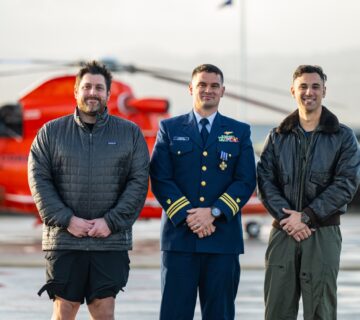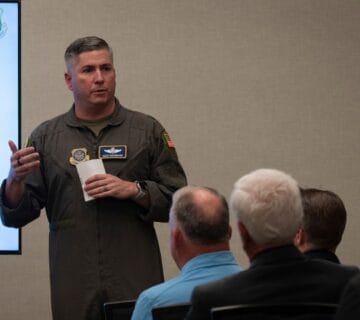
Army Col. Stewart Lindsay, chief of staff for the 11th Airborne Division, visited U.S. Coast Guard units and operations in Kodiak, Alaska, on Oct. 29 as leaders from Alaskan Command and the Coast Guard Arctic District worked to strengthen coordination in the region. The visit, documented in a DVIDS photo set published Nov. 13, put aviation at the center of a practical question: how federal forces with different missions share access, information and support across a large, remote area.
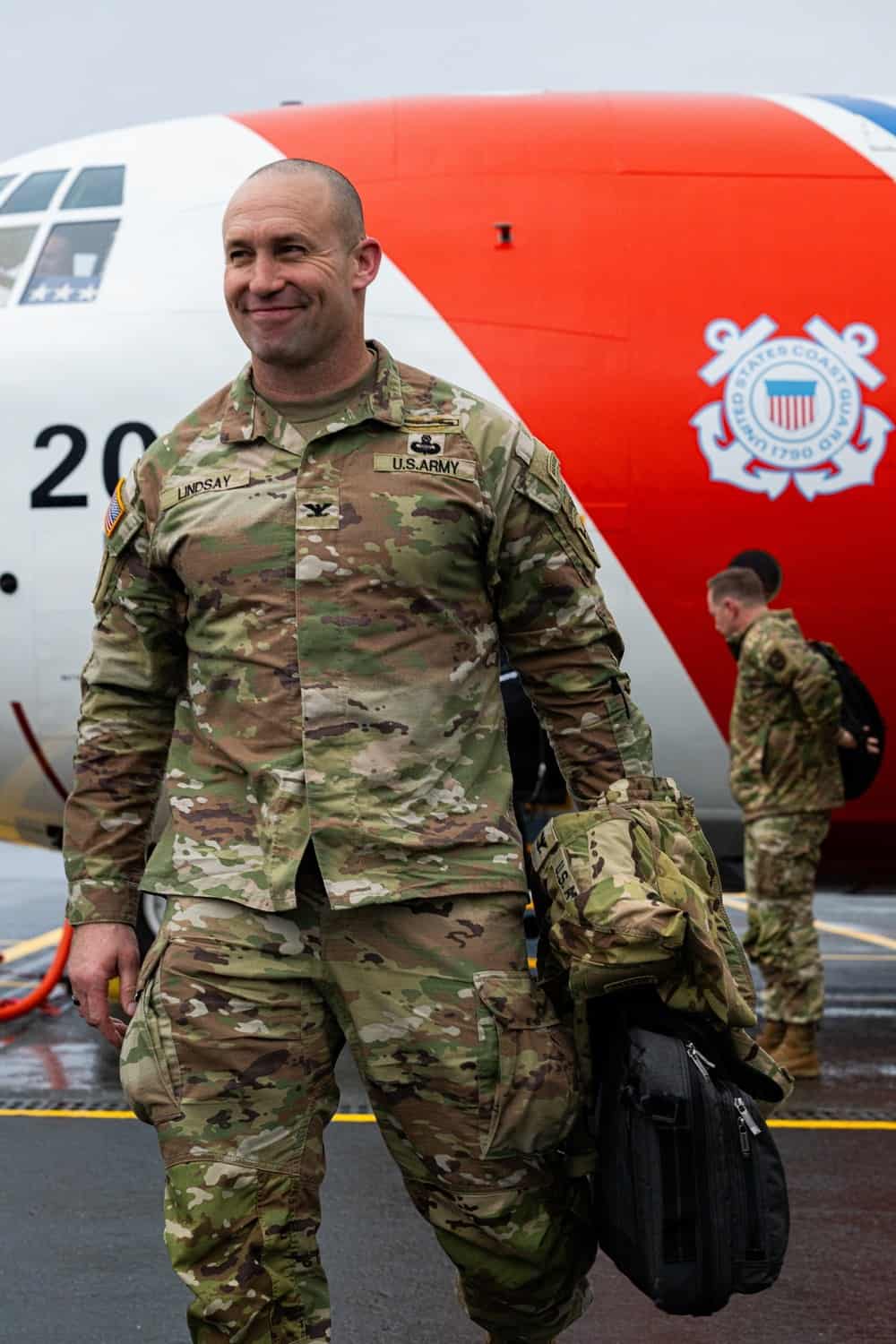
A U.S. Coast Guard photograph from the visit shows Lindsay stepping down from an HC-130J Super Hercules at Air Station Kodiak. The image documents his arrival, not a separate operational flight or exercise. DVIDS photo captions say the group toured Coast Guard units and operations to bolster joint-branch interoperability in the Arctic. It does not announce a new agreement, deployment or change to either service’s mission. That distinction matters: the reported development is a leadership visit intended to build familiarity and coordination, while the aircraft and crews continue their established operational roles.
A visit tied to a broad operating area
Air Station Kodiak sits on Kodiak Island, about 250 miles southwest of Anchorage. The Coast Guard describes its area of responsibility as more than four million square miles, including the Gulf of Alaska, Bristol Bay, the Bering Sea and the Pacific Ocean north of 40 degrees latitude. That span connects coastal communities, remote outposts, busy fisheries, shipping routes and waters where weather and distance shape what responders can do.
The station’s published missions range from search and rescue and enforcement of laws and treaties to marine environmental protection, aids to navigation, national defense, disaster relief and support for local, state and federal agencies. The Coast Guard’s Air Station Kodiak overview makes clear that aviation there is not a single-purpose service. An aircraft may support a rescue, patrol, logistics movement or response to a maritime incident, depending on the tasking and conditions.
That range of responsibilities helps explain why the Oct. 29 visit brought together leaders from the Coast Guard and the 11th Airborne Division. The Army unit is based in Alaska and has a role in the region’s joint-force environment; the Coast Guard provides persistent maritime and aviation capabilities. The official visit account describes the purpose as strengthening interoperability. In practical terms, exchanges like this allow leaders to see the facilities and aircraft that may become part of a future coordination problem before a crisis requires rapid decisions. That is an explanation of the value of familiarization, not a claim that the visit itself changed operational readiness.
The HC-130J’s role in Coast Guard aviation
The HC-130J in the DVIDS photograph is a long-range surveillance aircraft used by the Coast Guard for missions that include search and rescue, transport, law enforcement and maritime patrol. The service’s HC-130J profile lists a 4,900-nautical-mile range and more than 20 hours of endurance. Those figures describe the aircraft’s published characteristics; actual flight planning depends on payload, weather, route, reserves and the mission.
Coast Guard aircraft are configured for more than transit. The service says the HC-130J can serve as an on-scene command-and-control platform or as a surveillance aircraft able to detect, classify and identify objects and share information with operational forces. Its listed equipment includes radar and electro-optical and infrared sensors. The Coast Guard also describes a 360-degree, belly-mounted, multimode surface-search radar on its Super Hercules fleet. These systems can help an aircrew build a picture of activity over a wide maritime area and pass information to other responders.
At Kodiak, long-range fixed-wing aircraft work within an aviation organization that also uses helicopters. The station’s mission material identifies both C-130 and H-60 maintenance functions, and its core search-and-rescue work relies on aircraft and crews matched to the task. A fixed-wing aircraft can cover distance and remain airborne for extended periods; a helicopter can conduct close-in work such as hoisting people from a vessel or reaching a location where a landing is not possible. Those are complementary capabilities, not interchangeable ones.
Why coordination matters across the Arctic
The Coast Guard’s Arctic strategy frames the northern region as an area of growing economic and strategic interest and sets out goals that include improving the service’s ability to operate in a changing Arctic domain, strengthening a rules-based order and adapting through innovation. The strategy provides the broader policy context for the Kodiak visit; it does not describe the Oct. 29 tour as a new mission or operation.
In a region measured in millions of square miles, joint work can involve more than aircraft performance. Units need to know how to request support, exchange information, coordinate communications and understand each other’s authorities. A long-range aircraft may locate a vessel or provide a broad-area view, but response decisions can involve Coast Guard watchstanders, aircrews, cutters, Army or other military partners, and civilian agencies. The Coast Guard’s public mission list at Kodiak reflects that multi-agency reality: support to local, state and federal partners is one of the station’s listed responsibilities.
The Oct. 29 visit is therefore best read as a relationship-building step within an established network of Arctic operations. DVIDS photo captions identify the participating organizations—Alaskan Command, the Army’s 11th Airborne Division, Coast Guard Pacific Area and Coast Guard Cyber Command—and says the group toured Coast Guard units and operations in Kodiak. It does not provide a detailed itinerary or identify specific systems demonstrated. The available photo captions support a focused account of the visit’s purpose and aviation setting, but not claims about new tactics, capabilities or agreements.
Aviation as a bridge between services
For Coast Guard crews, Kodiak’s aircraft support everyday public-service work as well as national defense and emergency response. For Army leaders, seeing the station and its aircraft can help clarify what Coast Guard aviation can contribute when a joint problem crosses service lines. That does not mean the Coast Guard aircraft become Army assets or that the services’ command structures merge. It means leaders can build a shared understanding of who operates what, where units are based and how information and requests move.
The distinction between coordination and command is especially important in reporting about joint operations. The Coast Guard is a military service and a federal law-enforcement agency with its own statutory authorities and operational chain. The Army’s Alaska-based forces have separate responsibilities. The sources available for this visit support the narrower point that leaders sought to strengthen interoperability, not that a new operational arrangement was created.
The aircraft itself helps make the connection visible. The HC-130J combines long-range flight with sensors and communications designed for maritime surveillance and coordination. In Kodiak, those qualities are useful because the station’s area is extensive and its duties include both maritime response and support to other agencies. A visiting Army leader arriving aboard one of the Coast Guard’s aircraft offers a concrete view of the service’s aviation footprint, even though the photograph alone cannot establish what was discussed during the tour.
What the public record establishes
The public record is straightforward. The visit took place Oct. 29 in Kodiak; Col. Stewart Lindsay, the 11th Airborne Division’s chief of staff, was among the visitors; the group toured Coast Guard units and operations; and the photo captions say the visit was intended to bolster joint-branch interoperability in the Arctic. The photograph by Petty Officer 3rd Class Cameron Snell shows Lindsay deplaning from an HC-130J. The image page identifies the photograph as public domain and supplies the credit.
What the account does not establish is equally important. It does not say that the visit led to a new exercise, an expanded aviation detachment, a revised command arrangement or a particular future operation. It does not detail the discussion or quantify a readiness change. Until either service publishes more information, those points remain unreported. For now, the visit is a small but concrete example of how Alaska’s military and maritime organizations maintain working familiarity in a region where distances, weather and mission demands make coordination essential.
Sources
- DVIDS photo set: Alaskan Command and Arctic District leadership visit Coast Guardsmen in Kodiak, Alaska (Nov. 13, 2026)
- DVIDS photo 10093930: image details, caption and public-domain designation
- U.S. Coast Guard: Air Station Kodiak mission and area of responsibility
- U.S. Coast Guard: HC-130J Long Range Surveillance Aircraft profile
- U.S. Coast Guard Arctic Strategy
- DVIDS copyright and attribution guidance