
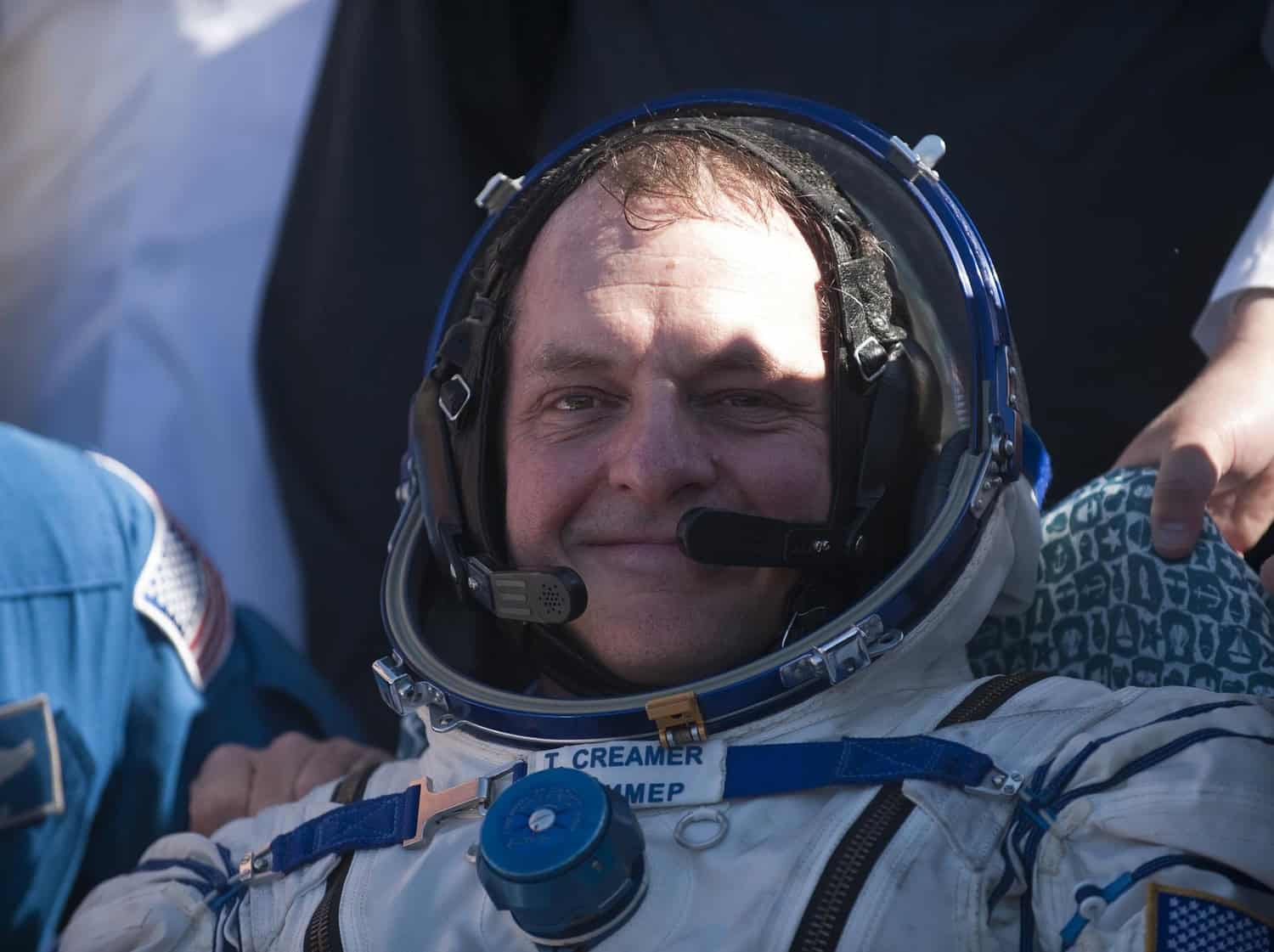
Timothy J. “TJ” Creamer turns 67 on November 15, 2026. NASA’s flight director and retired astronaut has spent a career moving between roles that usually belong to different professional tracks: Army helicopter pilot, International Space Station crew member, operations director coordinating science on the station, and flight director leading teams in Mission Control. His birthday is a fitting moment to look at how those experiences connect.
Creamer’s career is not simply a story of a pilot reaching orbit. It is also a story about the work that surrounds a spaceflight: integrating vehicles before launch, supporting crews from the ground, maintaining the station’s systems, and coordinating a team that must make decisions while a mission unfolds. NASA’s biographical record describes each of those steps, including his 2010 Expedition 22/23 mission and his later transition to flight director.
From Army aviation to NASA
Born in Fort Huachuca, Arizona, and raised in a military family, Creamer considers Upper Marlboro, Maryland, his hometown. He graduated from Loyola College in Baltimore in 1982 with a chemistry degree, then accepted a commission through the Army ROTC program. After Army flight training, he qualified as an aviator in 1983 and served in assignments that included the 1st Armored Division and the 82nd Airborne Division. His Army work included leadership and aviation roles, and he later taught physics at the U.S. Military Academy after earning a physics master’s degree from MIT in 1992.
The mix of aviation, science and operations would become useful at NASA. Before his astronaut selection, Creamer worked as a space operations officer with the Army Space Command in Houston. NASA had assigned him to Johnson Space Center in 1995 as a space shuttle vehicle integration test engineer. He served as an engineering link for launch and landing operations, took part in integrated orbiter systems tests and directly supported eight shuttle missions as a vehicle integration test team lead. The work put him close to the practical details that make a spacecraft and its ground teams ready to fly.
NASA selected Creamer as an astronaut in June 1998. After candidate training, he worked in the Astronaut Office’s Space Station branch, focusing on station command-and-control computers and operational networks shared across partner modules. His assignments also included astronaut support for Expedition 3, hardware integration, on-orbit information technology, robotics operations and real-time support for Expedition 12. Those jobs placed him on the ground side of missions long before he joined a crew in orbit.
161 days living and working aboard the station
Creamer launched aboard Soyuz TMA-17 in December 2009 and joined the International Space Station’s Expedition 22 crew as a flight engineer and NASA science officer. He continued with Expedition 23 before returning to Earth in June 2010. NASA’s biography says he spent 161 days living and working aboard the station during the mission and logged 163 days in space overall. The Expedition 22 and Expedition 23 records place him among international crews conducting research and maintaining the orbiting laboratory through a period that included visiting spacecraft, station operations and ongoing science.
His mission also included a small but memorable communications milestone. While on orbit, Creamer connected the station’s onboard network to the Internet through Twitter, sending what NASA’s biography identifies as the first live tweet from orbit. The episode reflected the station’s changing role: a complex research outpost that was not only operated by an international crew but increasingly connected to people on Earth. It was a communications first rather than a substitute for the crew’s core work in science and station operations.
NASA’s Expedition 22 and 23 summaries describe research spanning human physiology, plant biology, fluid physics and materials, alongside the daily work of keeping the station functioning. Creamer’s own responsibilities as a flight engineer and science officer sat at that intersection. Crew members had to carry out scheduled experiments while also handling maintenance, vehicle traffic, exercise, communications and the operational demands of living in microgravity. The role required technical discipline and coordination with the ground teams who planned and supported the work.
The first flown astronaut to lead payload operations
After returning from space, Creamer went back to operations on the ground. From 2011 to 2015, he served as a certified payload operations director at NASA’s Marshall Space Flight Center in Huntsville, Alabama. In that role, he helped coordinate real-time operations for science activities aboard the station. NASA describes him as the first flown astronaut to serve in the position. The distinction mattered because it joined first-hand crew experience with responsibility for organizing experiments and teams working from Earth.
Payload operations directors work across the science and operations sides of the station. Experiments arrive with objectives, constraints, hardware, crew time and data requirements; the orbiting laboratory has limited resources and a busy schedule. NASA’s biography says Creamer coordinated station science events and later supported planning for missions beyond low Earth orbit. His time as an astronaut offered a direct understanding of the environment in which that work had to be performed, while his earlier integration and information-technology assignments gave him experience with the systems and coordination behind it.
From astronaut to flight director
In September 2015, NASA selected Creamer as a flight director, making him the first astronaut to move into that position. A flight director leads the mission control team responsible for the safe and effective execution of a human spaceflight mission. The position requires coordinating specialists across the control room, weighing technical information and maintaining a shared operational picture as conditions change. Creamer’s flight-control team is known as Saber Flight, a name NASA links to his Army cavalry background.
NASA’s biography credits Creamer with leading cargo missions, including Orbital ATK’s eighth commercial resupply mission and SpaceX’s 17th and 18th cargo missions. He also served as lead flight director for space station increments 56 and 57 and for Axiom Mission 1 and Axiom Mission 2, the first two private astronaut missions to the station. The move from astronaut to flight director was unusual, but his prior work had already crossed the boundary between crew, engineering, science operations and mission control.
In a NASA podcast interview, Creamer described his astronaut-to-flight-director path as a first and only transition at the time. The same conversation traces the early influences behind his career: a childhood flight with his father, an Army aviator, sparked his interest in flying, while a magazine article about Army astronauts later helped him see a possible route into space. The sequence was not a straight ladder. It was a series of assignments that kept combining aviation, technology, science and leadership.
A career that connects today’s missions
Creamer’s current assignment continues that pattern. NASA identifies him as the lead flight director for Gateway, the planned lunar-orbit outpost intended to support lunar surface missions and science. Gateway is part of NASA’s broader exploration architecture, and its development depends on coordination among spacecraft, crews, ground teams and international partners. Creamer’s background spans many of those operational layers: he has worked on shuttle integration, station systems, crew support, science operations, station expeditions, cargo missions and private astronaut flights.
That range helps explain why his career stands out in NASA’s astronaut corps. Many astronauts build expertise around flight testing, engineering, science, piloting or operations. Creamer’s record crosses several of those areas. He served as an Army aviator and physics instructor, prepared shuttle orbiters for missions, worked on the station’s command-and-control and robotics systems, flew a long-duration mission, coordinated experiments from the ground, and later led flight-control teams. Each role contributed a different view of how human spaceflight is planned and carried out.
On his 67th birthday, the clearest milestone is not a single flight or title. It is the uncommon continuity between operating in space and directing missions from the ground. Creamer’s route from Army aviation to the International Space Station and Mission Control shows how astronaut experience can inform work beyond the spacecraft itself. His story is a reminder that exploration depends on the people who fly, the teams who support them, and the systems that connect those teams into one mission.






No comment