
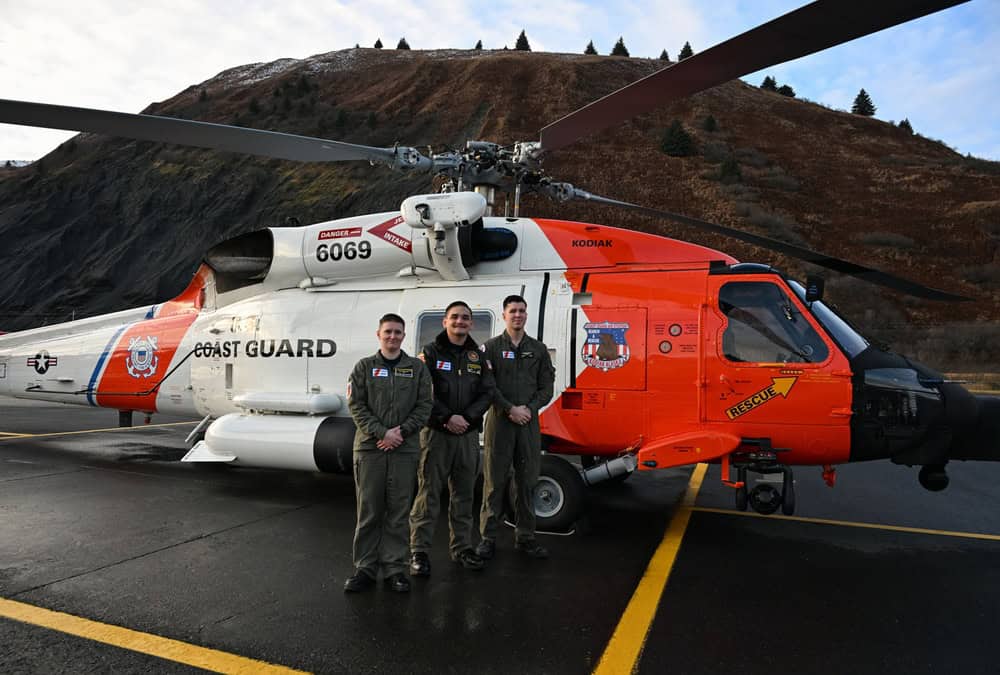
A U.S. Coast Guard Air Station Kodiak MH-60 Jayhawk crew rescued four people from the disabled fishing vessel Peregrine near Icy Bay, Alaska, on Oct. 29, after the boat lost propulsion and could not anchor. The Coast Guard said the aircrew hoisted all four people. A crew portrait released afterward identifies three of the participating aviation specialists and notes that the mission’s primary pilot, Lt. Cmdr. Mary Klynman, was not pictured. The Coast Guard’s rescue video and description | Crew photo and caption
The incident was more than a helicopter hoist. The vessel was adrift in the northeast Gulf of Alaska, and the Coast Guard asked NOAA for trajectory support while search-and-rescue operations were underway. NOAA’s IncidentNews record says the fishing vessel had lost propulsion and identifies oil as a potential threat. Those details place the rescue within a broader response that included aviation, maritime coordination and environmental support. NOAA’s public record does not describe a spill or say that fuel was released. NOAA IncidentNews: F/V Peregrine Adrift
A disabled boat in a demanding response area
The Coast Guard’s account is concise: the Peregrine became disabled and could not anchor, and the Kodiak-based helicopter crew hoisted the four people. The service has not publicly detailed the exact position of the hoist, the time the aircraft reached the scene, weather and sea conditions, the vessel’s damage, or the crew’s condition after rescue. Those specifics should not be inferred from the fact that a helicopter was used.
NOAA’s incident record adds a separate view of the response. The Coast Guard notified NOAA’s Scientific Support Coordinator that the fishing vessel had lost propulsion in the northeast Gulf of Alaska and requested trajectory support. NOAA also supplied a small-diesel-spill fact sheet and requested a National Weather Service forecast. These actions indicate that responders were considering how the disabled vessel might drift and what environmental concerns could arise; they do not establish that a spill occurred or that the helicopter rescue involved a pollution-control operation.
The distinction matters in maritime emergencies. A search-and-rescue crew needs to locate and reach people in danger, while other responders may help assess the vessel’s drift, nearby hazards and potential effects on the water. The same incident can require several kinds of expertise even when the public-facing account focuses on the aircraft and the hoist. In this case, the Coast Guard confirmed the aviation rescue, and NOAA documented the requested trajectory and weather support.
The Jayhawk’s role in Coast Guard aviation
The MH-60T Jayhawk is the Coast Guard’s all-weather, medium-range recovery helicopter. The service’s acquisition profile lists a range of 700 nautical miles, endurance of 6.5 hours and a crew of four. It also describes surface-search radar, electro-optical and infrared sensors, a digital cockpit, and cameras associated with the sensor and hoist systems. These are aircraft specifications, not mission data for the Peregrine rescue: the Coast Guard has not published the flight’s distance, fuel plan or time on scene.
Air Station Kodiak operates in a particularly broad area. The Coast Guard says the station supports search and rescue across more than four million square miles spanning the Gulf of Alaska, Bristol Bay, the Bering Sea and Pacific waters north of 40 degrees latitude. It also flies fisheries-enforcement patrols and provides logistical support to remote Coast Guard units. A rescue near Icy Bay therefore falls within a mission set in which aircraft may need to support communities and vessels spread across a vast region.
That geography helps explain why the MH-60’s endurance and sensors matter, but it should not be mistaken for proof of the conditions on this flight. The service has not said whether the Peregrine was beyond the helicopter’s normal operating radius, whether another aircraft or support location was involved, or how long the crew spent on the rescue. The public record supports the central result: four people were hoisted from the disabled vessel by a Kodiak MH-60 crew.
The people behind a hoist mission
The Coast Guard’s Nov. 10 crew photograph names Lt. Cmdr. Jessica Richardson, a pilot; Petty Officer 2nd Class Matt Hidy, an avionics electrical technician; and Petty Officer 2nd Class Gabriel Davila, an aviation survival technician. The caption says Lt. Cmdr. Klynman served as the primary pilot during the rescue and was not pictured. It is a post-mission portrait taken on the Kodiak flight line, not an image of the hoist or the fishing vessel.
That distinction is important for readers: the photograph documents the people associated with the response, while the Coast Guard’s video provides the operational account. The image is not presented as a scene photograph. DVIDS identifies it as a U.S. Coast Guard photograph by Petty Officer 3rd Class Rylan Singleton and marks it public domain. The caption dates the portrait to Nov. 10, 2026, even though the image metadata field separately displays Jan. 1, 2023; the specific caption and VIRIN identify this as a 2026 image, so the caption date is used here.
The rescue also illustrates why a helicopter crew is a team rather than a single pilot and aircraft. The service’s published MH-60T crew size is four, and the image caption identifies aviation roles spanning piloting, avionics and survival expertise. The Coast Guard has not released a complete roster for this sortie, so the named personnel should not be treated as a full list of everyone aboard or involved from shore.
What the public record confirms—and what remains open
Available official sources establish the date, general area, vessel name, basic failure and outcome: on Oct. 29, 2026, the Peregrine lost propulsion near Icy Bay and could not anchor; an Air Station Kodiak MH-60 Jayhawk crew hoisted four people. NOAA confirms the Coast Guard requested trajectory support for a disabled fishing vessel with four people in the search-and-rescue picture and an oil threat considered by responders. The Coast Guard’s photo record later linked the crew to the rescue.
The public sources do not establish how the vessel lost propulsion, whether it was subsequently recovered, whether any fuel reached the water, the precise hoist coordinates, or the rescue’s duration. They also do not report medical injuries or the identities of the four people aboard the fishing vessel. Without those details, the event is best understood as a successful aviation-assisted rescue with a documented multi-agency support element, rather than as a broader casualty or spill narrative.
For Alaska’s maritime operators, the episode is a reminder that loss of propulsion can quickly become a safety problem when a vessel cannot hold position. For the Coast Guard, it shows the Jayhawk performing its recovery mission in a region where the service maintains aircraft and crews across enormous distances. The agency’s short account does not reveal every operational decision, but it records the outcome that matters most: all four people were taken off the disabled vessel by helicopter.
Sources
- U.S. Coast Guard Arctic via DVIDS, “Coast Guard rescues four people near Icy Bay, Alaska,” Oct. 29, 2026.
- DVIDS photo 10087358, Coast Guard aircrew portrait, Nov. 10, 2026; public domain; U.S. Coast Guard photo by Petty Officer 3rd Class Rylan Singleton.
- NOAA IncidentNews, “F/V Peregrine Adrift; Gulf of Alaska,” Oct. 29, 2026.
- U.S. Coast Guard, MH-60T program profile and specifications.
- U.S. Coast Guard, Air Station Kodiak mission and area of responsibility.





No comment