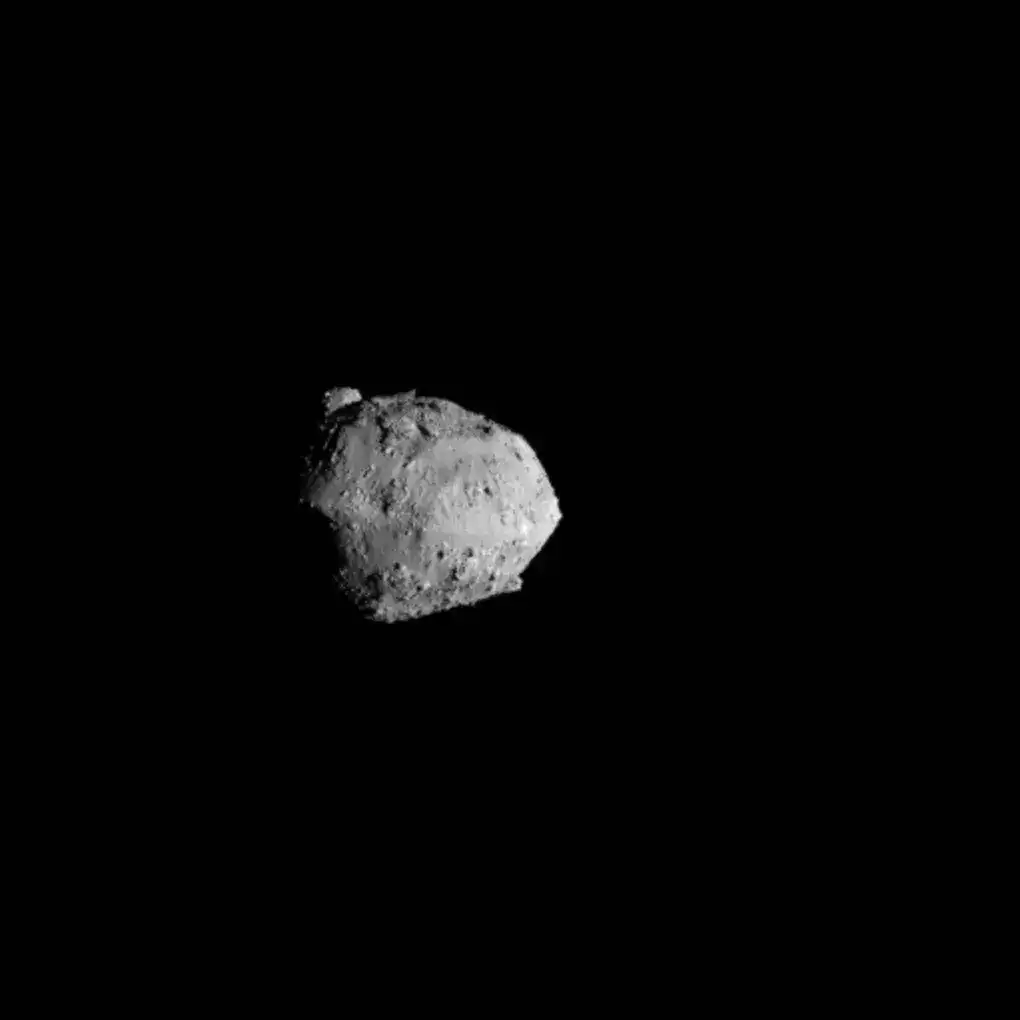
A new image from the European Space Agency’s Hera spacecraft offers a close look at the binary asteroid system that became the setting for humanity’s first full-scale asteroid-deflection experiment. The Asteroid Framing Camera view, released by ESA on Nov. 12, was acquired from 56 kilometers away. It shows one face of the larger asteroid Didymos and only a small portion of its moonlet, Dimorphos, peeking above the northern edge. The image is an early preview of the mission’s work at the target, not the detailed post-impact survey that Hera was sent to conduct. ESA says detailed images of both bodies are planned for Nov. 25. (ESA’s Nov. 12 release)
A moonlet at the edge of the frame
ESA describes Didymos as roughly 780 meters across and Dimorphos as about 151 meters in diameter. In the new frame, Dimorphos is mostly hidden behind its much larger companion; just a small part of the moonlet is visible near Didymos’s north pole. The image’s documented range is 56 kilometers. That specific distance should be kept separate from Hera’s later operating geometry: a separate ESA update described the spacecraft following a series of rectangular orbits roughly 25 to 30 kilometers from the asteroid pair during its early characterization phase. Those figures refer to different mission moments, not conflicting measurements of one view. (ESA on Hera’s rectangular orbits)
The picture shows more than the outline of two bodies. ESA points to large boulders, smoother surface regions and a sharply defined ridge around Didymos’s equator. The latest view adds to earlier previews from the approach, each giving the science team a different look at the larger asteroid and its smaller companion. Because the image was made by a spacecraft instrument, it records the scene as Hera’s camera saw it; it is not a ground-based telescope photograph or a computer rendering. ESA’s official image terms allow editorial and informational use of ESA-owned material when the required credit is retained. The image used here is credited to ESA and the Asteroid Framing Camera scientific instrument.
Why the ridge and boulders matter
Surface details help investigators understand how the bodies formed and how they behave. Didymos rotates once about every 2.2 hours, according to ESA. Models of rapidly spinning asteroids suggest that material may migrate from higher latitudes toward the equator; in some cases, material could be shed from the larger body. ESA presents that as a possible explanation for the ridge and perhaps for the origin of Dimorphos, not as a settled finding. Resolving the shape, distribution and texture of surface features will help researchers test such explanations against observations rather than relying on a single image or model.
The boulders and smoother patches also provide recognizable landmarks. Hera’s visible-light cameras are designed to support both navigation and scientific data gathering. The Asteroid Framing Camera system has two monochrome 1,020-by-1,020-pixel cameras for redundancy, according to ESA’s instrument description. Repeated images from different positions can help the team map surface features and build three-dimensional models. A single frame gives a useful view, but it does not reveal the depth, internal structure or composition of every feature it shows. Those questions require measurements from Hera’s other instruments and its planned close survey. (ESA’s instrument overview)
Hera is investigating the aftermath of DART
The mission’s central task is to examine the consequences of NASA’s Double Asteroid Redirection Test. On Sept. 26, 2022, DART deliberately struck Dimorphos at about 6.1 kilometers per second. Follow-up measurements showed that the impact shortened Dimorphos’s orbit around Didymos by about 33 minutes. NASA calls DART the first mission to demonstrate asteroid deflection by kinetic impact, but the change in orbital period is only one part of the result. Scientists also need to understand how the impact affected the moonlet’s shape, surface and interior, and how much momentum the collision transferred to the asteroid system. (NASA’s DART mission overview)
That is where Hera’s work begins. ESA says the spacecraft reached the Didymos system in early November after more than two years in transit. Its investigation is intended to characterize both bodies and study the site and effects of the DART collision. The images arriving during approach help the team orient itself and build familiarity with the target; they do not by themselves answer the mission’s deeper questions about the impact. The German Aerospace Center, DLR, which leads the scientific work for the Asteroid Framing Camera, likewise describes the first images as a preview of the mission’s scientific phase and says the observations will help researchers examine surface structures and the possible effects of material ejected by DART. (DLR’s mission update)
A broader instrument survey is still ahead
The camera view is one part of a coordinated survey. ESA’s instrument deck includes a thermal infrared imager supplied by Japan’s JAXA to map surface temperatures, a laser altimeter to measure distance and topography, and other instruments that will add spectral and physical information. Hera is also designed to deploy two small spacecraft, Milani and Juventas, for closer observations. ESA describes Juventas as carrying radar to probe beneath Dimorphos’s surface, while Milani will contribute observations of surface composition. These instruments are meant to turn a visual record into a more complete account of the asteroid pair, including properties that a camera cannot determine on its own. (ESA on the Hera CubeSats)
The upcoming detailed-image release is therefore a milestone in a longer investigation, not a conclusion. A sharper look at Dimorphos can help researchers identify the impact region and choose features to track, but the mission still has to relate those visible details to mass, density, internal structure and the physics of the collision. The system is a little over a kilometer across from Didymos to Dimorphos, and the smaller body completes an orbit around its parent roughly every 12 hours. Measuring how the surface and orbit fit together is essential if a kinetic impact is ever to be planned as a reliable planetary-defense response. The DART result established that a spacecraft can alter an asteroid moonlet’s motion; Hera is designed to explain how that happened.
The limits of an early preview
The Nov. 12 image is valuable partly because it is modest in what it claims. Dimorphos appears only partially, so it does not yet provide a full view of the moonlet’s impact-altered surface. ESA’s release emphasizes Didymos’s visible geology and the small portion of Dimorphos at the top of the frame. The agency has set Nov. 25 for a more detailed image reveal. Until then, the safest interpretation is that the new view documents Hera’s progress into close study and sharpens the questions the team will investigate: how the equatorial ridge formed, what the boulders reveal about surface history, and how DART’s ejecta may have redistributed material between the two bodies.
For planetary defense, the distinction between demonstration and understanding matters. A successful deflection test shows that an impact can change a target’s motion under specific conditions. A future response would also require dependable knowledge of the target’s mass, structure, composition and response to impact. Hera’s images are an early layer of that evidence. The spacecraft’s upcoming close observations, thermal measurements, ranging data and CubeSat investigations are intended to provide the context needed to interpret what DART changed. The new 56-kilometer image does not settle those questions, but it places the target system in view as the mission begins the work of answering them.
Sources
- European Space Agency: “Hera spies a half-hidden asteroid moonlet,” Nov. 12, 2026
- European Space Agency: Hera spacecraft in rectangular orbit around target asteroids
- German Aerospace Center: Hera spots its target, Nov. 12, 2026
- NASA Science: Double Asteroid Redirection Test
- European Space Agency: Hera instruments
- European Space Agency: Image and video terms of use
Featured image: ESA (Asteroid Framing Camera scientific instrument). The spacecraft-camera image was captured from 56 km away. ESA’s terms permit editorial/informational use with attribution; third-party content requires separate permission. The ESA Hera gallery identifies this image as ESA AFC imagery.