
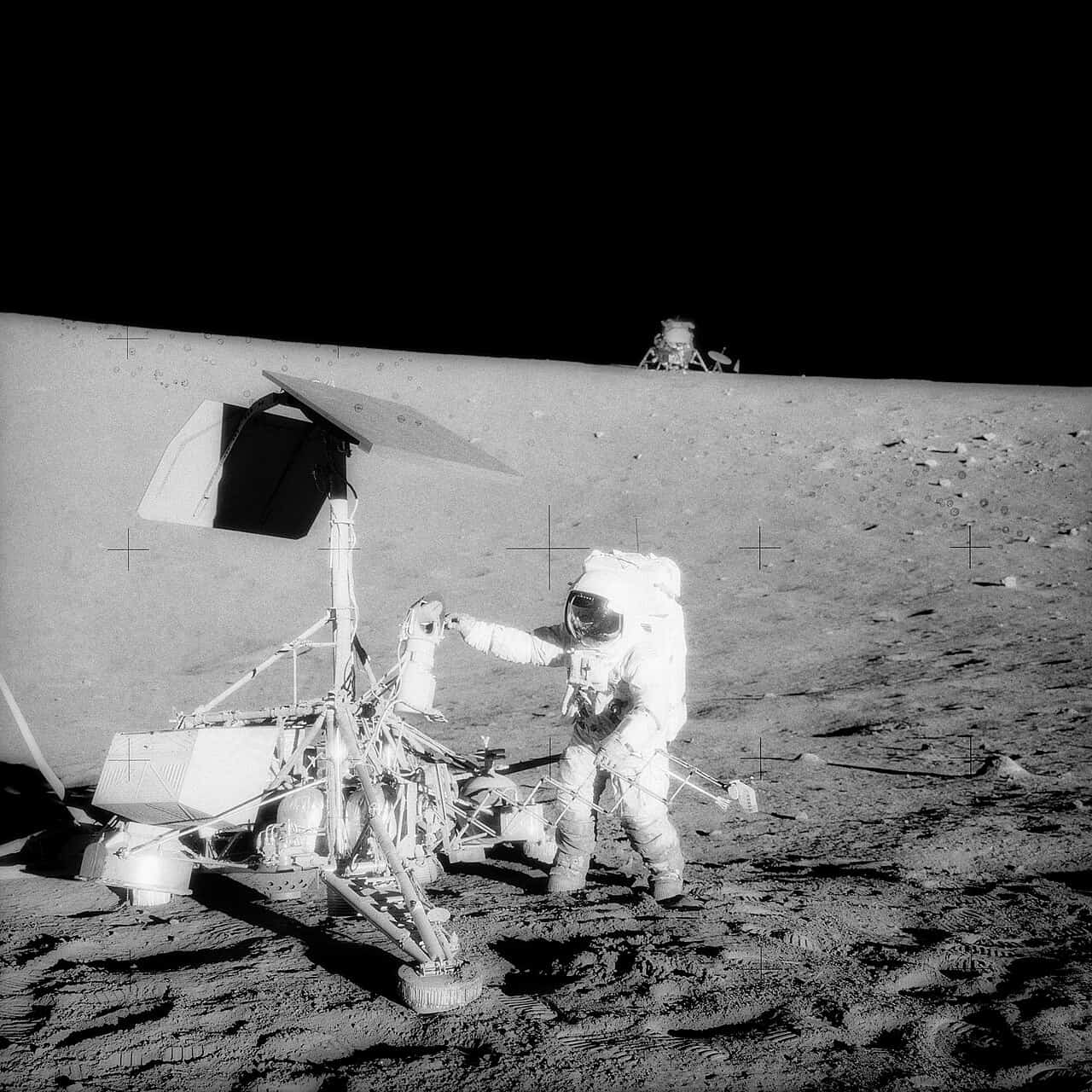
November 19, 1969: Apollo 12 achieved the second crewed lunar landing and demonstrated precision navigation on another world.
A landing with a purpose
On November 19, 1969, Apollo 12’s lunar module Intrepid touched down in the Ocean of Storms, making the second crewed landing on the Moon. Four months after Apollo 11’s historic first landing, NASA faced a different challenge: demonstrate that a crew could reach a carefully selected site rather than simply find a safe place to land. Commander Charles “Pete” Conrad and lunar module pilot Alan Bean accomplished that goal while command module pilot Richard Gordon continued orbiting overhead aboard Yankee Clipper.
The road from launch to the Moon
Apollo 12 lifted off from Kennedy Space Center on November 14 aboard a Saturn V. Lightning struck the launch vehicle during ascent, disrupting some electrical systems and producing a tense early test for the crew and flight controllers. The mission continued after the crew restored the affected systems. The incident became a reminder that even a well-tested launch vehicle could encounter unexpected conditions, and that astronaut training and the expertise of ground controllers were essential parts of mission success.
Aiming for Surveyor 3
Apollo 11 had demonstrated that people could land on the Moon and return. Apollo 12 aimed to improve precision. Its destination was near Surveyor 3, an uncrewed robotic spacecraft that had landed in April 1967. Reaching a known landmark would make it possible to inspect hardware exposed to the lunar environment for more than two years. The astronauts’ arrival close to Surveyor was not just a navigation achievement; it opened an opportunity for engineers to compare what they had predicted about the lunar environment with the condition of real spacecraft hardware.
Two astronauts on the surface
Conrad descended the ladder first, followed by Bean. Their work combined exploration and carefully planned engineering tasks. The astronauts deployed a package of scientific experiments, photographed the surrounding terrain and collected rock and soil samples. During their second excursion they traveled to Surveyor 3, examined the robotic lander and removed components for return to Earth. Gordon, meanwhile, remained in lunar orbit, maintaining the command module that would carry all three astronauts home after the surface crew rejoined him.
Why the experiments mattered
The science package included instruments intended to help researchers understand the Moon’s physical environment. A seismometer could record vibrations and provide clues about the lunar interior. Other instruments examined aspects of the local environment that could not be reproduced easily on Earth. The samples brought back by Apollo 12 helped expand the scientific record beyond the single landing site visited by Apollo 11. Comparing different lunar locations was crucial to moving from a remarkable demonstration of flight to a sustained program of exploration and research.
The value of a precise landing
Apollo 12’s accuracy helped establish a capability needed for later expeditions. Future crews would have to reach scientifically valuable terrain, sometimes near difficult features or equipment already on the surface. A landing that missed its target by a large distance could limit the crew’s ability to complete a planned investigation. Apollo 12 showed that navigation, guidance and astronaut judgment could work together to place a spacecraft near a selected destination on another world.
A mission that kept delivering
Conrad and Bean spent more than a day on the lunar surface before departing in Intrepid’s ascent stage to rendezvous with Gordon. Apollo 12 returned to Earth on November 24, 1969. Its scientific materials and photographs continued to support research long after splashdown. The Surveyor hardware was particularly valuable because it provided a direct example of how spacecraft materials had endured prolonged exposure to lunar conditions. Apollo 12 also demonstrated how robotic and human exploration could complement one another, a relationship that remains important in modern mission planning.
Why November 19 still matters
The anniversary is more than a celebration of the second Moon landing. It marks the moment lunar exploration became more repeatable and more purposeful. Apollo 11 proved that the journey could be made. Apollo 12 showed that a crew could return, navigate to a particular destination, carry out a varied research program and bring back evidence from both the lunar landscape and a previous robotic visitor. The lesson still resonates: major advances in exploration depend not only on reaching a destination, but on arriving where the science requires and doing useful work once there.
Sources
- NASA — Apollo 12 mission
- NASA — On This Day: Apollo 12 Lands on the Moon
- NASA — Apollo 12 historical overview
Featured photograph: NASA image AS12-48-7134 by Alan Bean. Pete Conrad stands behind Surveyor 3 on Nov. 20, 1969. Public-domain image and archive record.






No comment