
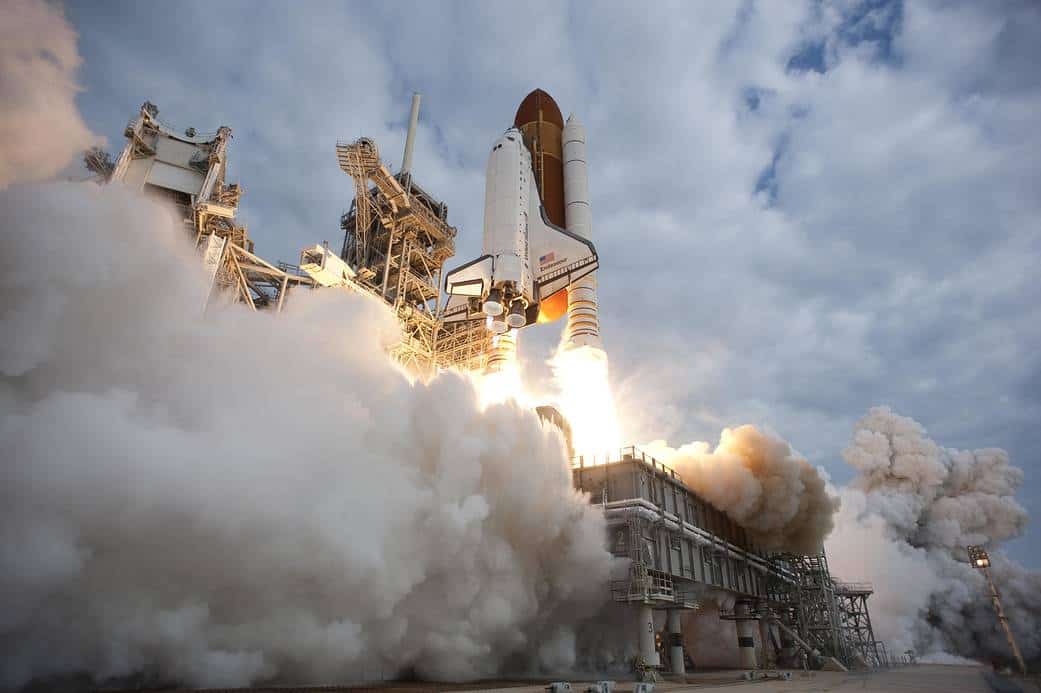
The California Science Center opened the Samuel Oschin Air and Space Center in Los Angeles on November 13, giving NASA’s space shuttle Endeavour its permanent public home. The centerpiece is the orbiter mounted vertically alongside an external tank and two solid rocket boosters. The Science Center’s opening announcement describes a 200,000-square-foot expansion with 100 artifacts and 100 hands-on exhibits. LAist’s opening-day coverage confirmed the public opening.
Why Endeavour is standing upright
Endeavour spent years on horizontal display after its arrival in Los Angeles in 2012. The vertical arrangement lets visitors see the orbiter as one part of the launch vehicle. Its wings and payload bay are familiar features, but most of the volume beside the orbiter at liftoff belonged to the tank and boosters. Their placement helps explain how the shuttle could take off as a rocket and return as a glider.
The external tank supplied liquid hydrogen and liquid oxygen to the orbiter’s main engines during ascent. The two solid boosters supplied additional thrust early in flight. After the boosters separated, the main engines continued drawing propellant from the tank until the orbiter was close to orbital velocity. The tank then separated. With the hardware assembled in the gallery, visitors can see where each component sat in relation to the others.
A spacecraft built to carry work into orbit
The upright exhibit also offers a way into the story of Endeavour’s last mission. On May 16, 2011, it lifted off from Kennedy Space Center on STS-134, flew to the International Space Station and delivered the Alpha Magnetic Spectrometer and an equipment carrier. The spectrometer was designed to study cosmic rays. The mission’s cargo illustrates how the shuttle’s large payload bay let crews bring substantial pieces of hardware to a station that was built and supplied in stages.
STS-134 was Endeavour’s 25th spaceflight. NASA’s mission record credits the orbiter with 299 days in space and 4,671 orbits by the end of its flying career. The gallery puts those mission totals alongside hardware visitors can examine at full scale. The orbiter’s familiar outline is only part of the story. The launch configuration shows what it took to send that aircraft-shaped spacecraft, its crew and its payload into orbit.
From landing configuration to launch configuration
The display required a building that could accommodate the full stack. On the ground, the shuttle normally rested horizontally on its landing gear. That orientation is useful for seeing the vehicle as it looked after a mission and for appreciating the size of its wings. Standing it vertically changes the comparison. Visitors can see the orbiter next to the propellant tank and boosters at the same scale and follow the geometry of the stack from the base toward the nose.
The opening marks a change in what the public can inspect in Los Angeles. Endeavour’s earlier display gave visitors a close look at the orbiter. The new gallery gives them a view of the larger system that put it into space. For a vehicle that launched vertically and landed horizontally, those two views explain different parts of the same trip.
Featured photograph: NASA/Tony Gray and Tom Farrar, Endeavour’s STS-134 launch on May 16, 2011. Original NASA photograph and credit. Used under NASA’s editorial media guidelines.
Sources
California Science Center opening announcement
LAist opening-day reporting
NASA STS-134 mission record
NASA launch photograph







No comment