
Published November 20, 2026
On November 20, 1919, Coast Guard aviator Elmer Fowler Stone reported to the Navy Yard in Washington, D.C., for assignment as a test pilot. The Coast Guard’s aviation chronology records the assignment at the request of the Navy. It came less than six months after Stone and the crew of the Navy flying boat NC-4 completed the first crossing of the Atlantic Ocean by aircraft.
The two events show how early military aviation depended on officers moving between the services and between experimental and operational flying. Stone wore a Coast Guard uniform, earned naval aviator qualifications and flew a Navy aircraft on the crossing. When he returned to test work in Washington, the Navy was again drawing on experience he had gained in both services.
The Coast Guard’s first aviator
Stone belonged to the first group of Coast Guard aviators to graduate from naval flight training at Pensacola, Florida, on March 22, 1917. The Coast Guard lists him as its Aviator No. 1 and as Naval Aviator No. 38. Those two numbers identify the same officer and reflect how the Coast Guard used Navy training to build its own flying capability.
By October 1917 the Navy’s Bureau of Construction and Repair had assigned Stone to seaplane test work. That earlier assignment matters when reading the November 1919 entry. His reporting date at the Navy Yard marks his return to a field he already knew. The Atlantic crossing in between gave him experience with the consequences of design and operating choices far beyond the airfield.
Six crew members and a flight made in stages
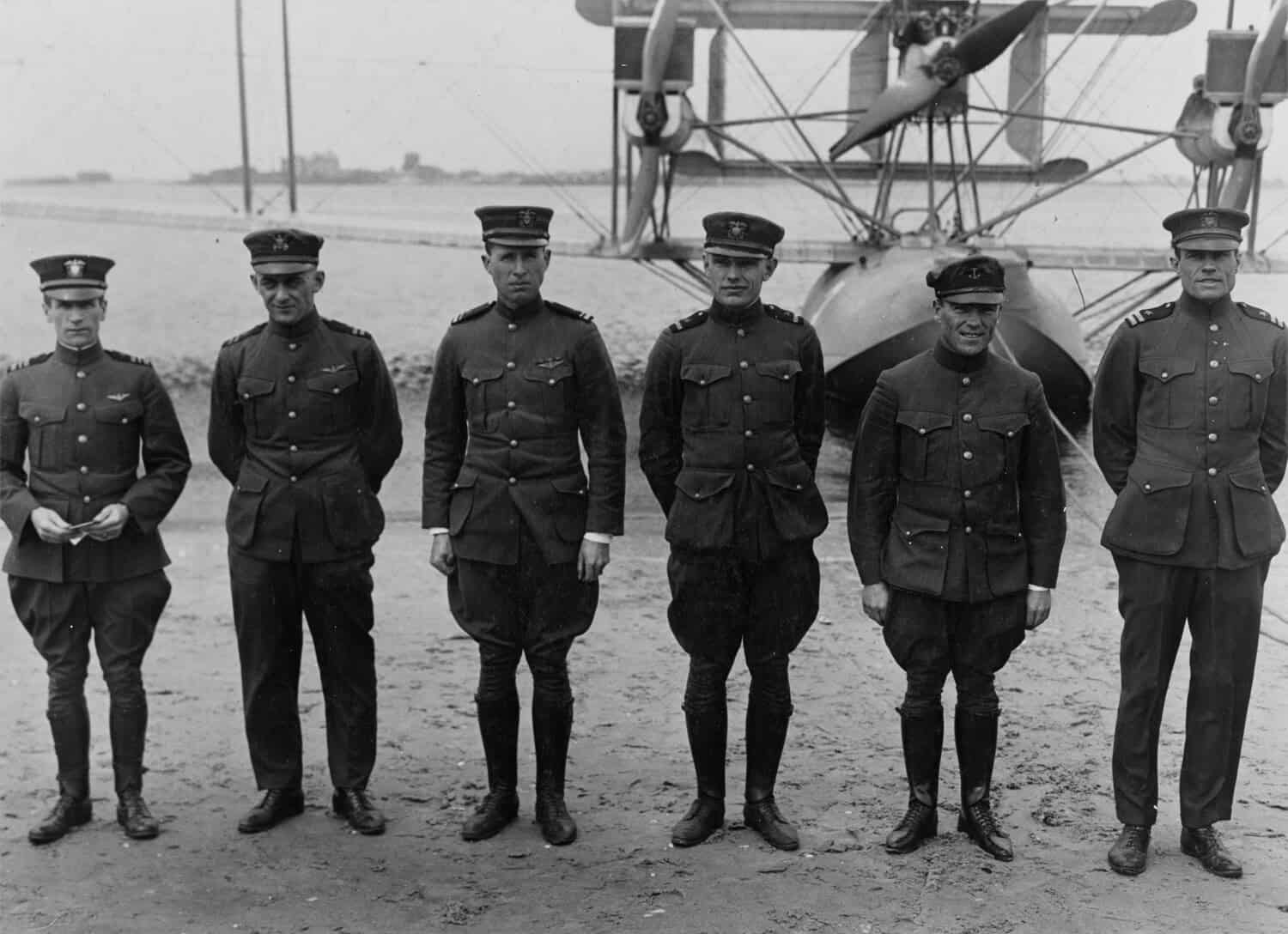
The U.S. Navy’s April 30, 1919 crew photograph shows six men in front of NC-4, with aircraft commander Albert C. Read at left and Stone beside him. Walter Hinton, Herbert Rodd, Eugene Howard and James Breese complete the group. The photograph predates the crossing and preserves a view of the team before the flight for which it would become known.
The Navy sent three flying boats on the attempt. The route took them from New York through stops in the northeastern United States and Canada, then across the ocean from Newfoundland by way of the Azores. Only NC-4 completed the journey. It reached Lisbon on May 27 and continued to Plymouth, England, arriving May 31. The Naval History and Heritage Command’s account describes the stops and interruptions that shaped the trip.
Those stops were integral to the attempt. In the Azores, NC-4 had to turn back on an initial departure for Lisbon because of a mechanical problem, according to the Navy account. The crew’s success depended on handling interruptions and continuing when conditions and the aircraft allowed. The ocean crossing was an achievement shared by the people flying, navigating, communicating and keeping the aircraft’s machinery working.
Back to test flying
The November 20 assignment is easy to overlook beside the crossing. It shows what the Navy asked Stone to do once the celebrated flight was over. At the Washington Navy Yard, he was reporting for work with the aircraft division of the Bureau of Construction and Repair. The Coast Guard chronology gives the date and purpose of the assignment. It does not identify a particular flight on that date.
Stone’s place in aviation history rests on more than a single flight. He helped establish a flying profession in the Coast Guard when the service had only just begun training aviators. The Navy used his skills for test work and for one of its most ambitious flying-boat missions. November 20 marks the day that experience went back into the work of testing aircraft.
Featured photograph: NC-4 crew, April 30, 1919. U.S. Navy photograph NH 120191, public domain. Photo record and credit.
Sources
U.S. Coast Guard Historian’s Office, Significant Dates in Coast Guard Aviation
Naval History and Heritage Command, NC-4 crossing account
U.S. Navy crew photograph and public-domain record





No comment