
Published November 20, 2026
On November 20, 1953, research pilot Scott Crossfield flew the Douglas D-558-2 Skyrocket to Mach 2.005, becoming the first pilot to fly at twice the speed of sound. NASA’s account of the program gives the speed as 1,291 mph. Crossfield was flying for the National Advisory Committee for Aeronautics, the federal research agency that preceded NASA.
What the speed record measured
Mach number compares an aircraft’s speed with the local speed of sound. That reference speed changes with air temperature, so Mach 2 does not always translate to the same figure in miles per hour. The significance of the 1953 flight was that the Skyrocket crossed a threshold defined by the air around it. It did so in a research aircraft, on a flight planned to examine a part of the speed range pilots had never reached.
The Skyrocket was air launched in its rocket configuration. A Navy P2B, a version of the B-29, carried it beneath the bomber before releasing it at altitude. This gave the research aircraft a different starting point from a conventional runway takeoff. The NASA history describes Crossfield’s final approach to Mach 2 as a climb followed by a shallow descent. The record was a peak measured during that flight rather than a sustained cruise speed.
A record built on earlier research
NASA notes that Crossfield had already made 20 flights in the Skyrocket studying how the airplane behaved, including the loads on its wing and tail and the way it responded to control inputs. Earlier pilots had exposed problems that were less obvious at lower speeds. The engineers could use those flights to compare what they expected with what the instrumented airplane actually did. The record flight extended that work into another part of the flight envelope.
The distinction matters because the Skyrocket’s legacy includes more than the speed in its record book. Its research examined the behavior of swept wings and the stability of an aircraft as it moved through the transonic and supersonic ranges. The program gave engineers evidence collected in a full-size aircraft. NASA’s program history links that broader research to design choices in later aircraft, including movable horizontal stabilizers.
The view from the hangar
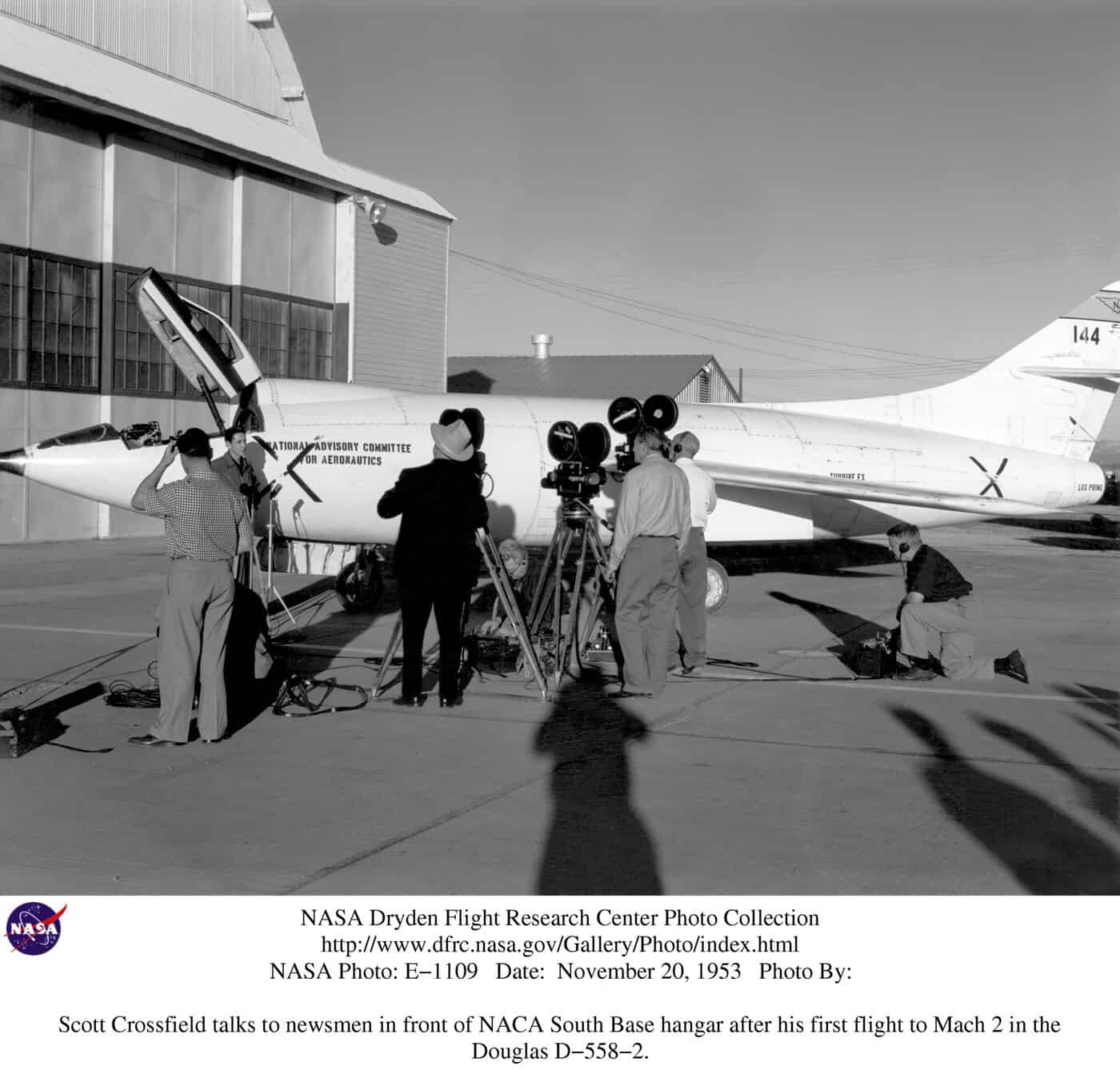
A photograph taken after the flight shows Crossfield speaking with reporters outside the NACA South Base hangar. The group gathered there could see the pilot, while the measurements that established the record came from the work done in the air. On its anniversary image page, NASA credits the preparations made by the ground team as part of the story. The picture preserves the public moment after a flight that depended on the work of a much larger group.
Featured photograph: Crossfield speaks with reporters on November 20, 1953, after his Mach 2 flight. Public-domain NACA photograph E-1109, cataloged by NASA Armstrong Flight Research Center. Archive record and full-frame file history. The featured copy was resized from the full frame.
Sources
NASA’s D-558-II Skyrocket program history
NASA’s November 20, 1953 anniversary image article
NACA photograph E-1109 archive record





No comment