
Published November 21, 2026
On August 12, 1977, Fitzhugh L. Fulton Jr. and Thomas McMurtry flew a modified Boeing 747 into the skies over Edwards Air Force Base with the prototype space shuttle Enterprise attached to its back. At about 25,000 feet, Enterprise separated and began its first independent flight. Fred Haise and Gordon Fullerton flew the prototype to a landing, while Fulton and McMurtry brought the carrier home. It was the first of five free flights, and Fulton and McMurtry were in the 747 cockpit for each one. NASA’s Approach and Landing Tests flight record
Two aircraft, one test
Enterprise was built to test the shuttle’s handling during approach and landing. For those tests, it had to begin its flight already in the air. The modified 747 supplied the altitude and speed, then released the orbiter so its crew could fly an unpowered approach. The test pilots aboard Enterprise were working toward a landing that orbital crews would later have to make after returning through the atmosphere. The carrier crew’s job was to give them repeatable starting conditions for gathering data. NASA’s Fulton biography
Fulton was the project pilot for the early Shuttle Carrier Aircraft tests. NASA built up to the separation in stages. First came captive flights with Enterprise carried as an uncrewed test article. Later, shuttle crews flew inside an active Enterprise while it remained attached to the 747. The July 26 captive flight put Haise and Fullerton in the orbiter to verify conditions for a free flight with the same carrier pilots who would take them aloft in August. Each stage let the teams learn about the combination before moving to a flight in which both aircraft had to land independently. NASA’s test chronology
How the flights changed
The first set of release flights used a tailcone on Enterprise. NASA removed it for the last two flights, on October 12 and October 26. The October 12 configuration included three simulated engine bells. The final flight also gave the program a chance to assess the landing gear on a paved runway. By varying the configuration and landing conditions across flights, NASA could examine the orbiter’s behavior in more than one test setup. The same two 747 pilots flew the carrier throughout the five-flight series. NASA’s free-flight records
From flight research to shuttle ferrying
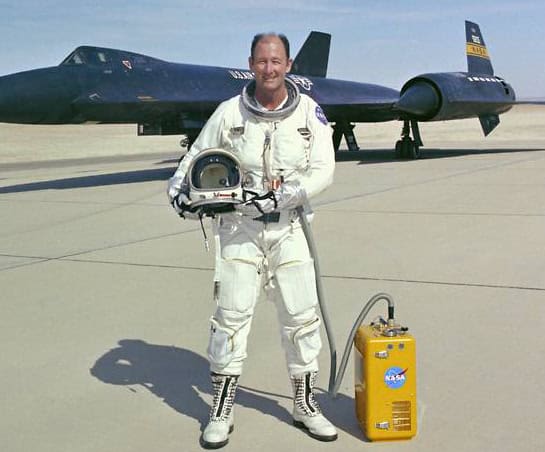
Fulton came to NASA in 1966 after 23 years as a U.S. Air Force pilot and spent nearly two decades flying research aircraft at what is now Armstrong Flight Research Center. The 747 was one part of a career that also included the YF-12 high-speed research program. The two assignments put him in very different aircraft, but both depended on planning a specific flight condition and helping researchers collect measurements under that condition. His work as a research pilot also included reviewing mission safety, briefing crews and reporting what happened after the flight. NASA’s YF-12 history · NASA’s Dryden anniversary profile
The 747 assignment continued after the landing tests. Once the shuttle began orbital missions, Fulton flew carrier trips returning orbiters to Kennedy Space Center. He also flew the carrier during Enterprise’s 1983 European tour. NASA awarded him Exceptional Service Medals for his work on the Approach and Landing Tests and on that tour. The same platform that had released Enterprise for test flights had become a way to move orbiters between sites. Fulton helped NASA establish both uses of the aircraft. NASA’s biography and service record
Sources
NASA pilot biography · NASA Approach and Landing Tests report · NASA YF-12 program history · NASA archival photograph EC72-2977-12
Featured photograph credit: NASA, EC72-2977-12. Editorial use under NASA’s media guidelines.





No comment