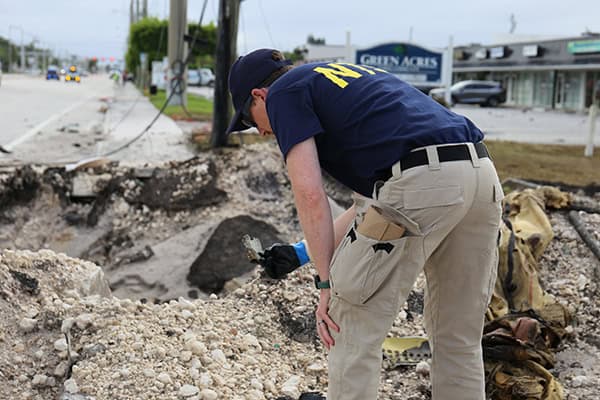
The National Transportation Safety Board has recovered the cockpit voice recorder from the Learjet 60 that crashed near Greenacres, Florida, on Nov. 1. The recorder was found at the site of the aircraft’s initial impact and is now being evaluated at the NTSB Vehicle Recorders Laboratory in Washington, the agency said in its latest investigation update on Nov. 9.
The recovery marks a significant step in the investigation, but it does not establish what caused the crash. The NTSB has not released recorder findings or a probable cause. Its investigation page continues to identify the case as ongoing and warns that the information is preliminary and subject to change. The agency also said excavation at the impact site has been completed.
What investigators have confirmed
The Learjet 60 was operated by Aurora Aviation, doing business as Upper Jet. The NTSB says the flight was traveling from Austin-Bergstrom International Airport in Texas to North Eleuthera Airport in the Bahamas when radar and radio contact were lost. The crash occurred near Greenacres in Palm Beach County. The Associated Press reported that all nine people aboard were killed.
In updates posted during the week after the crash, the NTSB described a broad wreckage recovery. Investigators identified and recovered portions from both wings, both engines, the flight deck, the vertical and horizontal stabilizers, the left elevator, aileron sections and multiple flap-track assemblies. Some components were sent to NTSB laboratories for closer inspection. Those details describe what has been collected; the agency has not said that any one recovered part explains the sequence of events.
The agency said the CVR was located at the initial impact site. It is now under evaluation in Washington. The NTSB has not said publicly whether the recorder contains usable audio, what period of time it may cover, or whether investigators have completed a readout. Recovery is not the same as a successful download, and a recorder’s contents must be evaluated alongside the other evidence.
Why the cockpit recorder matters
A cockpit voice recorder captures flight-deck voices, radio transmissions and other sounds in the cockpit. The NTSB describes those recordings as one tool in a larger investigation: engine sounds, warnings, crew communications and other audio can help investigators establish what was happening and when. They are considered with aircraft records, physical evidence, air-traffic-control information and other material gathered for the case.
The recorder does not, by itself, provide a complete explanation of an accident. It is distinct from a flight data recorder, which records aircraft parameters such as altitude, airspeed and heading. The NTSB’s public update in this investigation concerns the cockpit voice recorder; it does not announce a flight-data-recorder recovery or provide a finding about the cause of the crash.
There are also limits on what the public will hear. The NTSB says federal law prohibits release of cockpit voice recorder audio. In some investigations, the agency later releases a written transcript or a summary of relevant findings, but it has not announced a transcript or readout for this case. That process protects the private cockpit recording while allowing investigators to present information relevant to the safety investigation.
A preliminary investigation, not a final explanation
The NTSB’s public case page lists the investigation as ongoing. Its Nov. 9 update says the recorder is being evaluated and the excavation work at the impact site is complete. Earlier updates documented the recovery and transfer of aircraft parts. Those are steps in evidence collection; the Board has not issued a final report or identified a probable cause.
Investigators will need to compare the recorder’s contents, if recoverable, with the aircraft wreckage and the flight’s available records. The purpose is to build a supported sequence of events, identify any relevant safety issues and determine whether recommendations are warranted. Until the NTSB publishes additional findings, explanations based on a single piece of evidence would go beyond what the agency has confirmed.
The crash also affected the surrounding community. The NTSB said wreckage and debris were found away from the initial impact location and asked members of the public not to keep, move, alter or dispose of any aircraft debris they might find. The agency directed people who locate material to contact investigators so it can be documented and recovered.
The next public milestone will be an update from the investigation team about the recorder evaluation or other evidence. For now, the confirmed development is narrower: the CVR has been recovered, it is at the NTSB laboratory, and its contents have not yet been publicly reported. The Board’s findings remain pending.
Sources
- NTSB: Crash of Learjet 60, Investigation ERA27MA026
- NTSB: Cockpit Voice Recorders and Flight Data Recorders
- NTSB: Media Resources — Cockpit Voice and Flight Data Recorders
- Associated Press: Investigators recover the voice recorder from a jet crash in Florida that killed 9
Featured photograph: An NTSB investigator searches the impact site. Courtesy: National Transportation Safety Board. The NTSB’s website policy states that its staff-created web imagery is public domain unless otherwise noted.