
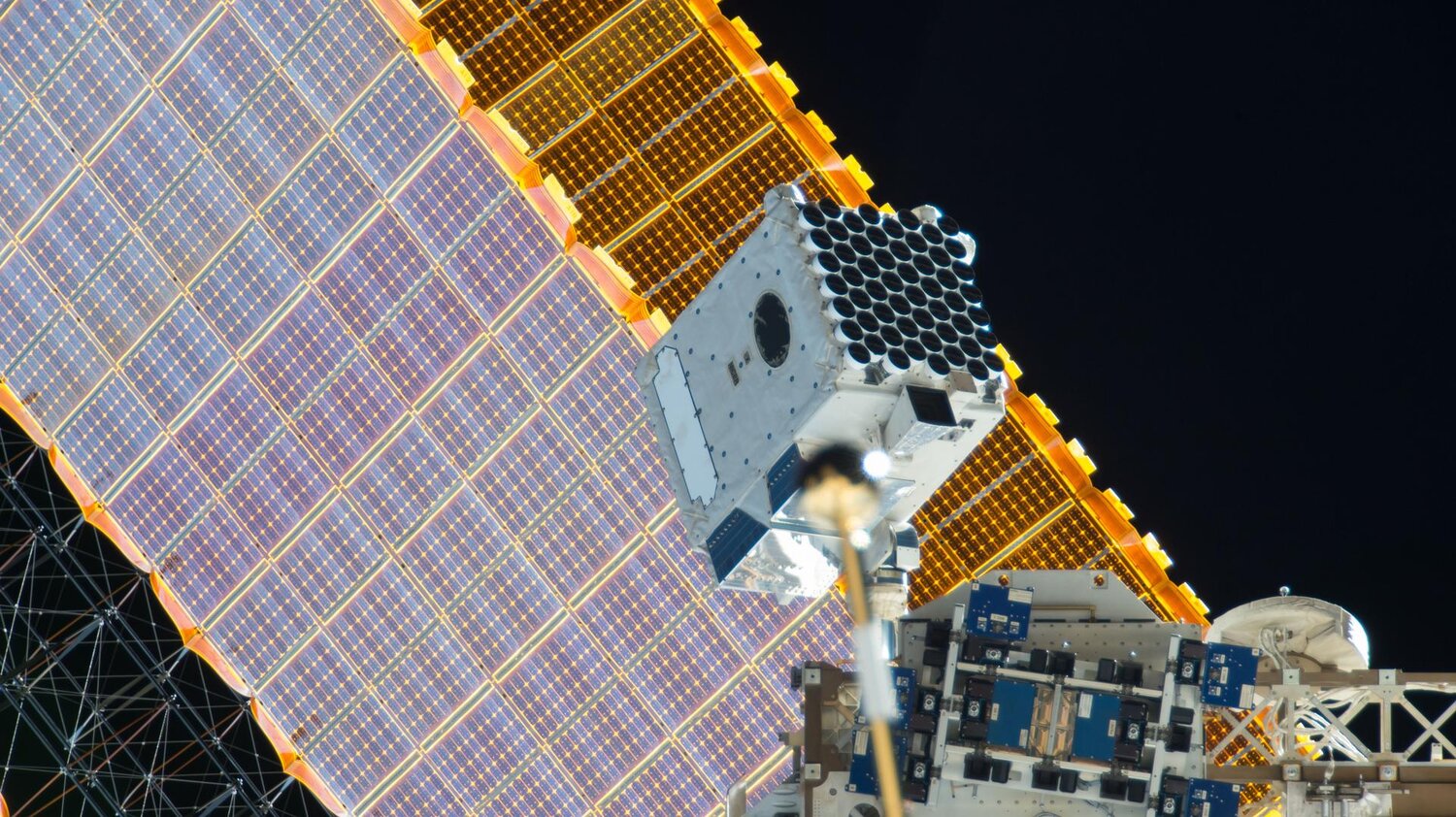
NASA announced on Nov. 17 that its NICER X-ray telescope aboard the International Space Station has ended science operations. The instrument, launched in 2017 for an initial 18-month mission, continued for years beyond that plan. The mission status update says the team is now preparing an eight-year archive and planning the telescope’s decommissioning and removal.
A pointing fault ended observing
NICER stopped collecting data in June 2025 after its ability to pivot side to side became restricted. A telescope that cannot point freely has fewer opportunities to follow its targets. Engineers reviewed photographs taken by cameras outside the station to rule out external causes. NASA says the investigation points to an internal motor failure.
The pointing issue followed a separate problem with unwanted sunlight entering the instrument. In January 2025, astronaut Nick Hague installed patches during a spacewalk. NASA later reported improved daytime observations after the repair and changes to the detector electronics. The later motion fault affected the telescope’s pointing rather than the amount of sunlight reaching the detectors.
An archive of the X-ray sky
NICER measured X-rays from neutron stars, black holes and other energetic systems. Neutron stars are especially valuable targets because they let scientists study matter under conditions difficult to reproduce on Earth. NICER also demonstrated a navigation technique that uses the regular X-ray pulses of certain neutron stars as timing references. The telescope’s observing program has ended, but its measurements can still be used as NASA completes the archive.
The telescope is mounted outside the station near its starboard solar array. NASA describes detachment as planned work and does not give a date in the Nov. 17 update.
Sources
NASA’s Nov. 17 NICER status report and earlier repair updates







No comment