
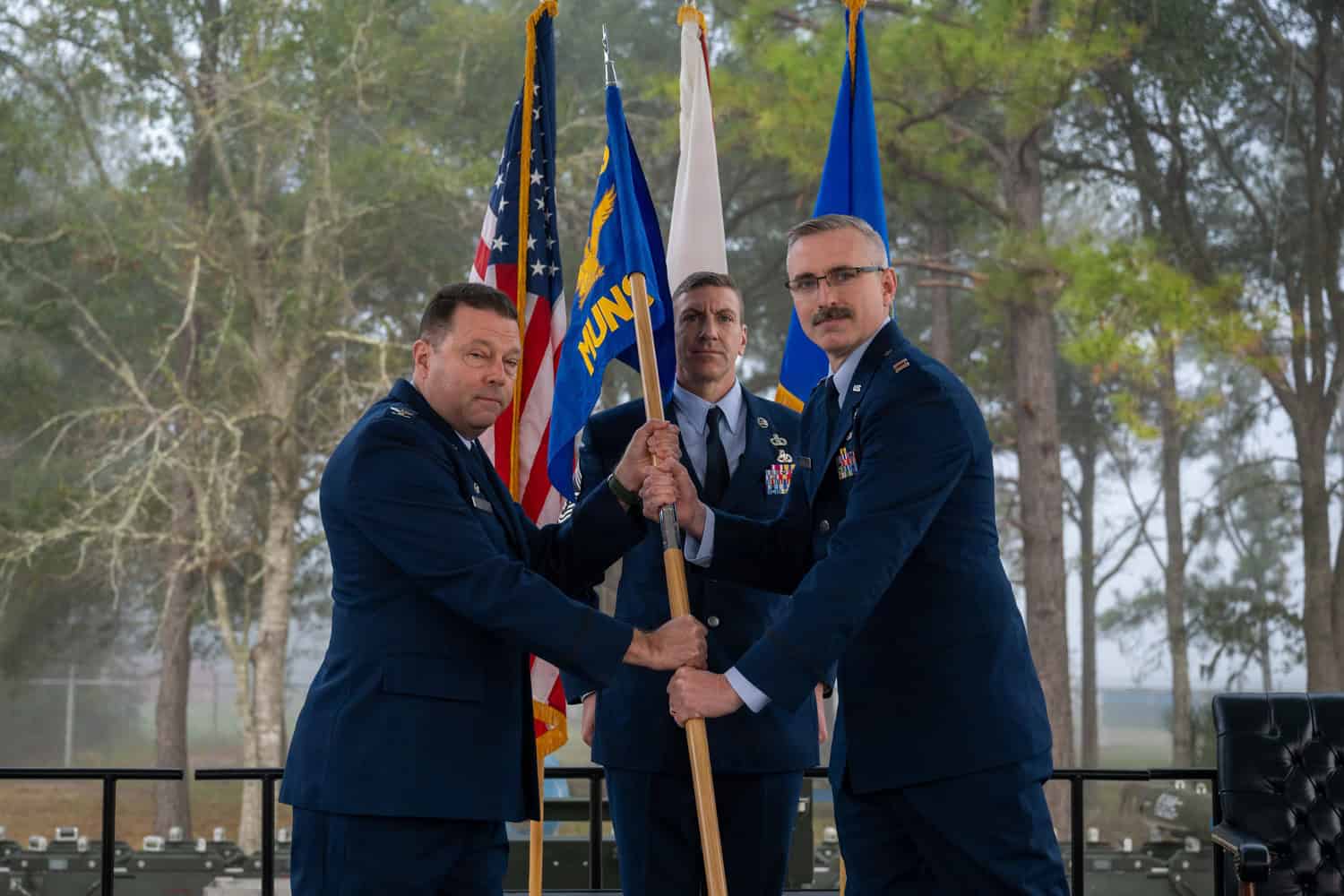
The Florida Air National Guard’s 125th Fighter Wing has activated a dedicated munitions squadron as it continues its transition from the F-15 Eagle to the F-35A Lightning II. The new 125th Munitions Squadron was activated Nov. 8 at Jacksonville Air National Guard Base, giving the wing a separate unit structure for managing the people, equipment and storage systems that support its expanding munitions mission. The wing announced the organizational change on Nov. 16.
The change is more than a new name on an organizational chart. The munitions organization had operated as a flight within the 125th Maintenance Squadron. Its elevation to squadron status places command and control closer to the munitions storage area and gives leaders a dedicated chain for administrative decisions, training and resource allocation. The unit is also dividing its work into three flights: Production, Materiel and Systems.
A new structure for a changing mission
The 125th Fighter Wing’s core responsibility for munitions support remains in place, including managing geographically separated units and supporting state and federal missions. The aircraft transition adds a larger air-to-ground component alongside the wing’s traditional air-to-air role, according to the wing’s account of the activation. That expansion brings additional demands for personnel, equipment, storage and planning.
The wing said its munitions personnel, equipment and facility footprints are doubling to meet the F-35 mission. The dedicated squadron is intended to keep decisions about those resources within the munitions organization, rather than competing with priorities across the broader maintenance group. Capt. Steven Reilly, the new squadron’s commander, described the F-15-to-F-35 conversion and the squadron activation as concurrent efforts designed to support one another.
The three-flight arrangement separates distinct responsibilities. Production focuses on supporting the flying mission. Materiel manages custody accounts across the state, ranging from base-defense small-arms ammunition and cockpit egress explosives to demolition assets used by Explosive Ordnance Disposal and RED HORSE units. Systems handles command and control, planning, scheduling and safe operations. The wing says the structure is meant to clarify accountability across those functions.
Facilities, equipment and staffing
The expansion also requires changes at the installation. The wing reports that it is bringing in new explosives-storage structures and specialized equipment, including a munitions assembly conveyor. The system uses an assembly-line arrangement with gantry cranes and is intended to support larger-scale bomb assembly. These facilities and equipment form part of the physical infrastructure needed to support a more substantial air-to-ground role; the activation itself does not mean the wing has completed its conversion or reached full operational readiness.
Manning the organization ahead of full readiness has involved both retraining and recruiting. Existing Airmen from legacy aircraft career fields are being retrained, while the wing has also recruited people entering military service and prior-service Airmen from the Regular Air Force through the Palace Chase program. Reilly told DVIDS that experienced prior-service members can bring relevant weapons experience into the unit as it grows. The wing’s report does not give a date for when the squadron will reach its full staffing requirement.
The expanded structure is also connected to a broader Air Force effort, begun in 2019, to standardize munitions organizations across active-duty and reserve components. The stated aim is to make units more consistent and better able to integrate when deployed. Reilly said a standardized organization is intended to allow the squadron’s personnel to deploy together and operate within a joint or total-force environment. That is an organizational goal described by the wing, rather than a report of a specific deployment.
The F-35 transition at Jacksonville
The 125th Fighter Wing’s transition has unfolded in stages. The unit received its first F-35A in March 2025, and the first permanently assigned aircraft arrived at Jacksonville Air National Guard Base on July 9, 2025. The wing said the phased delivery plan was designed to maintain readiness while it moved from its F-15C/D fleet to the F-35A. The munitions squadron activation is a new support-organization milestone within that longer conversion.
The F-35A changes the range of missions the wing is preparing to support. The aircraft is a fifth-generation fighter with air-to-air and air-to-ground roles, and the wing says its munitions organization is being built to serve both. The unit’s work includes managing weapons-related materiel and systems, maintaining custody and accountability, and coordinating safe operations. Specific weapons inventories, operational plans and readiness timelines were not detailed in the activation report.
For the Florida Air National Guard, the transition carries both federal and state responsibilities. The wing’s munitions unit supports the fighter mission, but its accountability extends to assets and geographically separated organizations across Florida. The Materiel Flight’s stated responsibilities—from small-arms ammunition to demolition assets—show that the squadron’s work is broader than loading aircraft for sorties. It is also a custody, safety and logistics function that must work across multiple mission areas.
Building a unit for the next phase
The ceremony marked the formal activation of the 125th Munitions Squadron, while its staffing, facilities and equipment continue to expand. The distinction matters: a unit can be activated before every part of its future structure is fully staffed or operational. The wing’s report describes a build-out underway, including new storage infrastructure, specialized assembly equipment and a larger workforce, but does not state that the conversion is complete.
The new squadron’s first task is to establish a durable organization around those changes. Production, Materiel and Systems provide defined areas of responsibility as the wing works through the F-35 transition. The challenge will be to grow those functions while maintaining the munitions support required for the unit’s day-to-day flying and its state and federal commitments.
For the 125th Fighter Wing, the activation links a new aircraft era to a reorganization of the support personnel behind it. The F-35 transition is often measured by aircraft deliveries, but the munitions squadron announcement highlights the less visible work of expanding storage, training, accountability and command arrangements. The wing has created the organization; its next milestones will be the continued growth of the people and systems needed to support the aircraft.
Sources
- DVIDS: 125th Fighter Wing activates Munitions Squadron amid F-35 conversion (Nov. 16, 2026).
- DVIDS photo 10097927 (activation ceremony, Nov. 8, 2026; public domain; Tech. Sgt. Marissa Welker, U.S. Air National Guard).
- 125th Fighter Wing: First permanently assigned F-35 arrives (Aug. 21, 2025).






No comment