
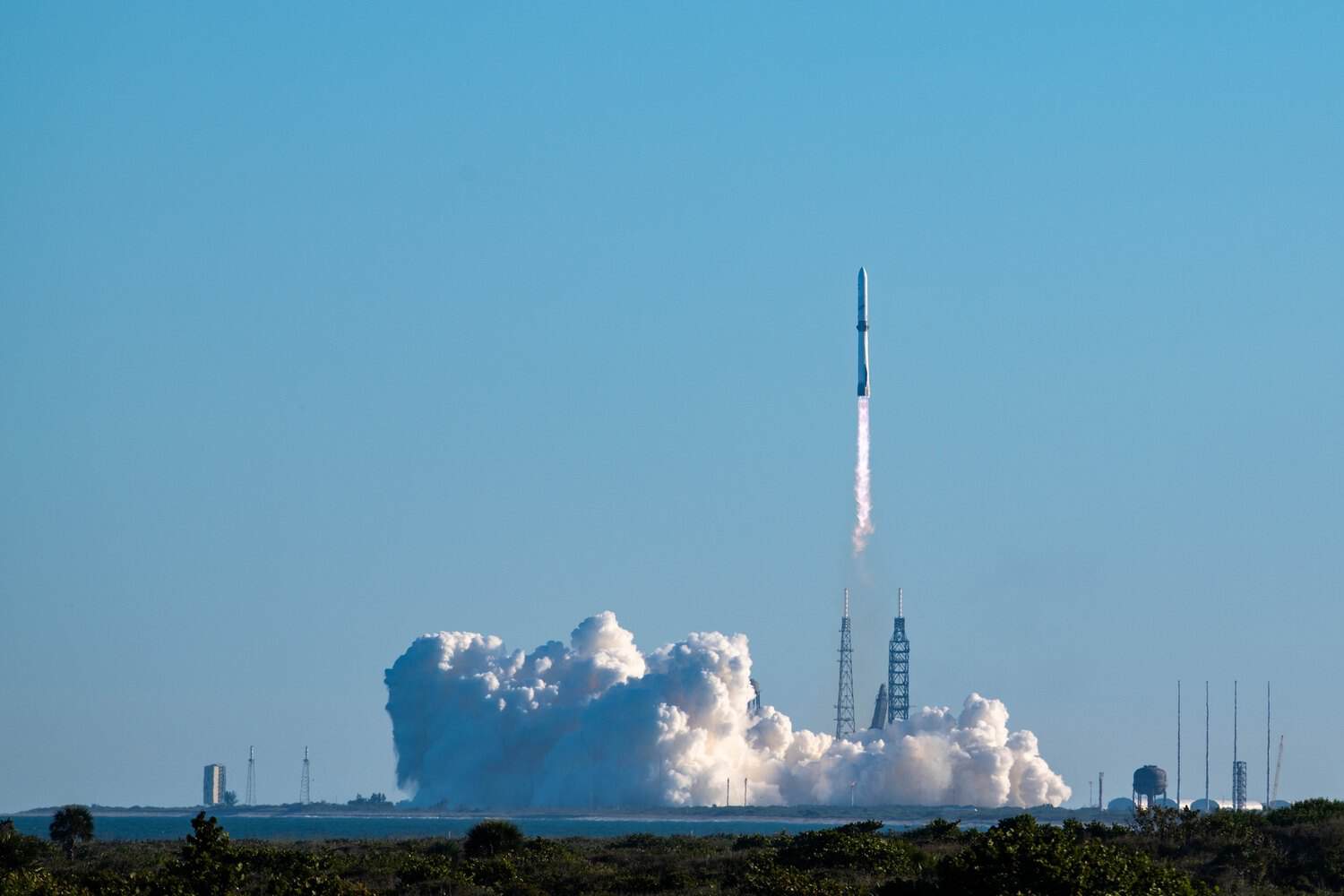
Blue Origin and Google announced on November 19 that they have signed a launch services agreement for Project Suncatcher, Google’s research program for running machine-learning workloads aboard satellites. The companies are targeting the first quarter of 2029 for a dedicated New Glenn flight. They say the mission is designed to place multiple satellites in sun-synchronous orbit, each with computing capacity roughly comparable to a data-center rack. Blue Origin’s announcement · Google’s announcement
The contract adds a heavy-lift mission to a program that has already flown an initial prototype and has a separate two-satellite milestone planned for 2027. Each step addresses a different scale of experiment. The prototype offers a place to try computing hardware in orbit. Two satellites can test working across spacecraft. The dedicated New Glenn flight gives Google a way to launch a larger group of computing satellites together. Google’s prototype update and 2027 milestone · Reuters coverage of the agreement
What Blue Origin has agreed to launch
The payloads are intended to carry Google’s Tensor Processing Units, or TPUs, the company’s chips designed for machine-learning tasks. The companies describe the computing capacity at the level of each satellite. That comparison gives a sense of how much computing hardware Google wants to put on an individual platform. It leaves open the combined capacity of the mission, since the announcements give no satellite count, chip count or throughput figure. Blue Origin’s mission description · Google’s description of the payloads
Using a dedicated launch gives the mission a flight arranged around its own payload and orbital objectives. That differs from Google’s first prototype flight, which used a shared launch with other spacecraft. Blue Origin cited New Glenn’s payload capacity and room inside the fairing in describing why the rocket can support the mission. The announcement establishes a target quarter and orbital class. A specific launch date and the deployment sequence have yet to be announced. Blue Origin’s launch agreement details · Google’s initial prototype announcement
From one prototype to several spacecraft
Google said its first prototype, built with satellite operator Planet, launched October 1, 2026, on SpaceX’s Transporter-18 rideshare. Later that month the company reported receiving a response from the spacecraft. That update was an early sign that the hardware could be reached in orbit. Google described reliable execution of workloads as work it needed to verify before moving on to the interconnected pair planned for 2027. Google’s October 1 launch update · Google’s October 30 contact update
There is a practical difference between computing on one satellite and coordinating work among several. A single spacecraft can help researchers study how the chip and the rest of the spacecraft behave together. Work spread across multiple spacecraft also depends on how quickly and consistently they can exchange information. Google’s broader Project Suncatcher concept calls for an interconnected network of solar-powered satellites. The announced flights give it opportunities to test pieces of that idea in orbit as the program moves toward bigger payloads. Blue Origin’s summary of the network concept · Google’s test plans
Why the orbit matters
A sun-synchronous orbit is arranged so the spacecraft crosses a given latitude at roughly the same local solar time on successive passes. That property can help mission planners manage lighting conditions. The companies linked their choice of orbit to a research program exploring how solar energy could support computing in space. Their announcements give the orbital class, while mission-specific details such as altitude, lighting schedule and available electrical power have yet to be published. Google’s plans for the orbit
Power is only part of the spacecraft design. Computing hardware also produces heat, which has to be moved away from the electronics and ultimately radiated into space. The satellite must do that while supplying power to its other systems and maintaining communications. A rack-scale comparison offers a familiar measure of the computing ambition, while those engineering constraints help explain why the program has started with prototypes. Google’s overview of the engineering challenges
Sources
Blue Origin launch announcement · Google launch announcement · Google prototype launch · Google prototype contact update · Reuters · Featured photograph, DVIDS 9387521
Featured photograph: U.S. Space Force photo by Samuel Becker, public domain. It shows a New Glenn launch on November 13, 2025, on an earlier mission.







No comment