
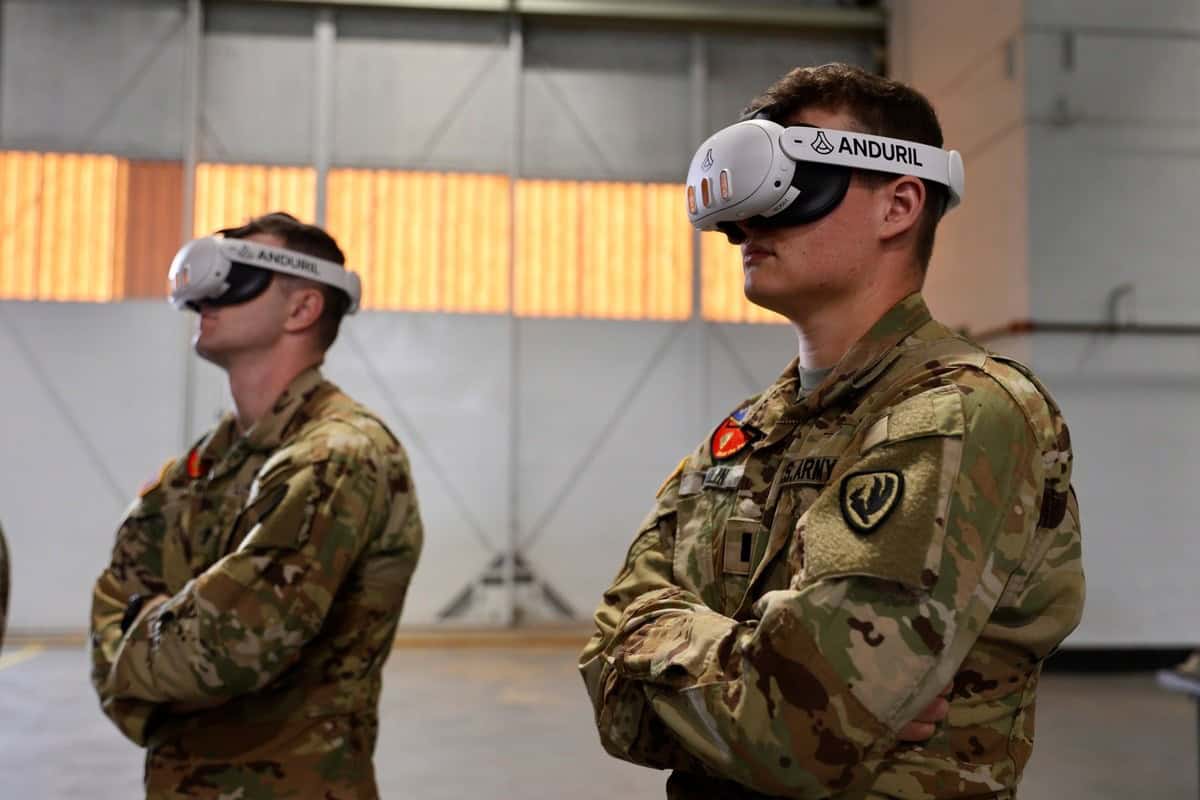
Army aviation students at Fort Rucker, Alabama, put on virtual reality headsets on Nov. 20 to examine how pilots could work alongside autonomous aircraft. The Army’s account of the demonstration describes a classroom exercise in which students could explore emerging technology before encountering it in operational units.
Among the students were First Lts. Colby Clark and Patrick Mullin, who were in the academic phase of AH-64 Apache flight training. The event brought a broader question into that phase of their education: what should an aviator understand about an aircraft or system that operates alongside their own, even if they never sit at its controls?
From aircraft concepts to a shared picture
The demonstration had two parts. Students first reviewed examples of unmanned and optionally piloted aircraft. They also saw a hybrid-electric tiltrotor concept, which the Army described as an industry example for discussion. The examples gave the class a way to compare different ideas about autonomy and aircraft design without treating them as choices the service had already made.
Students then used a three-dimensional simulation that the Army likened to a sand table. A traditional sand table lets a group discuss terrain and positions around a common physical model. In this exercise, a virtual display gave students a common view for discussing information from air, ground and space systems. Clark singled out that portion as a useful way to see how unmanned systems might fit into planning.
What the demonstration established
Anduril Industries supported the session at the request of Maj. Gen. Phillip C. Baker, commanding general of the Army Aviation Center of Excellence and Fort Rucker. Glenn Rizzi, a retired Army aviator and Anduril program manager, introduced the experience. The Army said the event carried no procurement, fielding or endorsement decision.
That distinction matters when a classroom demonstration presents an aircraft concept. A simulation can help students think through what they need to know and what questions to ask. The Army identified further experimentation, testing and airworthiness assessment as steps that would precede any wider operational use. The release did not report flight test results or a schedule for introducing the concepts to units.
Featured photograph: U.S. Army photo by Leslie Herlick, showing Clark and Mullin during the Fort Rucker demonstration. Original photograph. Editorial reuse under the Army’s imagery policy.






No comment