
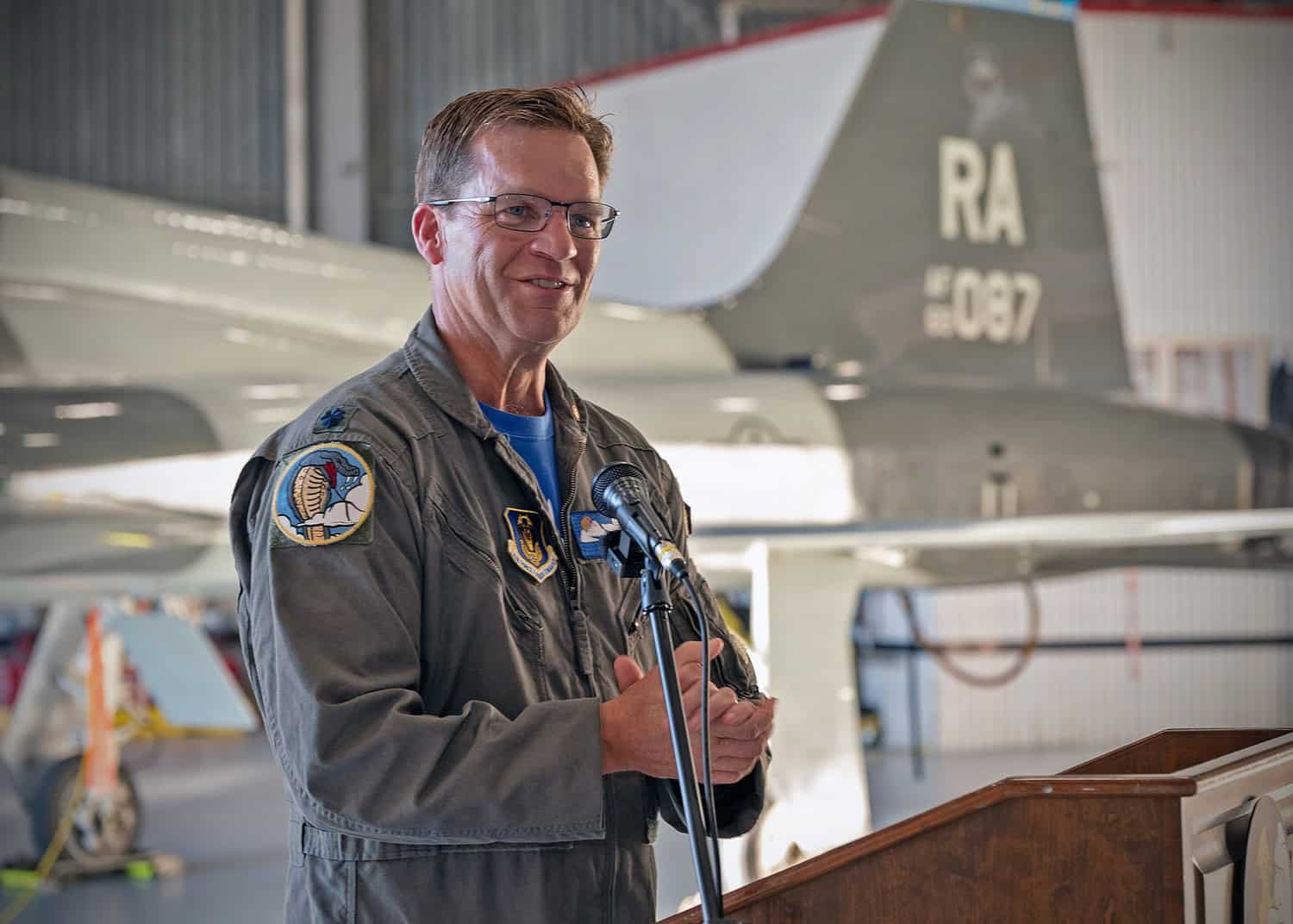
Lt. Col. Matthew “MiG” Alley closed a flying career measured in more than 3,500 hours in the Northrop T-38 Talon, but his final sortie at Joint Base San Antonio-Randolph also marked the end of a different kind of service: years helping children facing serious illness experience the Air Force from the inside. Alley flew his final T-38C flight on Nov. 6, 2026, with Under Secretary of the Air Force Matthew Lohmeier in the rear seat. The 39th Flying Training Squadron instructor pilot finished with 3,539 hours in the Talon and more than 32 years of military service, according to the 340th Flying Training Group’s account published through DVIDS.
The flight ended with a formation of four T-38Cs over Randolph, followed by a retirement ceremony. The public account of the day ties the number of hours to the aircraft Alley flew, and also describes his work as a coordinator and champion of the base’s “Pilot for a Day” program. That program brought pediatric patients and their families to the installation for a day built around aviation, including visits and a “dream flight immersion.” The story of Alley’s career therefore has two distinct measures: instructor flying in a supersonic trainer, and community work that introduced children to the people and routines behind military aviation.
A final flight in the T-38C
Alley’s final sortie took place at Joint Base San Antonio-Randolph in Texas. During the flight, Lohmeier rode in the rear seat. Four T-38C aircraft flew in formation, and Lohmeier later delivered remarks and officiated the retirement ceremony, according to the DVIDS report and its photo captions. The photos show more than one part of the event: formation flying, the presentation of a patch recognizing Alley’s accumulated T-38 time, and the ceremony where he addressed colleagues and supporters.
A “fini flight” is a unit tradition marking a pilot’s last flight in a particular assignment or aircraft, often followed by a gathering with colleagues and family. In Alley’s case, the ceremony recognized a full military retirement after three decades of service. The published account does not characterize the flight as a test or operational mission; it was a ceremonial final sortie in the aircraft that had defined much of his aviation career.
The T-38 is a two-seat, twin-engine supersonic trainer. The Air Force describes it as a high-altitude aircraft used for advanced pilot training, including preparation for fighter and bomber aircraft. Its tandem cockpit allows an instructor to fly with a student, a role central to the training system Alley served. The T-38C is an upgraded version of the Talon used by Air Education and Training Command for undergraduate and instructor pilot training. The Air Force’s T-38 fact sheet explains the aircraft’s place in that pipeline.
3,539 hours and the work of instruction
Alley’s 3,539-hour total is specifically reported as time in the T-38 Talon. DVIDS identifies him as a 39th Flying Training Squadron T-38 instructor pilot and flight commander, and the printable version of the story also describes him as a chief functional check flight pilot. Those jobs place an experienced aviator in a training environment where consistency, judgment and communication matter alongside hands-on aircraft skills. Instructor pilots do more than demonstrate maneuvers: they assess how a student processes a situation, help establish sound habits and build the confidence required for more advanced training.
The T-38’s continued training role links the instructor’s daily work to the next stage of military aviation. Air Force student pilots assigned to fighter or bomber tracks use the Talon to build skills before moving on to operational aircraft. The Air Force lists the F-15, F-16, A-10, B-1 and F-22 among the aircraft for which T-38 training provides preparation. The Talon is not a substitute for those aircraft; it is a high-performance training platform that helps pilots develop formation flying, instrument procedures and the judgment needed for advanced flight.
That instructional role adds context to a long flying-hour record. A final flight ends an individual’s time in the cockpit, but the teaching reaches forward through the pilots he helped train. The DVIDS account describes Alley as a mentor to the next generation of military aviators and notes that fellow Airmen gathered for his retirement. It does not enumerate how many students he instructed, so the reported 3,539 hours and more than 32 years are the clearest public measures of his flying career.
Pilot for a Day: a different kind of mission
Alley’s work with children and families gave his role a second dimension beyond flight training. The 340th Flying Training Group says he was a driving force behind the Air Force’s Pilot for a Day program and hosted pediatric patients from local medical centers, including Christus Children’s Hospital. The visits offered families an aviation-centered day, with a VIP experience and what the unit described as a dream-flight immersion. The available report does not detail every visit or identify the children involved, preserving the focus on the program rather than private medical stories.
The program’s premise is to give a child and family time away from the demands of treatment and a chance to explore aviation in a military setting. Historical Air Force material traces the original Pilot for a Day program to Randolph Air Force Base in December 1994, when Capt. Rory “Ox” Blackburn organized it after visiting his wife at a local hospital. Programs using the same name later appeared at other Air Force bases, with local variations. The 119th Wing’s program history records that origin; the 340th group’s recent account documents Alley’s role in the Randolph-area effort.
That background helps explain why the unit framed Alley’s legacy in terms of both airmanship and community service. For children who are invited to a base, the experience can make a military installation and its aircraft more approachable. The public report does not claim a medical outcome, and none is needed to understand the program’s value: it is designed to create an aviation experience for children and families navigating serious illness. The hours Alley spent supporting those visits are not captured in the 3,539-hour flight total, but they form a separate part of the record colleagues honored at retirement.
Recognition at Randolph
The retirement ceremony brought together instructor pilots, unit leadership and supporters. DVIDS reports that Lohmeier provided remarks and officiated the ceremony after flying with Alley. The public account includes a comment from 39th Flying Training Squadron commander Lt. Col. Christopher Puccia praising Alley’s professionalism in the air and commitment to the community on the ground. The unit’s recognition focused on his service, mentorship and long experience in the T-38 community.
Photographs from the event provide a documentary record of the final-flight tradition. One image shows Alley speaking at the ceremony, with a T-38 in the hangar behind him. Another captures a formation of four T-38Cs on the sortie, while a separate frame records a patch presentation recognizing his 3,539 T-38 hours. The featured photograph for this report is from the retirement ceremony itself, not a generic training image: it shows Alley addressing the audience on Nov. 6 at Randolph.
What the milestone says about a training fleet
The T-38 first entered Air Force service in the early 1960s and remains in use for advanced training. Its age makes the instructor’s role and the system around the aircraft especially important: safe, repeatable training depends on maintenance, procedures, instructors and students as much as on the aircraft’s performance. The Air Force’s fact sheet describes the Talon as a platform used for a variety of training tasks and notes that the C-model incorporates an avionics upgrade. The service continues to use the T-38C to prepare pilots for fighter and bomber assignments.
Alley’s last flight does not mark the end of the T-38 mission at Randolph. The aircraft and its training role continue with the pilots and instructors who remain. But the retirement of a veteran instructor closes a personal chapter and transfers accumulated knowledge through the students, colleagues and procedures he leaves behind. The Air Force’s public account does not suggest that one person alone defines a squadron’s training output; instead, Alley’s career is presented as an example of the people who sustain that work over years of service.
A career measured beyond the cockpit
Alley’s Nov. 6 final flight brought a 32-plus-year military career to a formal close. The tally of 3,539 hours in the T-38 gives the milestone a precise aviation measure, while his work with Pilot for a Day points to a quieter form of service. In the air, he trained military aviators in a demanding aircraft. On the ground, he helped open the base to children and families for whom a day around aircraft and flight crews could become a memorable break from medical routines.
For a Pilot of the Day profile, the distinction is worth keeping: Alley’s achievement is not only the number of hours, and the community program is not an accessory to his flying career. Both are part of the record his unit shared at retirement. The final formation flight ended his own time in the Talon; the pilots he helped instruct and the families he helped welcome to Randolph carry the wider legacy forward.





No comment