
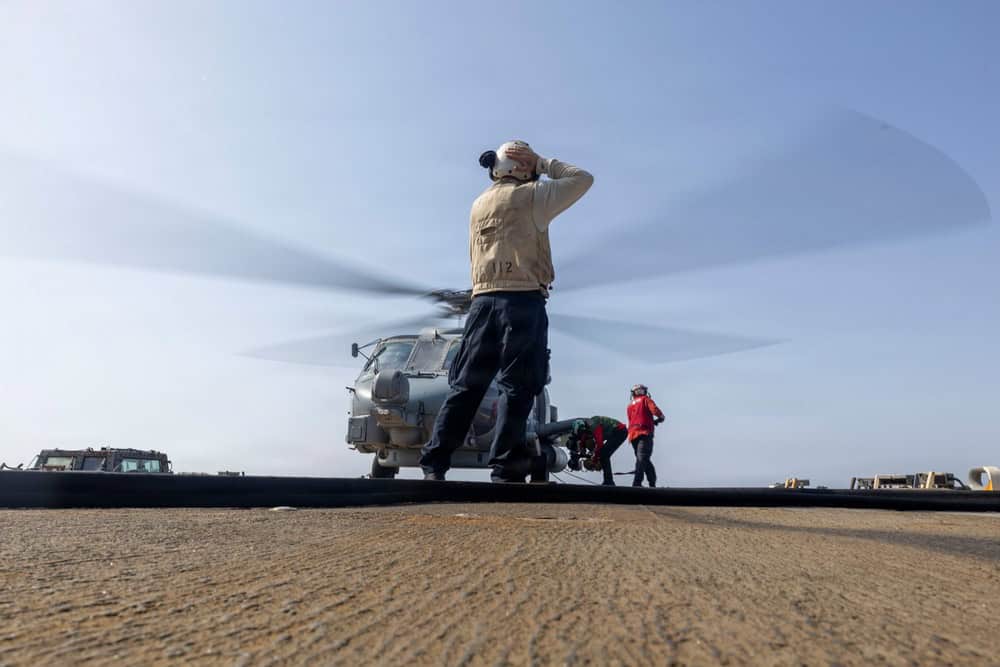
When the Arleigh Burke-class destroyer USS Michael Murphy returned to Joint Base Pearl Harbor-Hickam on Nov. 12 after an 11-month deployment, its embarked helicopter detachment brought home a substantial flight record: 330 sorties, more than 900 mishap-free flight hours, and 273.4 combat flight hours. Those figures, published by U.S. 3rd Fleet, offer a rare quantitative look at the aviation work carried out from a destroyer during an extended deployment across several fleet areas.
The aircraft were MH-60R Seahawk helicopters operated by Helicopter Maritime Strike Squadron 71 Detachment 2, or HSM-71 Det. 2. The Navy’s release reported the totals as part of the ship’s deployment summary. It did not provide a sortie-by-sortie account, a breakdown of mission types, or a detailed explanation of how it classified combat flight hours. The figures should therefore be read as the Navy’s reported aggregate, rather than as a complete operational log.
A helicopter detachment at sea for nearly a year
Michael Murphy left Pearl Harbor on Dec. 1, 2025, and returned Nov. 12, 2026. The Navy described the deployment as 11 months and said the ship operated in the U.S. 3rd, 7th, and 5th Fleet areas of operations. Independent reporting by Defense One likewise reported the destroyer’s return after a 346-day deployment, including operations in the South China Sea and 12 contested transits of the Strait of Hormuz.
The helicopter detachment was part of the ship’s deployed force, not an air wing operating from a carrier. The distinction matters: a destroyer has a smaller aviation footprint, and its helicopter is integrated into the ship’s day-to-day operations. NAVAIR describes the MH-60R’s primary mission set as anti-submarine warfare, surface warfare, electromagnetic warfare, command and control, and non-combat operations. The platform can also support search and rescue, medical evacuation, logistics, intelligence, surveillance, and reconnaissance. Those are capabilities of the aircraft; the Navy’s deployment summary does not say which ones accounted for the detachment’s 330 sorties.
The Navy’s reported total works out to an average of about 30 sorties per month across an 11-month deployment. Dividing the stated flight-hour minimum of 900 by 330 sorties gives a little more than 2.7 hours per sortie on average. These are simple calculations from rounded public totals, not figures separately published by the Navy, and they cannot show how flying was distributed among months, crews, or mission types. Some sorties may have been shorter or longer, and the public summary does not identify the number of aircraft assigned to the detachment at any given time.
What the deployment record says—and what it leaves out
The 273.4 combat flight hours are a subset of the more than 900 total hours reported for HSM-71 Det. 2. The release does not define the Navy’s accounting criteria for that category or connect the hours to named operations. It does establish that the detachment’s work extended beyond routine transit and training: Michael Murphy operated under U.S. Central Command and U.S. 5th Fleet during part of the deployment, then also conducted surface and anti-submarine operations in the South China and Philippine Seas while operating in U.S. 7th Fleet.
The destroyer’s account describes an environment in which ship and aircraft operations formed one part of a larger force. The ship served with Carrier Strike Group 3 and Destroyer Squadron 21, then operated alongside other carrier strike group staffs, ships, and aircraft under Task Force 50 leadership. The Navy reported that Michael Murphy coordinated the defense of 14 U.S. and coalition vessels, including Coast Guard cutters and logistics ships, and completed 12 contested Strait of Hormuz transits while escorting four merchant tankers. These were ship-level tasks; the public release does not attribute each one to the helicopter detachment.
That caveat is important when interpreting flight statistics. Sorties and hours measure activity, but on their own they do not explain the aircraft’s exact contribution to a particular operation. A flight could support surveillance, ship defense, training, personnel movement, or another authorized task. The source does not report how many of the sorties were combat missions, how many were training events, or how many were conducted in each region. It also does not identify the aircraft’s availability rate or maintenance workload.
Why the MH-60R fits a destroyer’s mission
The MH-60R is designed for maritime operations from aircraft carriers and other aviation-capable ships. Its anti-submarine and surface-warfare roles make it a complement to a destroyer’s sensors and weapons: the aircraft can extend the ship’s reach beyond the horizon, while the ship provides a mobile operating base, communications, fuel, maintenance support, and coordination with the wider force. NAVAIR notes that the MH-60R replaced the Navy’s older SH-60B and SH-60F helicopters and remains in production.
That arrangement has practical limits. A helicopter detachment aboard a destroyer is not equivalent to a carrier air wing, and the ship’s schedule, weather, deck conditions, maintenance needs, and available aircraft all affect how often it can fly. The Nov. 12 release does not provide those details for HSM-71 Det. 2. Its totals are still useful because they document a sustained aviation presence across a long deployment, but they should not be treated as a proxy for every capability the ship or helicopter demonstrated.
The mission record also sits alongside a demanding surface schedule. The Navy said Michael Murphy steamed more than 97,000 nautical miles, conducted 43 replenishments at sea, and received 1,100 pallets of supplies and mail. It reported eight combat in-port refuelings and the transfer of more than 8 million gallons of F-76 marine diesel and 2 million gallons of JP-5 fuel. These details help describe the deployment’s scale, although the release does not break out how aviation fuel was apportioned or identify the helicopter detachment’s support burden.
A demanding return, with more detail still unpublished
The Navy said Michael Murphy and its crew received the Presidential Unit Citation and Combat Action Ribbon in recognition of the deployment. That award announcement concerns the ship and crew as a whole; the release does not list separate awards for the aviation detachment. The ship’s commanding officer described the crew’s work in the context of defending allies and operating through contested chokepoints, while the public account gives the helicopter detachment’s contribution in aggregate flight totals.
For aviation observers, the most concrete takeaway is the scale of that record: more than 900 flight hours and 330 sorties from a small ship-based detachment over a deployment lasting nearly a year. The available figures show that the MH-60R team maintained a steady flight presence while Michael Murphy moved among fleet areas and carried out its wider assignment. They do not reveal what each flight achieved, but they provide a measurable baseline for the aircraft’s sustained use aboard a deployed destroyer.
Further detail would make the record more informative: the number of aircraft and crews assigned, the distribution of sorties by mission, the meaning of “combat flight hours” in this accounting, and the maintenance effort required to sustain the pace. Until such information is released, the Navy’s summary remains the clearest public account. The Nov. 12 return closed the deployment; the aviation totals help explain one part of what the ship and its detachment were asked to sustain at sea.
Photo and sources
Featured image: a U.S. Navy sailor signals an HSM-71 MH-60R aboard USS Michael Murphy on June 4, 2026. It is an archival photograph and is not an image of the ship’s Nov. 12 return. Credit: U.S. Navy photo, courtesy of U.S. Central Command Public Affairs via DVIDS, Photo ID 9733650. DVIDS marks the photograph public domain.






No comment