
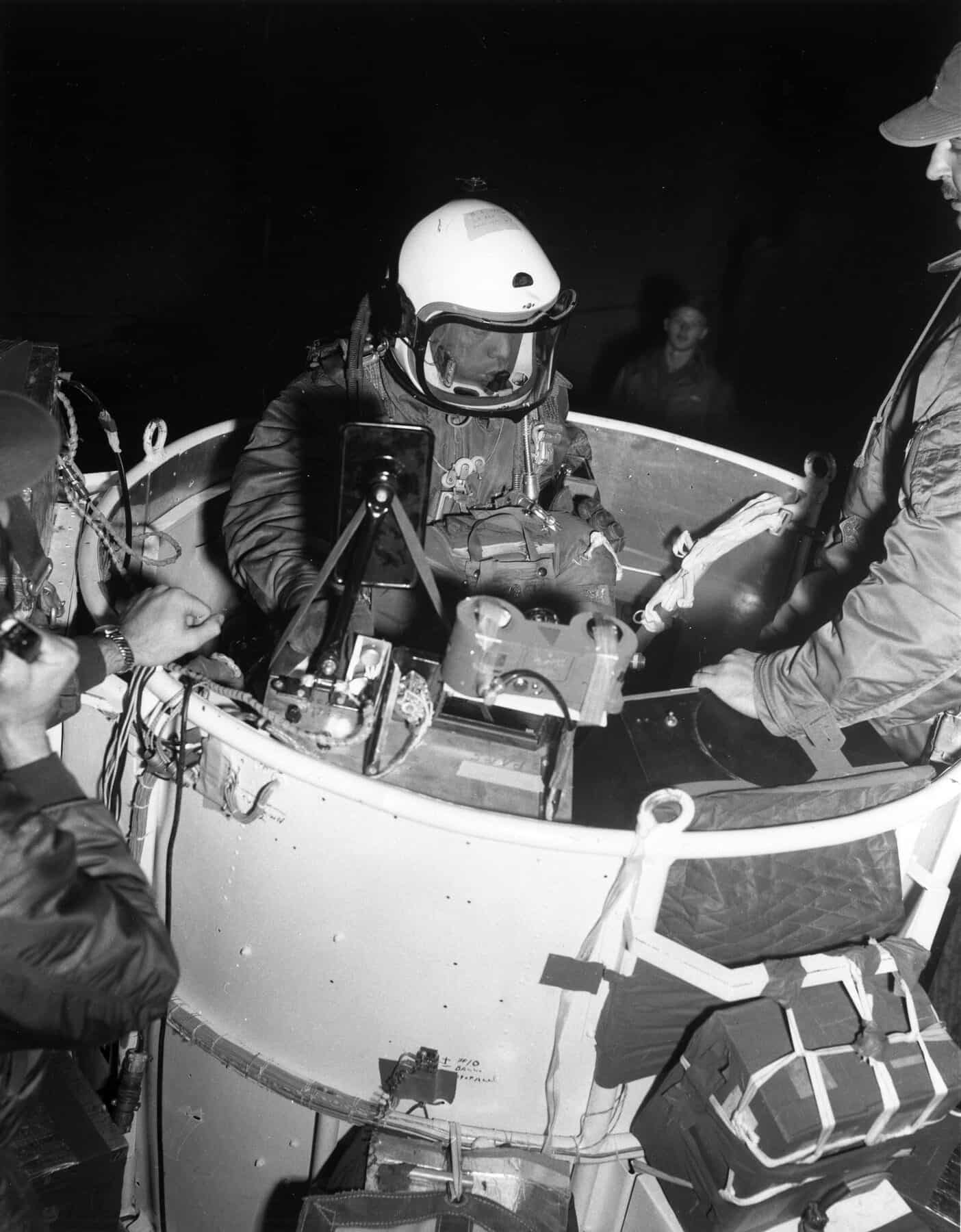
On Nov. 16, 1959, U.S. Air Force Capt. Joseph W. Kittinger Jr. stepped from an open balloon gondola at roughly 76,000 feet above New Mexico. The jump was the first flight of Project Excelsior, a high-altitude escape study meant to understand how a pilot might get safely out of an aircraft near the edge of space. Its first trial nearly killed him. Today marks 67 years since that frightening descent, a mission that showed why a parachute system for extreme altitude had to control a person’s fall before a conventional canopy could safely open.
Kittinger is often remembered for the record-setting 102,800-foot jump he made the following year. The Nov. 16 flight was different: it was the first of three Excelsior jumps, and the one that exposed a dangerous flaw in the new stabilization sequence. That distinction matters. The first mission was not a record stunt; it was a test that revealed how a small timing error could turn a carefully planned escape into an uncontrolled spin.
A pilot selected for a high-altitude problem
Kittinger’s route to the gondola began as a military flying career. The New Mexico Museum of Space History records that he was born in Tampa in 1928, soloed in a Piper Cub as a teenager and received Air Force pilot wings in 1950. He flew as a NATO test pilot in Germany, then moved to Holloman Air Force Base, where he flew experimental jets and joined aerospace medical research. The work brought him into contact with Col. John Paul Stapp, whose research examined how the human body responded to acceleration and other flight stresses.
Before Excelsior, Kittinger had already served as a test pilot on Project Manhigh. In 1957, he rose in a pressurized balloon gondola to about 96,000 feet and remained aloft for nearly seven hours. The project examined the effects of near-space conditions on a human observer. The museum says the Manhigh flights provided data later used in NASA’s Project Mercury. For Kittinger, those missions combined flying skill with a willingness to work inside unfamiliar equipment where physiology, pressure suits, oxygen and the balloon itself were all part of the aircraft.
Project Excelsior addressed a more urgent engineering question: could an aircrew member bail out at extreme altitude without being overcome by cold, low pressure, lack of oxygen or a violent flat spin? At lower altitudes, a parachute can open soon after a jump. At very high altitudes, opening a large canopy immediately could injure the person because of the speed and thin atmosphere. Waiting to open it created another hazard: an unstable body could rotate faster and faster before reaching denser air.
The answer under test was a staged parachute system. A small pilot chute would deploy first, followed by a six-foot stabilization canopy to keep the falling person oriented, and then a larger main parachute at a lower altitude. The National Museum of the U.S. Air Force describes the system as a way to test parachutes for escape from aircraft at extremely high altitudes. Kittinger’s own account, published by National Geographic, explains that the stabilization canopy was designed to prevent the dangerous flat spin before the main parachute opened.
The first Excelsior jump went wrong
On Nov. 16, the Excelsior I balloon lifted Kittinger above the New Mexico desert. Sources give the altitude as about 76,000 to 76,400 feet. He was in a pressure suit and carried the equipment needed to breathe, communicate and descend. The New Mexico museum’s biography describes the moment he left the gondola as the beginning of a near-fatal malfunction; Kittinger later wrote that the timer lanyard for the stabilization unit had been pulled too early.
Instead of waiting the planned 16 seconds, the small stabilization canopy and its lines deployed after only about two seconds. The lines fouled around him, and Kittinger began spinning rapidly. In his National Geographic account, he recalled realizing that he could not stop the rotation and then losing consciousness. The New Mexico Museum of Space History also recounts the rapid spin and says the emergency parachute opened automatically low in the descent, bringing him down alive.
The failure was severe, but the test also made the engineering issue unmistakable: deployment timing and line management were critical. A parachute system intended to save an aircrew member could create a new lethal hazard if the stabilizing device opened before the jumper had fallen long enough. The accident was not a reason to treat the entire idea as impossible. It was evidence that the system needed refinement before the next flight.
That is why the first Excelsior jump deserves attention apart from the later record. The mission demonstrated both the difficulty of high-altitude bailout and the value of testing the escape sequence under controlled conditions. A successful descent alone would not have answered every question. The malfunction identified what needed to change, while Kittinger’s survival allowed the team to continue.
From a near-fatal test to a record ascent
Kittinger returned to the balloon on Dec. 11, 1959, for Excelsior II. The gondola climbed to 74,700 feet, and the stabilization sequence worked as intended. The following August, Excelsior III carried him to 102,800 feet. The Air Force museum says Kittinger made three balloon-gondola jumps during 1959 and 1960, with the third reaching more than 102,000 feet. The highest flight produced records for an open-gondola balloon ascent, free fall and parachute descent.
On the 1960 flight, Kittinger remained at altitude despite a pressure-glove problem that caused intense pain in his right hand. He stepped out of the gondola and fell for several minutes before the main parachute opened at roughly 18,000 feet. The National Air and Space Museum describes that mission as a test of a parachute system for pilots forced to eject at high altitude. The headline record was striking, but the practical purpose remained escape and survival.
The work’s influence is often summarized through the stabilization chute. Kittinger later said that the small drogue parachute developed through the program continued to be used in ejection-seat systems. The National Museum of the U.S. Air Force similarly presents Excelsior as research into escape from high-altitude aircraft. Those sources support the broader lesson: a controlled sequence for stabilizing a person in free fall could inform the design of life-saving escape equipment well beyond the balloon project itself.
A test pilot’s life beyond Excelsior
Excelsior was one chapter in a much longer aviation career. The New Mexico museum says Kittinger flew 483 missions during three combat tours in Vietnam, including time in A-26 aircraft and later as a vice commander in an F-4 wing. He was shot down over North Vietnam in May 1972 and spent 11 months as a prisoner of war. The U.S. Department of Defense’s account of his life also identifies him as a combat pilot, research pioneer and former prisoner of war.
After retiring from the Air Force as a colonel in 1978, Kittinger continued to fly balloons. In 1984, he became the first person to cross the Atlantic solo by balloon, traveling from Maine to Italy. The National Air and Space Museum’s biographical account records the flight as a 3,543-mile crossing completed in 86 hours. The variety of those experiences—experimental aircraft, high-altitude research, combat flying, captivity and ballooning—makes his career difficult to reduce to one record.
Still, the 1959 jump is a useful place to understand the pilot behind the later achievement. Kittinger was not simply a passenger carried aloft for a dramatic leap. He was an Air Force pilot and test participant working within a program that sought evidence about human escape at altitudes where ordinary assumptions about parachutes no longer held. On that first day, the system failed in a way that could have been fatal. His survival, and his willingness to return for the next flights, helped the team continue testing the solution.
Why the Nov. 16 anniversary matters
Project Excelsior belongs to the history of flight testing because it connected a specific operational risk—getting out of a disabled aircraft at extreme altitude—to a sequence of engineering trials. The experimenters had to consider not only the balloon’s lift and the suit’s pressure, but also how a human body would move through thin air, when a small canopy should deploy and how to delay the main parachute until it could open safely. The first Excelsior jump made those questions physical.
Sixty-seven years later, Kittinger’s first descent remains distinct from the famous 1960 record. It was a close call, but it was also a test that produced information the team could use. The later successful jumps did not erase the malfunction; they followed it. Remembering the Nov. 16 flight honors a pilot whose contribution came from facing a difficult technical problem, surviving a failure and returning to help finish the work.
Sources
- New Mexico Museum of Space History: Joseph W. Kittinger
- National Museum of the U.S. Air Force: Excelsior Gondola
- National Museum of the U.S. Air Force: “The Sky Is My Office” transcript
- Smithsonian National Air and Space Museum: “The Man Who Fell to Earth”
- Joseph Kittinger’s account of his November 1959 jump, published by National Geographic
- U.S. Department of Defense: “Flights, Jumps and Records: A Life to Remember”
- Featured image rights record: Wikimedia Commons, public-domain U.S. Air Force photograph; original source identified as the National Museum of the U.S. Air Force


No comment