
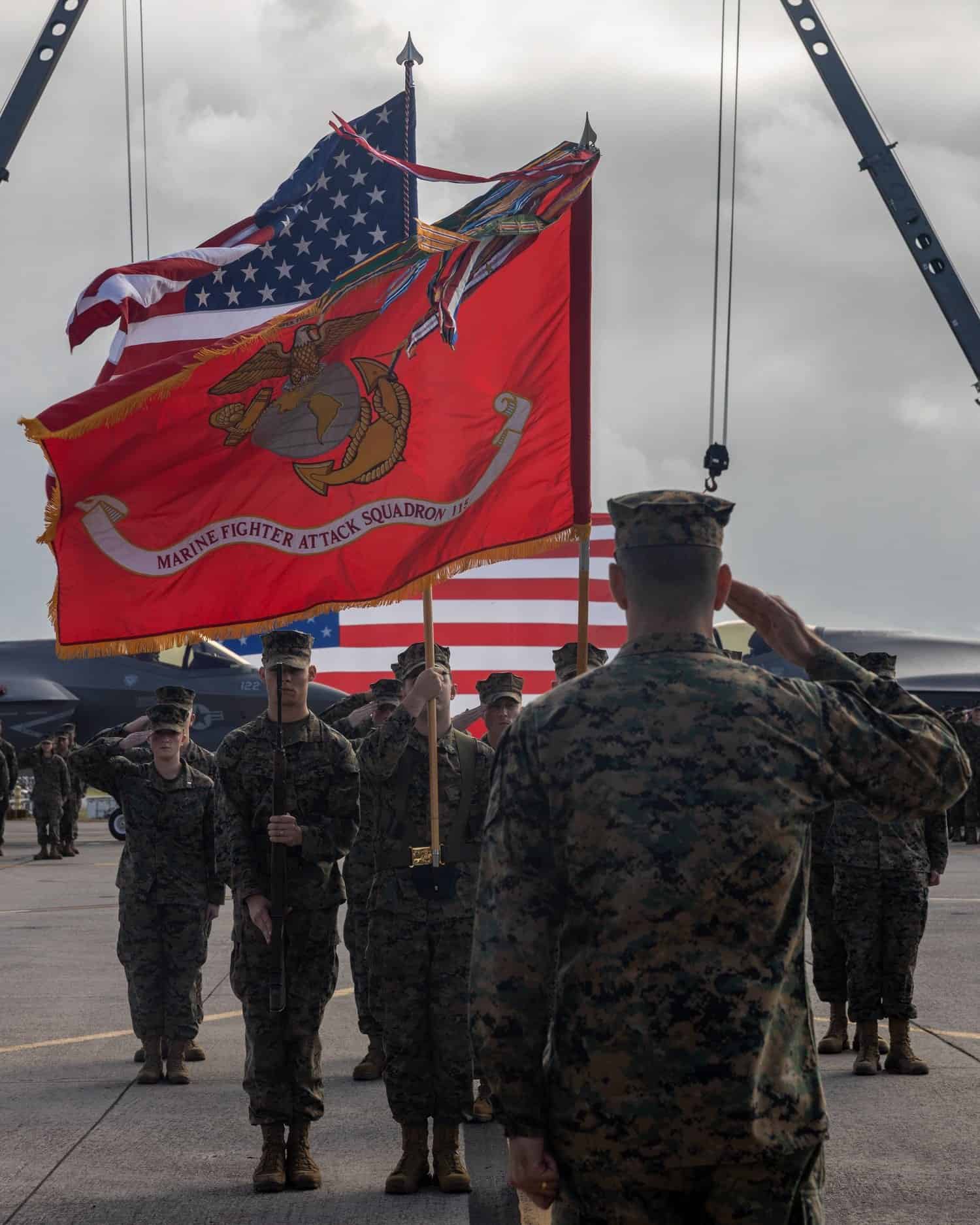
Marine Fighter Attack Squadron 115, the “Silver Eagles,” returned to the Marine Corps’ operational roster on Nov. 5, 2026, this time as an F-35C Lightning II unit based at Marine Corps Air Station Cherry Point, North Carolina. The ceremony marked more than a change of aircraft: it reactivated a squadron that had left the F/A-18 Hornet fleet in 2023 and shifted its home station from South Carolina to the East Coast’s principal Marine F-35C base.
The 2nd Marine Aircraft Wing’s account of the ceremony says Lt. Col. Hugh E. Anderson assumed command and Sgt. Maj. Derek B. Carlson became the squadron’s senior enlisted leader. VMFA-115 is now assigned to Marine Aircraft Group 14, 2nd Marine Aircraft Wing, within II Marine Expeditionary Force. Independent reporting by Stars and Stripes also identified the Silver Eagles as the second East Coast unit in 2nd MAW to transition to the carrier-capable C model.
A reactivation after the Hornet era
The transition followed the squadron’s final F/A-18 deployment, completed in October 2023. VMFA-115 deactivated the next month at MCAS Beaufort, South Carolina, where it had operated under Marine Aircraft Group 31. Its Nov. 5 ceremony at Cherry Point formally restored the unit under a new group and wing, with a new aircraft and a different basing role.
Those details matter because “reactivation” can describe more than putting a familiar name back on a building. In this case, the Marine Corps is rebuilding an operational squadron around a different aircraft, transferring it to another air station, and placing it in a wing whose carrier aviation force is expanding. The unit’s organizational change is complete, but operational certification remains ahead.
The Silver Eagles’ history stretches back to World War II. Stars and Stripes reports that the squadron flew F4U-1 Corsairs in the Pacific and later flew F/A-18s for 38 years. The service’s ceremony announcement also cited the unit’s record through conflicts from World War II, Korea and Vietnam to the Global War on Terror. That history supplies the identity carried forward by the squadron; it does not mean that its current role or equipment is unchanged.
Why the F-35C changes the mission
The F-35C is the carrier variant of the Lightning II. Its reinforced landing gear, folding wingtips and arresting hook are built for the high loads and limited deck space associated with catapult launches and arrested carrier landings. Those adaptations distinguish it from the Marine Corps’ short-takeoff-and-vertical-landing F-35B, which is designed to operate from shorter runways and amphibious assault ships.
The Marine Corps says the C model carries about 50 percent more fuel than the B model and has larger internal weapons bays for heavier precision-guided munitions. Those features support greater reach and time on station in the carrier strike role, but they also require a squadron to master a different set of aircraft, maintenance practices and shipboard procedures than the Hornet unit it replaced. The transition is therefore a training and readiness effort as much as a fleet recapitalization.
Stars and Stripes described VMFA-115 as the fourth Marine squadron to adopt the F-35C and reported that the Corps expects additional C-model squadrons in the coming years. It also noted that Cherry Point already hosts another F-35C unit, VMFA-251, alongside operational F-35B squadrons. The Silver Eagles’ return adds another carrier-capable squadron to that East Coast concentration, while keeping the B and C variants in distinct roles.
From first flight to certification
VMFA-115 flew its first F-35C sortie in July 2026, according to the Marine Corps announcement. The squadron is now conducting routine flight and maintenance operations while working toward “Safe for Flight” certification, which the service expects in early 2027. That milestone is a step toward the squadron’s planned initial operational capability; the Nov. 5 reactivation ceremony did not mean that the unit had already reached full operational status.
The distinction is important for readers tracking the modernization timeline. A squadron can be formally reactivated and begin routine operations while still completing the checks, training and qualification work required to demonstrate that it can perform its assigned mission. The Marine Corps has placed a target date on Safe for Flight certification, but the public release did not provide a detailed schedule of training events or a firm date for initial operational capability.
The move also marks a geographic shift. MCAS Cherry Point sits within the 2nd Marine Aircraft Wing’s North Carolina footprint, while Beaufort is in South Carolina and had been VMFA-115’s home during its Hornet years. The reassignment places the Silver Eagles under MAG-14 and brings the squadron into a wing already fielding the C model. Its future contribution will depend on completing certification and building the experience needed to deploy and operate the aircraft as a carrier strike unit.
What the ceremony does—and does not—signal
The reactivation is a concrete marker in the Marine Corps’ shift from legacy fighters to fifth-generation aircraft. It restores VMFA-115 as an operating squadron, documents the command team and home station, and identifies the F-35C as its platform. The associated public affairs release describes the unit’s role as providing dedicated fifth-generation carrier strike capability for 2nd MAW.
It is not, by itself, evidence that the squadron has completed its work-up or has already deployed with the F-35C. The next public measure to watch is the announced early-2027 Safe for Flight certification objective, followed by the service’s progress toward initial operational capability. The Marine Corps has not published a complete public checklist for either milestone in the release, so the timeline should be treated as the service’s stated plan rather than a guarantee.
For the Silver Eagles, the transition links a long unit lineage to a new aircraft and a new operational chapter. The squadron that stood down after its final Hornet deployment is flying again, but its reactivation is the beginning of the F-35C phase, not its conclusion.
Sources
- 2nd Marine Aircraft Wing, “VMFA-115 reactivates as Marine Corps’ newest F-35C squadron,” Nov. 5, 2026.
- Stars and Stripes, “Marines reactivate Silver Eagles fighter squadron as F-35 unit,” Nov. 6, 2026.
- U.S. Marine Corps photo record 10073892, VMFA-115 reactivation ceremony, Nov. 5, 2026 (public domain).






No comment