
How Barksdale’s B-52 maintainers reworked the inspection puzzle
Aircraft availability in the Air Force Reserve’s 307th Maintenance Group at Barksdale Air Force Base has climbed to a 10-year high, according to a Nov. 1 report from the 307th Bomb Wing. The milestone is tied to work on the B-52 Stratofortress fleet and a command-wide Air Force Global Strike Command effort called the North Star Readiness Campaign. The campaign, launched in summer 2025, seeks to improve bomber readiness through changes to logistics, maintenance processes and resource allocation. (DVIDS report republished by Florida Transportation Times; 307th Bomb Wing’s Nov. 9 Gatorfest report)
The figure is a measure of aircraft availability, not a claim that every B-52 is mission-capable at all times. The public report does not disclose the underlying rate, its calculation, the number of aircraft included in the measure or how long the group has sustained the result. It does establish a notable trend for a unit whose work supports training, testing and operational aircraft at one of the bomber’s principal bases.
Changing the sequence of phase maintenance
A central part of the effort has been rethinking the B-52’s phase inspection process. These inspections are scheduled at set flying-hour or calendar intervals and involve extensive checks required to determine whether an aircraft remains airworthy. Instead of treating the work as a strictly linear sequence, maintainers at Barksdale began treating it more like a puzzle: when one area of an aircraft is not ready for work, teams can shift people and resources to a different section that is ready.
That approach aims to reduce idle time while preserving the inspection’s technical requirements. It does not eliminate required checks or make the aircraft available simply by moving tasks around. The practical gain comes from coordinating work so that a delay in one area does not automatically stop progress everywhere else.
Senior Master Sgt. Steven Spivey, the 307th Maintenance Squadron’s maintenance flight chief, described the method in the unit’s report as a change in how the team organizes phase work. The team also conducts a review after each phase inspection to identify what should be retained and what should change next time. Junior Airmen are included in those reviews, bringing shop-floor observations into the process.
Maintenance schedules can be disrupted by parts delays, competing work, aircraft condition and the availability of qualified personnel. The report does not quantify which of those factors contributed most to Barksdale’s improvement. It does describe a deliberate effort to make better use of the work that can proceed while another inspection task is waiting.
One maintenance group, several B-52 missions
The 307th’s maintenance work reaches beyond the aircraft used for local training. The Bomb Wing’s Formal Training Unit prepares B-52 aircrews, while other Barksdale-based organizations conduct weapons instruction and operational testing. The 307th report says the maintenance group supports those different flying missions, including the B-52 division of the Air Force Weapons School and the 49th Test and Evaluation Squadron at Eglin Air Force Base. (307th Bomb Wing on DVIDS; Air Force Reserve Command’s 307th Bomb Wing profile)
Those assignments give aircraft availability practical consequences. Training sorties help produce crews for the broader B-52 force. Weapons instruction develops tactics and expertise, while operational testing evaluates changes before they are adopted more widely. A jet waiting on maintenance cannot contribute to those flying hours, however, and a schedule slip can affect instructors, students, testers and support teams.
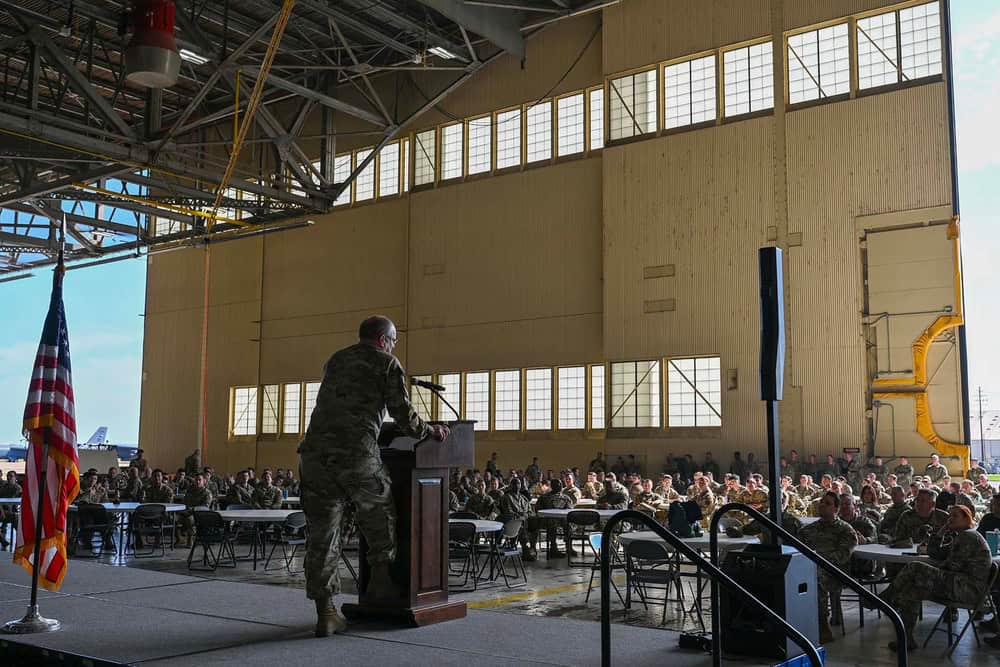
The group is an Air Force Reserve organization working alongside the active-duty 2nd Bomb Wing under the Total Force Integration model. In the 307th’s Nov. 9 account of its annual Gatorfest awards, Col. Terrell Eikner credited the Reserve and active-duty partnership with supporting the wing’s highest aircraft-availability rating in five years. The earlier Nov. 1 report described a 10-year high across aircraft availability for the maintenance group. The reports use different time frames and describe the achievement in different terms; neither provides a numerical rate. (DVIDS photo and caption, Nov. 7)
Experience passed across generations
The B-52’s long service life makes maintenance knowledge a strategic resource as well as a technical one. The aircraft entered service in the 1950s, and the crews who keep it operating work on a design that has been modified across generations. At Barksdale, the 307th has maintained the bomber for more than three decades, according to the wing’s reporting. Some maintainers have built careers around the same aircraft type, while newer Airmen are learning the procedures and judgment that come with years of work on the fleet.
Spivey’s team has been sharing its phase-inspection practices with counterparts from the active-duty 2nd Bomb Wing and the 5th Bomb Wing at Minot Air Force Base, North Dakota. The goal is a standardized playbook that gives maintainers across the B-52 community a common starting point when they encounter familiar or unusual maintenance problems. That kind of exchange cannot replace technical orders or engineering decisions; it can help units compare experience and avoid solving the same operational puzzle in isolation.
Continuity also matters because experienced maintainers eventually retire or move to other assignments. The 307th report says phase leaders are preparing successors by ensuring Airmen learn responsibilities beyond their immediate jobs. Such cross-training can make a team more flexible when work shifts, but it also requires time and supervision to build competence safely.
Keeping the bomber supportable into the future
The readiness effort is unfolding as the B-52 fleet prepares for a major modernization. The Air Force plans to re-engine the aircraft and update its radar as part of the B-52J program, extending the bomber’s operating life. The 307th report says maintainers expect newer engines to change phase-maintenance demands and may shorten some portions of the inspection process, but that remains a forward-looking expectation rather than a demonstrated result.
For now, the reported availability milestone is evidence of a local maintenance improvement, not a fleet-wide readiness statistic. It reflects the work of Reserve and active-duty teams at Barksdale and a reorganization of how phase inspections proceed. Further public data would be needed to assess the scale of the increase, its durability, and whether the practices are producing similar results at other B-52 bases.
The B-52’s operational reach depends on more than the aircraft itself. It also depends on inspection planning, parts, technical expertise and the ability to coordinate maintainers across shifts and units. At Barksdale, the 307th MXG’s approach is to keep productive work moving through the phase dock and bring lessons from each inspection into the next. The 10-year availability high is a concrete sign that the effort has mattered to the unit; the next measure will be whether it can sustain that performance as the fleet and its maintenance demands evolve.
Sources
- “Solving the phase puzzle: 307th MXG supports B-52 readiness milestone,” DVIDS story republished Nov. 13, 2026
- 307th Bomb Wing, “Behind Bomber Readiness: 307th Maintenance Group Honors Top Performers at Gatorfest,” Nov. 9, 2026
- 307th Bomb Wing official DVIDS page
- Air Force Reserve Command, 307th Bomb Wing unit profile
- DVIDS photo 10086072: Gatorfest 2026, public-domain rights and image record





No comment