
Published November 23, 2026
NASA astronaut Kathryn Thornton helped turn Hubble from a telescope with flawed early images into an observatory that could be repaired and upgraded in orbit. As a mission specialist on Endeavour’s December 1993 flight, she worked outside the shuttle with fellow astronaut Thomas Akers. Their assignments included changing the telescope’s solar arrays and installing an optical package that corrected the light reaching several of Hubble’s instruments. The two jobs addressed very different problems, and both had to be done with the telescope in the shuttle’s payload bay.
Replacing the solar arrays
On the second spacewalk of the mission, Thornton and Akers worked on Hubble’s power system. A NASA photograph shows Thornton positioned on the shuttle’s robotic arm amid the equipment for the servicing work. The arm gave the crew a way to move a spacewalker to the work site without asking that person to make every move along Hubble by hand. Someone inside Endeavour operated the arm, while the spacewalkers handled the hardware and coordinated the steps outside.
Hubble relies on its solar arrays to power the telescope and recharge its batteries. As the original arrays passed from sunlight into darkness and back again, temperature changes also produced vibrations that affected the observatory’s pointing. A telescope needs to hold its aim while an instrument gathers light. Motion that might be insignificant on another spacecraft can matter when the instrument is trying to make a precise measurement of a distant object. Changing the arrays was therefore part of making Hubble a steadier observatory as well as maintaining its power supply.
Giving the instruments a corrected view
The solar arrays were separate from the optical problem. Hubble’s primary mirror had been polished to a slightly incorrect shape, so light from a target did not come to focus as intended. The service crew left the mirror in place. One repair brought up a new camera with its own correction. Another brought up the Corrective Optics Space Telescope Axial Replacement, or COSTAR, which redirected light to instruments already aboard. NASA’s servicing mission history describes how the two approaches worked together.
Thornton and Akers installed COSTAR during their other spacewalk on the mission. The package occupied the space previously held by the High Speed Photometer. That exchange illustrates the decisions behind an orbital repair. Astronomers gave up one instrument position to improve the light reaching other instruments. The crew then had to remove one piece of equipment and install its replacement in a telescope hundreds of miles above Earth, where bringing the observatory back into a workshop was outside the mission plan.
From orbital repairs to laboratory research
Thornton brought a background in physics to NASA and flew on four shuttle missions. Her NASA biography records flight assignments on STS-33, STS-49, STS-61, and STS-73. STS-49, the first flight of Endeavour, gave her experience on another mission that demanded hands-on work outside the shuttle. On STS-73 she served as payload commander aboard Columbia on a mission devoted to microgravity research. The two kinds of work called for different skills. A servicing crew had to carry out carefully choreographed changes to a spacecraft, while a laboratory crew had to keep experiments running and make the observations that gave the flight its scientific value.
The first Hubble service mission is a particularly clear example of what Thornton contributed. Repairing the telescope required engineers to turn optical and mechanical problems into tasks a crew could perform in orbit. Thornton helped carry out both kinds of work, from handling large solar arrays to installing a package whose job was to move light through the telescope with far greater precision.
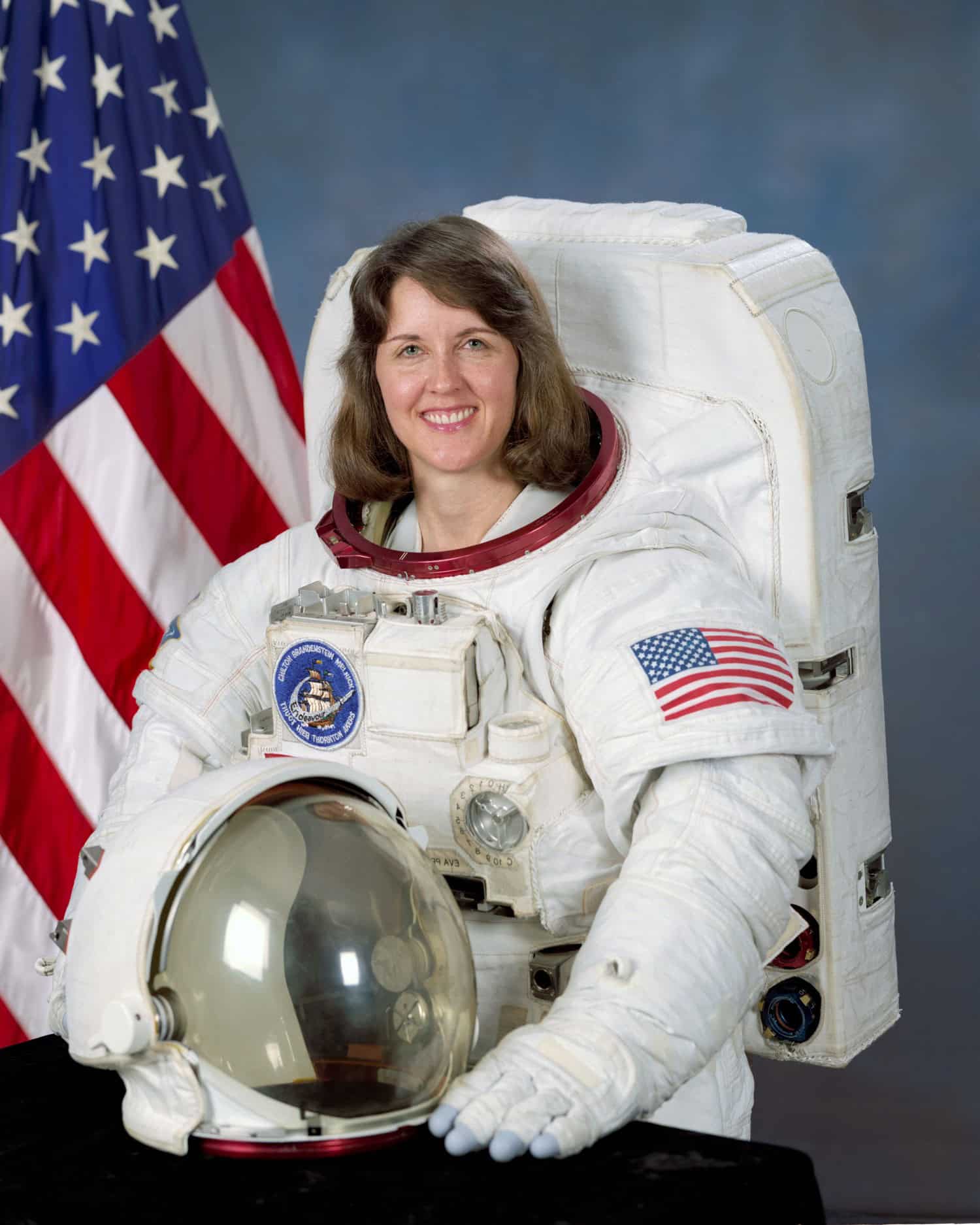
Featured image: Official 1992 portrait of Kathryn C. Thornton, NASA photograph S92-42897, U.S. public domain. Full frame resized.
Sources
NASA, Hubble Servicing Mission 1
NASA, Kathryn C. Thornton biography
NASA, Thornton during the second Hubble spacewalk


No comment