
Published November 23, 2026
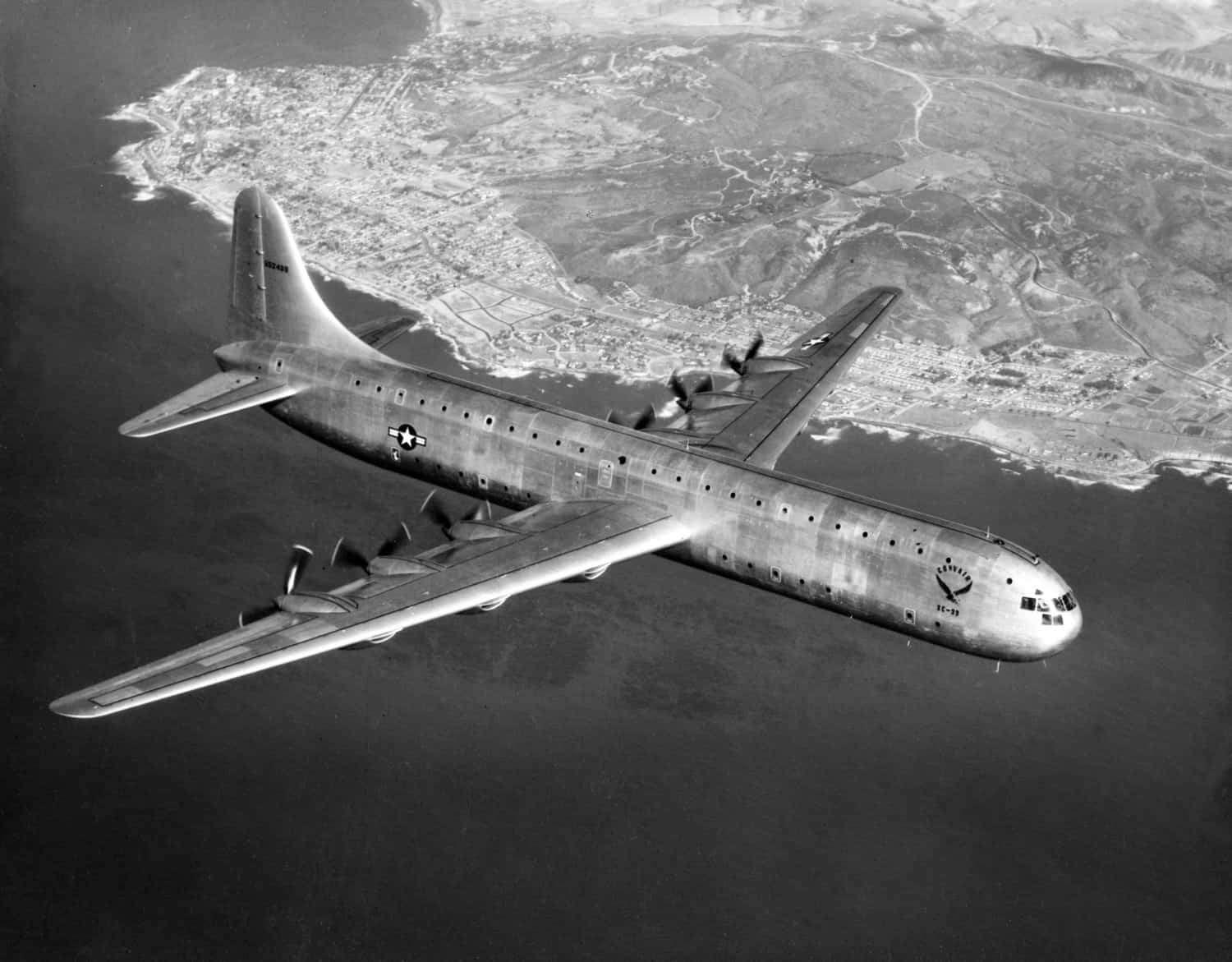
On November 23, 1947, Convair flew an aircraft built around a question that still matters in air cargo. How much can an airplane carry if the fuselage is designed around the freight from the start? The XC-99 took the wing and powerplant arrangement of the B-36 program and paired them with a deep transport fuselage. The result was a single prototype with two cargo decks, designed to carry loads that would have been difficult to split among smaller aircraft.
The first flight took place in San Diego, according to the historical record accompanying the archival U.S. Air Force photograph. The photograph shows the aircraft near La Jolla around 1948, after the first flight. Its shape makes the connection to the B-36 visible in the wing and six rear-facing propellers. The large fuselage ahead of that wing is the part that tells the cargo story.
Two decks and a way to load them
The National Museum of the U.S. Air Force describes the XC-99 as a transport derivative of the B-36 and shows the cargo compartment in its historical photographs. One image from a later period shows people looking through an opening into the cargo bay. The museum notes that a special hoist lifted cargo into the airplane. That detail helps explain what making a heavy transport work actually involved. Once an item was on the apron, its size and weight could be obstacles well before the flight crew started an engine.
Putting freight on two levels gave the designers more usable volume within the length of the fuselage. It also meant that a ground crew needed a way to handle different loads at different heights and place them where the airplane could carry them safely. A cargo deck is useful only when the loads can pass through the door and move to their assigned positions. Designing the aircraft around those operations was as consequential for its usefulness as increasing the power available for takeoff.
What a single aircraft could teach
The XC-99 remained a one-aircraft program, but the Air Force used it to carry cargo. That distinguishes its history from a proposal that never left the drawing board. A flight test could show how the airframe handled and whether the engines and controls worked together. Service flying exposed another set of questions. Crews had to prepare a large load for departure, use the loading equipment, and repeat the job at the destination.
The design also demonstrates the limits of borrowing from an existing aircraft. Common engines and a familiar wing can give a new project a starting point. A transport still has to provide enough room for bulky cargo, a working arrangement for moving it, and access for the people who load it. In the XC-99, the fuselage and cargo-handling provisions were central to that new job. They explain why the transport looked so different from the aircraft that supplied much of its design ancestry.
The first flight did not settle every question about the economics or practicality of very large piston transports. It did put the idea into the air in a form that could be tested and used. The innovation worth remembering on November 23 is the integration of a large lifting system with a fuselage and equipment built around the work of moving freight.
The hoist and the double deck are also a reminder that payload figures describe only part of what an airlifter can do. For a person planning a shipment, the useful question is whether the actual freight will fit, whether it can be moved safely into place, and whether the receiving field can unload it. Those are the practical problems that gave the XC-99 its distinctive shape.
Featured photograph: XC-99 near La Jolla, circa 1948. U.S. Air Force photograph via Wikimedia Commons, U.S. public domain. Full frame resized.
Sources
National Museum of the U.S. Air Force, Convair XC-99 Model
National Museum of the U.S. Air Force, cargo bay and hoist photograph
U.S. Air Force archival aircraft photograph and first-flight date






No comment