
Published November 22, 2026
An Air France Concorde touched down at New York’s John F. Kennedy International Airport at 8:47 a.m. local time on November 22, 1977, completing the airline’s inaugural scheduled Concorde flight from Paris to New York. The airline records an 11:12 a.m. departure from Paris Charles de Gaulle, also in local time. Scheduled service from London began the same day. The two routes made JFK a destination for regular supersonic passenger service from both sides of the English Channel.
A new route to JFK
For Concorde, the New York opening was the latest stage of an airline program already in service. Brooklands Museum dates the first scheduled operations to January 21, 1976, when British Airways flew from London to Bahrain and Air France started service from Paris to Rio de Janeiro via Dakar. The Federal Aviation Administration’s history records the start of scheduled service to Washington Dulles in May 1976. The later opening of the New York routes added another American destination and gave passengers a direct supersonic connection to JFK from London and Paris.
Air France’s account places the Paris flight’s arrival on JFK’s runway 31. The times in that account show one of the route’s most memorable features: traveling west, a passenger could arrive in New York earlier by the local clock than they had departed Paris. The time-zone difference explains the clock reading. The shorter crossing was made possible by Concorde’s ability to cruise at about twice the speed of sound. Air France lists a cruising speed of Mach 2.02 and a passenger capacity of 100.
Why New York took longer
Airport access was a separate challenge from flying the route itself. The FAA history describes how Concorde service to Dulles began before the airlines gained access to JFK. Air France’s retrospective identifies noise as the central concern behind the opposition in New York. For the operators, a route to one U.S. airport established that transatlantic scheduled operations were possible, while opening the route to a second airport depended on its own proceedings and operating conditions.
The distinction matters when describing the milestone. November 22 was the start of scheduled Concorde service at JFK. It therefore belongs in the history of passenger routes as well as in the story of the aircraft. A test or demonstration can establish that an airplane can reach a destination. A published schedule commits the carrier to making that trip repeatedly, turning an aeronautical achievement into an option passengers can book.
A photograph from the years that followed
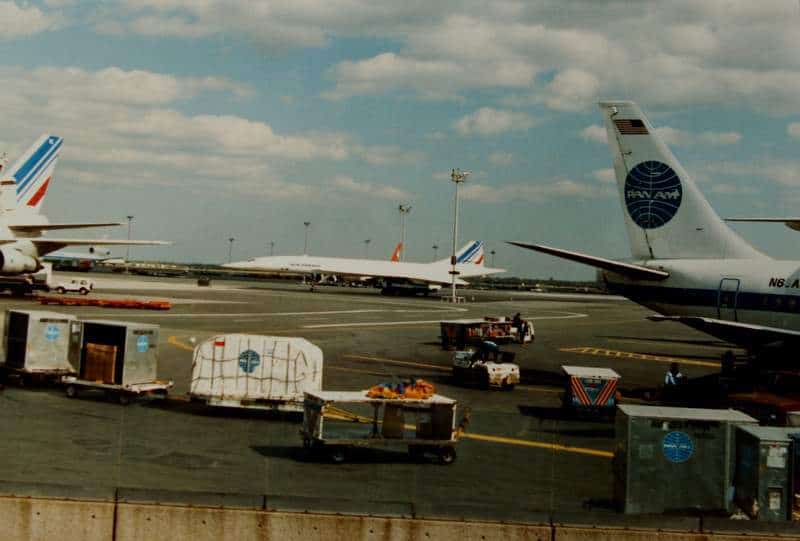
The featured photograph shows an Air France Concorde on the apron at JFK about a decade after the inaugural flight. Its later date is part of its value. It records the aircraft in an airport setting that had become familiar after service began, with the distinctive nose and delta wing visible on the ground. The image is a view of the route’s operating era. Air France’s records and the FAA history establish the date and circumstances of the original arrivals.
The Paris flight that ended at JFK that morning was one half of the opening. With the London service beginning alongside it, New York became the destination of two scheduled Concorde links on the same day. That is what the anniversary commemorates: the moment the ability to cross the Atlantic at supersonic speed became a regular service to New York from both European capitals.
Featured photograph. Air France Concorde at JFK, circa 1987. Hunter Desportes via Wikimedia Commons, CC BY 2.0. Original upload, full frame.
Sources
Air France, The Concorde lands in New York
Federal Aviation Administration, agency history
Brooklands Museum, Concorde timeline


No comment