
Published November 27, 2026
On April 7, 1983, Story Musgrave and Donald Peterson left Challenger’s airlock and entered its open payload bay. It was the first spacewalk of the Space Shuttle program and the first American spacewalk in more than nine years. The two astronauts used the bay to try out suits, restraints and ways of moving around an orbiter whose crews would eventually be called on to service satellites and assemble equipment in space. NASA’s account of Challenger’s first flight
An astronaut who helped develop the equipment
Musgrave came to NASA in 1967 as a scientist-astronaut. He was a physician and had training in physiology. During the years before his first spaceflight, he worked on equipment that shuttle crews would depend on outside the cabin, including suits, life support systems and airlocks. In 1983 he had the chance to test part of that work in orbit, on Challenger’s first mission. NASA astronaut biography
That background made his first flight an unusual kind of debut. An astronaut can train on equipment long before flying it. Musgrave had also spent part of his career helping develop equipment in the category he was about to use. On Challenger he could experience the transition from the crew cabin to the airlock and then into the cargo bay as one continuous operation, with both astronauts and the hardware working together in orbit.
A worksite inside an open cargo bay
The spacewalk was one part of STS-6, a mission that also deployed the first Tracking and Data Relay Satellite. NASA’s retrospective describes the preparations for the excursion, including the suit checks and the gradual depressurization of the airlock. The astronauts spent just over four hours outside. The payload bay gave them a defined work area where they could assess how the suits and equipment performed while moving and handling tools. NASA STS-6 mission record
A person in orbit can float from one place to another, but a worker also needs a way to stay put. Turning a tool or pulling on a fitting applies force to the astronaut as well as to the hardware. Handholds, tethers and foot restraints help turn a place where someone can float into a place where they can do precise work. The early shuttle spacewalks gave crews experience organizing their movement and their tools around a vehicle that served as both transport and worksite.
From trying equipment to repairing a telescope
Musgrave flew on six shuttle missions. A decade after STS-6, he served as payload commander on STS-61, the first servicing mission to the Hubble Space Telescope. Endeavour’s crew conducted five spacewalks. Musgrave worked outside with Jeffrey Hoffman on three of them. The Hubble assignment required the astronauts to use orbital work techniques on a telescope that already had years in space and had been designed to accept replacement hardware. NASA’s summary of Musgrave’s missions
The two flights show how the work changed over the course of one career. On Challenger, Musgrave and Peterson were gathering experience with the equipment and procedures that would let shuttle crews work outside. On Endeavour, Musgrave and his crewmates used those capabilities for a specific repair and upgrade program. The common thread was the human worksite around the orbiter. Crews had to bring themselves, their tools and the equipment they were servicing together in a position where each task could be carried out.
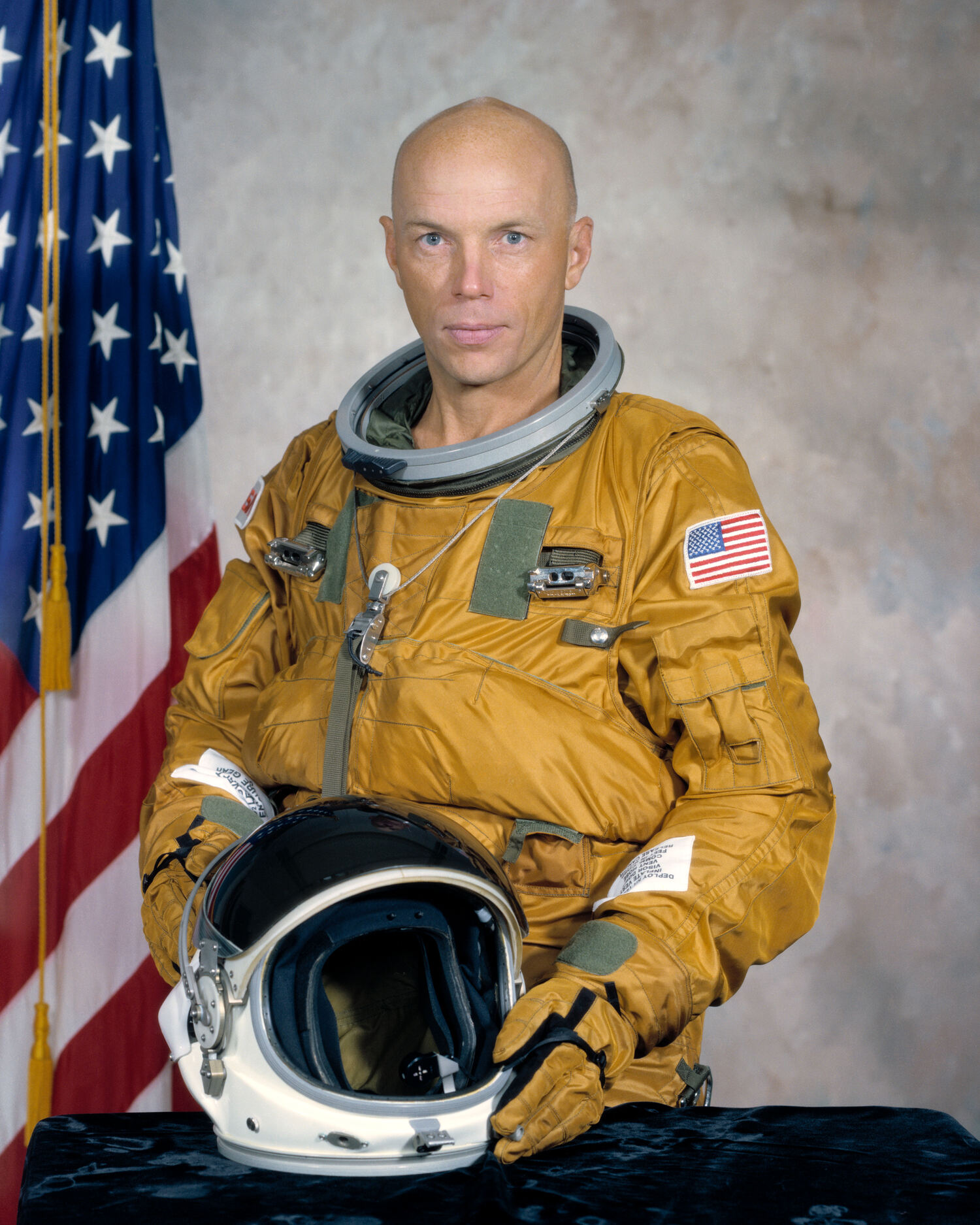
Featured photograph — Official portrait of Story Musgrave, October 26, 1979. NASA, S79-37745, public domain. Photo record and rights


No comment