
Published November 27, 2026
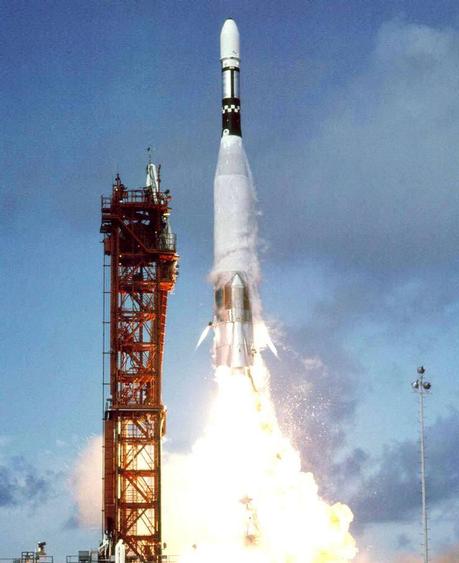
On November 28, 1964, an Atlas-Agena rocket lifted off from Launch Pad 12 at Cape Canaveral Air Force Station carrying Mariner 4. The spacecraft was on its way to Mars with a television camera and instruments that could sample the environment around the planet during a brief encounter. In July 1965 it returned the first close-up views of Mars. A photograph from the launch shows the beginning of a mission that would change what scientists could see of a planet they had previously observed from Earth. NASA launch photograph and date
A second chance in the same launch window
Mariner 4 followed Mariner 3, an earlier attempt to send a similar spacecraft to Mars. That spacecraft launched on November 5, 1964, but its protective shroud failed to separate. The mission could not continue as intended. NASA says the problem was corrected for Mariner 4, which left later in the month. The two launches show how an apparently straightforward part of a launch can determine whether the rest of a spacecraft ever gets to do its work. NASA’s history of the Mars Mariner missions
The shroud had a job for only a short part of the flight. It protected the spacecraft while the rocket climbed through the atmosphere. Once the rocket was beyond that part of the ascent, the covering had to come away so the spacecraft could continue its mission. The revised hardware gave the second spacecraft a chance to do what the first could not: make the journey to Mars and prepare for a close encounter.
One pass to collect the data
Mariner 4 flew past Mars in July 1965. The camera looked at a narrow path across the planet as the spacecraft passed, recording a series of views that included craters. NASA’s Jet Propulsion Laboratory describes the closest approach on July 14. What scientists saw was a sampled strip of terrain, a new source of evidence at a scale unavailable to telescopes on Earth. JPL mission overview
A flyby compresses the observations into the time when the spacecraft is close enough to see its target. There is no later orbit in which to revisit a feature or point the camera at a different part of the planet. Mission designers therefore had to choose where to look in advance and preserve the observations for transmission afterward. The amount of ground a camera covers on one pass also sets a limit on what its pictures can establish. Mariner 4’s pictures revealed real features on Mars and left large parts of the planet to be explored by subsequent missions.
The close-ups also changed the scale of the questions that could be asked. A telescope could follow broad changes in the planet’s appearance, while a passing spacecraft could record individual features within its camera’s field. The two kinds of observation told scientists different things. Mariner 4 provided a first sample from close range, and later missions could set that sample against photographs of other regions. NASA’s Mars Mariner mission history
From the camera to Earth
The spacecraft’s camera observations were stored for transmission after the flyby. That made the radio link part of the imaging system in practice. A working camera at Mars mattered only if the spacecraft could retain the information and send it across interplanetary distance. The camera was also one part of a larger scientific payload, which carried instruments to study the environment along the spacecraft’s route and near Mars. JPL’s Mariner 4 mission record
Later Mariners returned with more imaging opportunities and different mission designs. Mariner 4’s contribution was to establish that an automated spacecraft could travel to Mars, gather close-range observations during a single pass, and transmit them home. The launch photograph shows just one moment in that chain. Between liftoff and the pictures reaching Earth were months of travel and a flyby that the spacecraft had one chance to make.
Featured photograph — Mariner 4 launches on an Atlas-Agena from Cape Canaveral on November 28, 1964. NASA photograph, public domain. NASA image record
Sources
NASA Science — Launch of Mariner 4 Spacecraft in 1964




No comment