
Pilots know the upgrades that matter most rarely make headlines. New avionics, a fresh engine, better electrical power: none of it is flashy, but it is what keeps an airplane flying for another decade. On Thursday morning, two astronauts will step outside the International Space Station to finish exactly that kind of job, one that started more than five years ago.
NASA astronaut Anil Menon and Canadian Space Agency (CSA) astronaut Joshua Kutryk are scheduled to begin a spacewalk at 8:30 a.m. EST on Thursday, Nov. 5, to install the eighth and final roll-out solar array on the station’s starboard truss. In a Nov. 3 update, NASA said the installation “will complete the years-long process that began in June 2021” to raise the station’s power generating capacity from 160 kilowatts to about 215 kilowatts.
The second half of a two-spacewalk job
Thursday’s outing is the follow-up to a spacewalk the same pair made on Oct. 29. According to NASA, Menon and Kutryk spent 7 hours and 11 minutes outside that day, installing and deploying the seventh International Space Station Roll-Out Solar Array, or IROSA, on the station’s 2A power channel. They also knocked out several “get-ahead” tasks to prepare for this week’s work, when the final array goes onto the 3B power channel.
That Oct. 29 spacewalk was the 100th U.S. spacewalk and the 285th spacewalk in support of space station assembly, maintenance and upgrades, NASA said. It was also Kutryk’s first. The Canadian Space Agency called it a mission milestone for the colonel and noted that Canadarm2, the Canadian-built robotic arm, gave Menon a stable work platform while the two worked. NASA previewed the pair of outings as U.S. spacewalks 100 and 101, which makes Thursday’s the 101st.
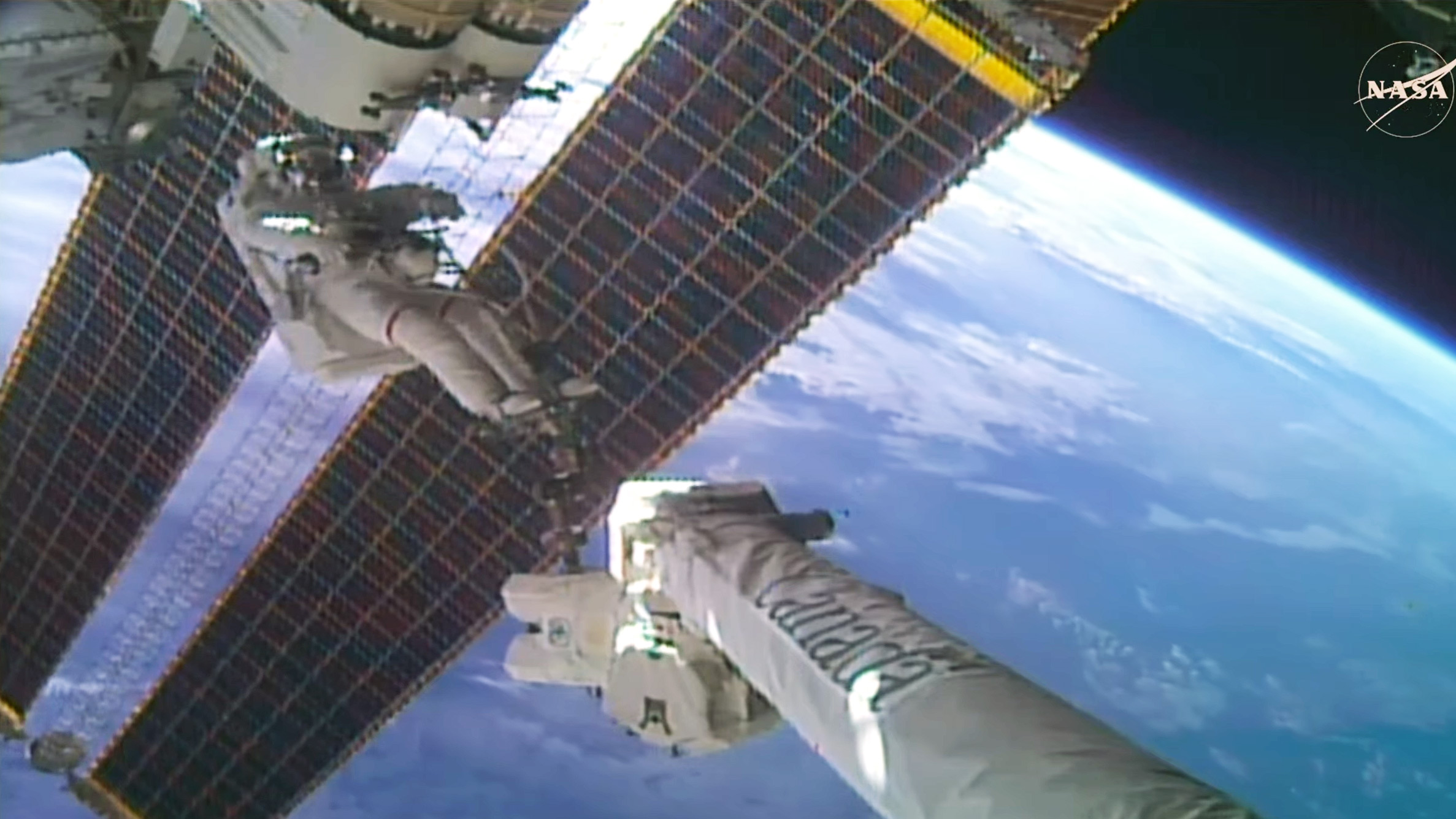
The featured photo above, captured from NASA’s live video, shows Menon riding Canadarm2 to begin the Oct. 29 installation on the port-side truss, orbiting about 260 miles above Earth.
A Florida launch and a solar panel with no motor
Both of the final arrays got their ride from Florida. NASA’s SpaceX 35th commercial resupply mission lifted off at 6:33 a.m. EDT on Oct. 13 from Space Launch Complex 40 at Cape Canaveral Space Force Station. Spaceflight Now reported that the two arrays traveled rolled up and folded on a carrier in the Cargo Dragon’s unpressurized trunk, each weighing about 750 pounds folded.
The deployment is the clever part. Once the array is bolted in place and connected, the spacewalkers release its restraints and it unrolls on its own. Spaceflight Now explained that no motors are required, because energy is stored in the array’s carbon-fiber composite booms. On Oct. 29, NASA said the array unfurled during a roughly 10-minute process, and Spaceflight Now reported it reached about 60 feet. NASA’s Rob Navias said the new array “will add 8 kilowatts to the overall power capability of the complex,” Spaceflight Now reported.
Why the station needs the power
The station’s original solar arrays have been flying for a long time. Space.com noted that they have gone past their 15-year design life and show degraded output. The newer roll-out arrays are installed in front of the legacy panels, partly covering them, and the two work together. NASA says that together the eight new arrays increase available power by up to 30%, and that the extra power supports critical operations, including a safe and controlled deorbit of the station.
For anyone who has ever managed an aging airplane’s electrical load, the logic is familiar. You don’t rip out a system that still works. You add capacity where it counts and keep the mission going.
The crew behind the spacewalk
Menon, selected by NASA in 2021, was SpaceX’s first flight surgeon and launched aboard the Soyuz MS-29 spacecraft on July 14, 2026, according to his NASA biography. On Tuesday, he and Kutryk staged their tools inside the Quest airlock, inspected the tethers that keep them attached to the station, and reviewed the procedures for the roughly seven-hour excursion, NASA said.
Inside, NASA astronauts Jessica Watkins and Luke Delaney will help the spacewalkers in and out of their suits, monitor them during the work and operate Canadarm2. NASA+ and other streaming platforms plan live continuous coverage starting at 7 a.m. EST on Thursday, according to NASA’s Nov. 3 update. Times can shift, so check NASA Live before tuning in.
When the hatch closes, the station’s years-long power upgrade will be complete if all goes to plan. It’s quiet, patient work, done in a spacesuit while moving at orbital speed, and it’s worth watching.
Got an aviation or space story Skylord should hear? We’d love to have you on Skylord Radio for an interview, and we’re always glad to hear story ideas for the show.
Sources
- NASA: Crew Keeps Up Spacewalk Preps, Research, and Cargo Operations (Nov. 3, 2026)
- NASA: Spacewalkers Install Roll-Out Solar Array for Power Generation (Oct. 29, 2026)
- Canadian Space Agency: A first spacewalk in the books for CSA astronaut Joshua Kutryk (Oct. 30, 2026)
- NASA 2026 news releases (SpaceX CRS-35 launch; spacewalks 100 and 101 preview)
- Spaceflight Now: Spacewalking astronauts unfurl upgraded solar array (Oct. 29, 2026)
- Space.com: 100 US spacewalks from the ISS
- NASA: Astronaut Anil Menon biography
Featured image: NASA astronaut Anil Menon rides the Canadarm2 robotic arm to begin installing a roll-out solar array on the International Space Station’s port-side truss, Oct. 29, 2026. Credit: NASA+


No comment