
Published November 27, 2026
Betty Skelton won three consecutive U.S. women’s aerobatic championships from 1948 through 1950. She won the first in a Great Lakes biplane and the next two in a Pitts Special she called Little Stinker. The change of aircraft came early in her air show career and early in the life of the Pitts design. The airplane that carried her to those last two championships now belongs to the Smithsonian’s National Air and Space Museum. Smithsonian Betty Skelton collection
From flight instruction to air shows
Skelton grew up in Florida and took up flying as a teenager. The Smithsonian’s archival collection describes her work as a flight instructor and her service with the Civil Air Patrol. In 1946 she began flying aerobatics professionally in a Great Lakes 2T1A, a biplane dating from 1929. By the time she won the women’s title in 1948, she’d already made the transition from teaching pilots to flying for spectators and judges. Smithsonian archival biography
Those settings ask different things of a pilot. An instructor has to make each step clear enough for another person to follow. An aerobatic pilot has to make an entire sequence legible from the ground. How the figures join together matters as much to the person watching as the shape of any single loop or roll. Skelton brought the experience of both kinds of flying to her competition career.
A small biplane with a big presence
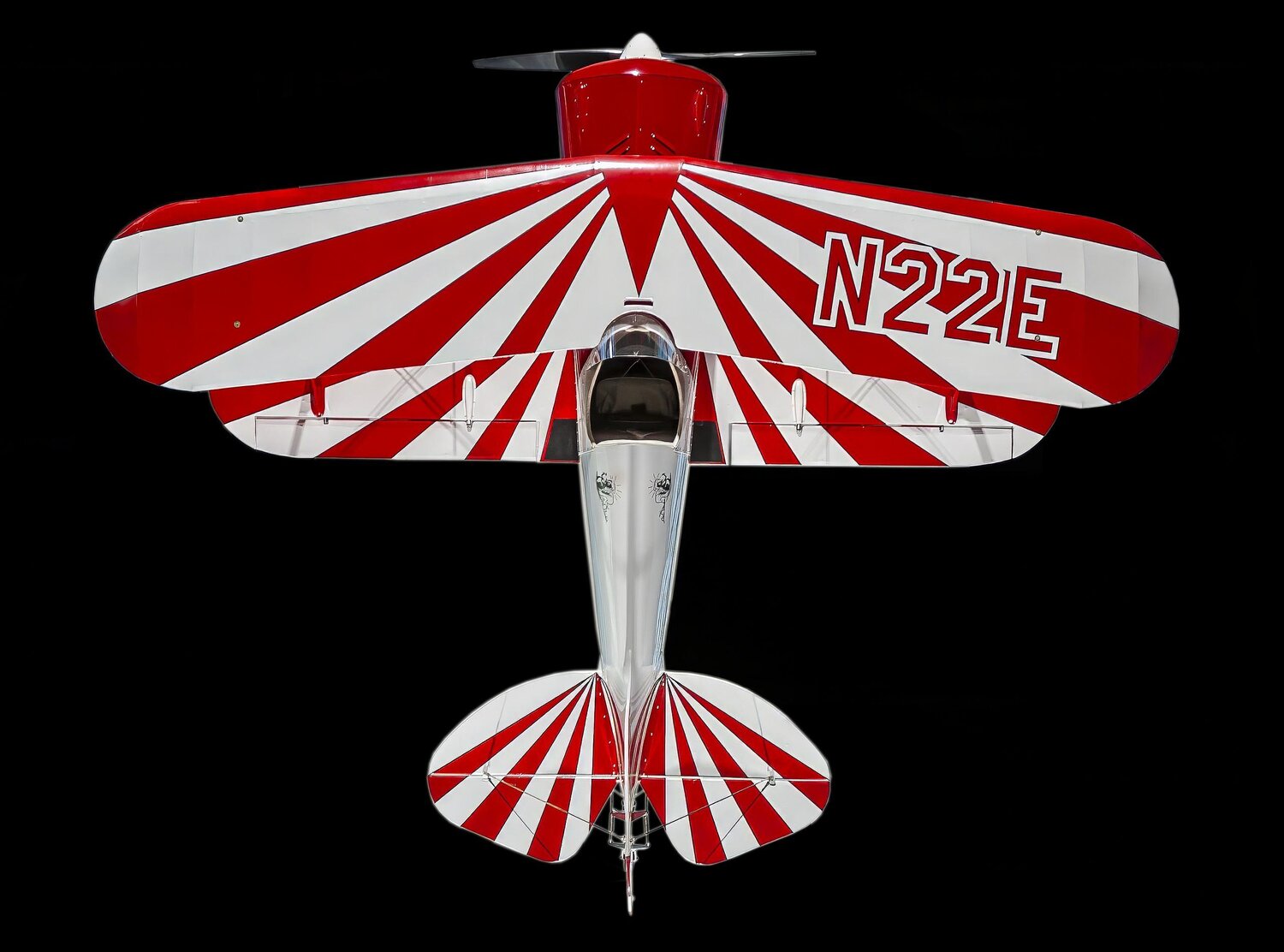
Curtis Pitts designed the single-seat biplane that became Little Stinker. The Smithsonian lists Skelton’s S-1C at just under 17 feet of wingspan. Its compact size is apparent in the museum photograph, where the upper and lower wings frame the single cockpit and the tail sits only a short distance behind it. The red and white pattern runs across the wings and tail, giving observers clear visual references as the airplane changes attitude. Smithsonian aircraft catalog
Skelton gave the airplane its nickname and won the 1949 and 1950 women’s national aerobatic championships with it. The titles document what the pilot and airplane achieved together. At the time the Pitts was still a young design, and a championship put it in front of audiences and other pilots who could see what a small, purpose-built aerobatic airplane could do. Smithsonian Betty Skelton collection
An air show photograph freezes one position. An aerobatic sequence makes the pilot link positions together in three dimensions. An airplane that responds promptly still has to be guided through each change and brought back to the intended line. The progression from the Great Lakes to the Pitts gives readers two concrete machines through which to follow Skelton’s development as a competitor.
The airplane returns to public view
Little Stinker passed through other hands before Skelton bought it back in 1967. She and her husband, Don Frankman, donated it to the Smithsonian in 1985. A volunteer crew later completed a six-year restoration, and the museum suspended the airplane in the entrance of the Steven F. Udvar-Hazy Center in 2003. Skelton entered the National Aviation Hall of Fame in 2005. Smithsonian ownership and restoration history
The restored display lets a visitor take in the whole airframe, from the propeller to the tail, at once. The competition record supplies the part a static exhibit cannot show. Two of Skelton’s national titles were won in that cockpit. A third came in a different biplane, which gives the Pitts its place in the story of a pilot who had already won before she flew Little Stinker to a championship.
Featured photograph — Betty Skelton’s Pitts S-1C Special Little Stinker. Smithsonian National Air and Space Museum, NASM2025-02157-000001, CC0. Image record and reuse rights
Sources
Smithsonian National Air and Space Museum — Betty Skelton Collection
Smithsonian Institution — Pitts S-1C Special, Little Stinker






No comment